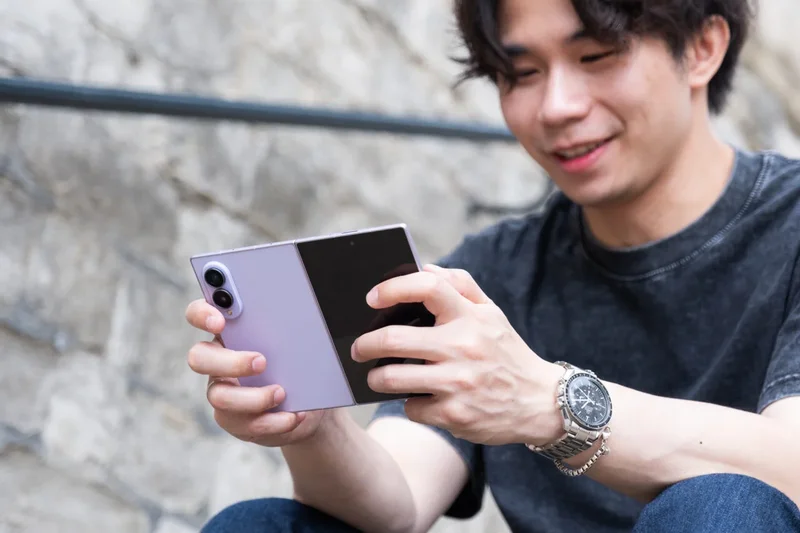
Samsungâs Galaxy Z Fold 8 is the best phone (not just foldable) Iâve ever used for consuming contentâwatching videos, playing mobile games, reading, and yes, even doomscrolling social mediaâthanks to its 7.6-inch inner screen.
The book-style foldable phoneâs novel shape when closed may look strange at first, but I promise you that its shorter and wider footprint (when closed) quickly feels normal after a few days. The whole point of this form factor is to unfold it for its larger tablet-sized screen, and I can assure you that youâll be doing that often because the experience encourages it more.
More importantly, the Z Fold 8 has fewer of the compromises that held back Samsungâs previous foldable phones. The device is lighter and easier to unfold, the battery is bigger and lasts all day, and Samsung has greatly reduced the crease on the inner screen.
Some apps still might not display correctly on both screens, but even so, Iâm declaring the Z Fold 8 a home run. I canât stop using it.
Samsung Galaxy Z Fold 8
The Galaxy Z Fold 8 is Samsung's best version of a book-style foldable phone yet, even with its premium price.
Pros
- Thin and light
- Gorgeous AMOLED screens
- Crease is greatly reduced and flat
- All-day battery life with faster charging
- Solid cameras
- Easy to use with one hand
- Quick Share works with Apple AirDrop
Cons
- Inner hole punch camera can block content
- Can get warm for no reason
- Only IP48 rating
- No built-in magnet ring for wireless charging
- Some apps aren't optimized properly
A new shape
The best size comparisons for the Z Fold 8 are a passport or a B7-sized notebook. The foldable measures 4.88 x 3.24 inches when it’s closed. Itâs a few hairs thicker than the Z Fold 8 Ultra, but because of the squatter dimensions and lighter weight, the Z Fold 8 doesnât feel unwieldy. Iâm mostly able to reach corner to corner on the 5.5-inch AMOLED cover screen, something I havenât been able to do on any âregularâ (read: 6 to 6.9-inch) bar-style phone in years.
It also fits in my front pants pockets better than expected; I had concerns that the width might be too wide. I guess if youâre already used to the width of an iPhone 17 Pro Max or a Galaxy S26 Ultra, the Z Fold 8âs only slightly wider.
Iâm able to reach the power button/fingerprint reader easily with my right thumb. Lefties might struggle since they canât use their thumb and will have to register their index finger, which might be a little stretch to press the button, like it is for me. The volume rocker is a little high for me; I prefer its lower position on the Z Fold 7/Z Fold 8 Ultra. Typing with two hands on the cover screen is a much easier affair than on narrower phones; I made fewer typos compared to my iPhone. One-handed typing will depend on whether your hand is large enough and your thumb can stretch across the keyboard.
The 10:16 aspect ratio of the cover screen is also not as cramped as it seems. You lose vertical space compared to most regular phones and taller foldables like the Z Fold 8 Ultra, which means apps will show less and youâll need to scroll more, but thatâs mostly a non-issue if you open the phone and rotate it to vertical orientation. I never found myself bothered that I couldnât see enough on the cover screen. If anything, I appreciated the shorter screen more because I didnât feel compelled to pull it out as much unless I wanted to unfold it.
Like on the Z Fold 8 Ultra, you can use the Z Fold 8 in âtentâ mode. This is great for propping up the device on a plane tray table or if youâre just too lazy to hold it up while in bed. I fly a lot for work, so tent mode is something I find very useful. A Z Fold 8 Ultra feature that you wonât find on the Z Fold 8 is âFlex mode.â On the Z Fold 8 Ultra, you can snap the screen so that it resembles a baby laptop, and some apps, like YouTube, will display the video above the crease and controls below it. I never found much utility for Flex mode on the previous Z Folds and I donât miss it on the Z Fold 8. If thatâs something you care about, get the Z Fold 8 Ultra instead.
Perfect for watching videos, gaming, and reading
Out of all the book-style foldable phones Iâve tested over the past seven years, the Z Fold 8 is the only one that I have unfolded more times than I have not. With each generation of Z Fold, Samsung made the dimensions more like a regular bar-style phone. I heaped praise on the Z Fold 7 for finally ditching the previous skinny, remote-like shape. And even though I considered the Z Fold 7 my favorite Android phone of 2025, I realized that I only used its inner screen maybe less than 50% of the time I pulled it out. With the cover screen being normal-sized, there just wasnât as much of a need to unfold it for the 8-inch screen.
That hasnât been the case with the Z Fold 8. Because of the shorter cover screen, I almost always unfold it to use the larger display. Maybe thatâs because the Flex Titanium technology helps the hinge spring open better or the beveled aluminum frame makes it easier to unfold without needing fingernails, or both. Whatever the reasons are, itâs easier to see and feel the benefits of the larger size of the inner screenâs 4:3 aspect ratio for most content than on a more square-ish folding screen like the Z Fold 8 Ultra’s. To get roughly the same diagonal screen for widescreen videos on the Z 8 Ultra, you need to rotate it, which is an extra step. Itâs a tiny bit of friction that makes the task of quickly unfolding and getting more screen real estate less convenient. When youâre unfolding the phone dozens of times a day, that one extra step adds up.
After two weeks of using the Z Fold 8 and Z Fold 8 Ultra, Iâve concluded that if you watch more videos and game more than you read, the Z Fold 8 is the better foldable since you wonât need to rotate it so much. If you do more reading and split-screen multitasking, the Z Fold 8 Ultra is more suitable since youâll get more vertical display on both the cover and inner screens without rotating, and youâll do less scrolling.
I consume a ridiculous amount of content on a daily basis, so I find the 4:3 aspect ratio more versatile for my needs. In just two weeks, I watched, gamed, and read more on the Z Fold 8 than I have on any new phone Iâve ever tested. Videos look incredible on the 7.6-inch inner screen; 16:9 videos have minimal letterboxing (black bars) above and below them, and old content like many original anime series in 4:3 aspect ratio fill up the entire screen. Iâve never felt more informed and entertained from my phone.
As with the Z Fold 8 Ultra, the Z Fold 8 lets you run three apps in split-screen layouts or four (with a pop-up) on the inner screen. I wouldnât recommend running more than two apps side by side in landscape orientation. Three apps side by side make each app window very skinny, and one app on one side and two stacked on the other half feel squished. Split-screen apps in vertical orientation just look too long to be useful in most cases. In some split-screen layouts, Samsungâs One UI 9 does let you tap between split-screen apps to have it fill more or most of the screen, but itâs not a function thatâs easy to discover.
Performance from the Qualcomm Snapdragon 8 Elite Gen 5 for Galaxy chip is snappy and the 12GB of RAM on my 256GB review unit (youâll get 16GB if you buy the 1TB model) never chugged when I threw Gemini and Galaxy AI tasks at it. The only thing that occasionally bugs me is that the Z Fold 8 gets toasty even when Iâm not doing anything power-hungry. I suspect the super-thin design doesnât leave much room for adequate thermals; thereâs no vapor chamber for cooling like there is on the Galaxy S26 Ultra and iPhone 17 Pro.
The inner screen has been a joy to use, especially on my 1-hour subway commute to and from work. And instead of reaching for my iPad mini in bed, the Z Fold 8 now fills the role instead. Itâs great only having to charge one device.
On the topic of charging, the Z Fold 8âs battery is rock solid, lasting me a full day even with heavy use of the inner screen. Thatâs not surprising since Samsung added a small percentage of silicon carbon into the 4,800mAh battery, which allows for the larger cell while maintaining a slim size. The 45W fast wired charging, with a compatible charger sold separately (of course), was more than quick enough to give me a recharge (around 0% to 65% in 30 minutes) whenever I was low on power. The Z Fold 8 also supports fast wireless charging at 20W, but I used it less compared to other phones like the iPhone 17 Pro or Pixel 10 Pro because Samsung still refuses to include built-in magnetic charging rings. You, again, need to buy a case with magnets to align the phone effortlessly with a Qi2 charger.
The only blemish, literally, on the larger screen experience is the 10-megapixel hole-punch camera on the inner screen. It can obscure essential parts of a menu, buttons, or text depending on what youâre looking at. For example, in Asphalt Legends, I couldnât see a menu button that the hole punch covered. The hole punch is most noticeable when reading long blocks of text or black and white manga. It makes more sense to put the camera in the corner since it canât fit in a bezel like on a regular tablet.
Other than that, I might nitpick the placement of the two stereo speakers. Theyâre located on the top and bottom of the cover screen, which makes them left-side oriented when the Z Fold 8 is unfolded. The speakers get loud enough, but because theyâre both on the left in tablet mode, it almost sounds mono coming from one side. To be clear, these are stereo speakers. I get why Samsung might have designed it like this: the speakers fire out of the left and right in tent mode. Maybe put one speaker on each side for a balanced sound when it’s unfolded?
As for the crease⦠Itâs less visible for sure, but hasnât been completely eliminated. Fresh out of the box, the inner screen is pristine and crease-free. Two weeks in, the crease has deepened with hundreds of folds and I can see it when the screen is off, but it doesnât warp as much as it did on past Samsung foldables. I almost never notice it when I’m watching videos, gaming, or reading. Besides the reinforced titanium alloy film on top of the screen and the titanium plate underneath it to ensure it stays flatter to the touch over time, Samsung also added an anti-reflective layer to reduce glare, and it really does help. Iâve said it before and Iâll say it again: the crease may never be fully eliminated from folding screens. The best we can hope for may just be making it less visible.
The cameras are fine
Depending on what you consider the Z Fold 8, either as the sequel to the Z Fold 7 or as a new class of foldables, the cameras will impress or disappoint. If viewed as a Z Fold 7 successor, the 50-megapixel main camera may feel like a downgrade from the previous 200-megapixel shooter. The 50-megapixel ultrawide on the Z Fold 8 will, however, be an upgrade from the Z Fold 7âs 12-megapixel one. You may also be upset it doesnât have a telephoto lens.
If you want triple rear cameras and more resolution for the main camera, Samsung sells the Z Fold 8 Ultra. I have no complaints with the dual 50-megapixel rear cameras and dual 10-megapixel hole-punch cameras on the Z Fold 8. I donât think most people will care thereâs no telephoto. You still get a 2x zoom that crops in on the 50-megapixel sensor and looks nearly optical-quality to me. This is similar to the virtual 2x âtelephotoâ that youâll find on other phones and all recent iPhones that have larger main sensors. The 4x and 10x zooms on the Z Fold 8 are digital, though, and the fuzzier image quality shows.
For everyday photos and videos, the Z Fold 8 cameras are good enough. Image quality looks vibrant and not overly saturated like it used to on Samsung phones and I think the HDR looks less processed compared to iPhone photos. Low-light shots look solid, too. If youâre the type of person who doesnât want to spend too much or any time editing your photos, the Z Fold 8 photos are more than fine to post directly to social media.
The Z Fold 8 is loaded with a bunch of AI editing features, like âPhoto Assist,â which lets you describe an edit with text; âMy FanCam,â which lets you motion-track a subject in a video and then crop it for different aspect ratios for posting to social media; and a âScanâ feature that can clean up photos of documents (i.e. sharpen text, flatten and fix the geometry, and remove folded corners or fingers). These can be useful, but there already are apps that exist that do these things. I suppose itâs nice theyâre free and built-in.
I also donât hate any of the new video recording features, like the dual recording mode that lets you record from both the front and rear cameras simultaneously in various layouts (side by side, split top and bottom, and picture in picture) and super steady recording with horizon lock, which keeps the horizon line straight. Again, none are particularly special, but itâs nice that theyâre there when you might need them.
Instant love
It didnât take long for me to fall in love with the Galaxy Z Fold 8. Thatâs just not something that happens often anymore. But fall in love with Samsungâs new foldableâI did. The Z Fold 8 is proof that great hardware still mattersâand matters more than simply shoving in more AI features.
I like it more than the Z Fold 7 and the Z Fold 8 Ultra, mainly because its 4:3 inner screen makes consuming content a better and more fun experience than swiping on a long bar. One UI 9 is a very polished Android experience, and a feature like Quick Share, which lets you AirDrop files to Apple devices, is a game-changer. Anything that makes an Android phone work with Apple devices is a big plus to me.
There are still some minor things that people will find fault with, like the fact that Samsung has stuck with an IP48 rating for dust and water resistance instead of bumping that up higher to IP68 like Google did with the Pixel 10 Pro Fold or that Samsung didnât bring back S Pen support. Neither omission makes the Z Fold 8 feel insufficient in my book. Iâm not exposing the Z Fold 8 to harsh conditions and I have no attachment to a stylus.
Look, I get it: the Z Fold 8 is still expensive starting at $1,900. I donât foresee the price of it coming down anytime soon. Samsungâs stuck to around $2,000 for its book-style foldables since the original Galaxy Fold. If you can justify the value of a larger screen experience, the Z Fold 8 is amazing in almost every aspect.