- See more Daily Mail on Google - save us as a Preferred Source
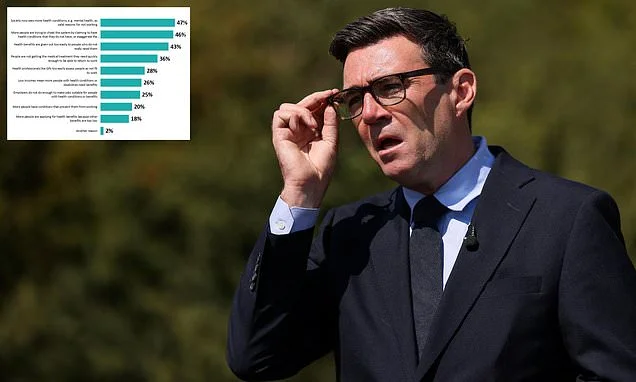
Nearly half of voters blame Britain's ballooning benefits bill on people claiming false health conditions, new polling shows.
A survey by Ipsos in the UK asked Britons what they think are the main causes for a rise in the number of working age people receiving disability and health benefits.
Some 46 per cent said they believe that more people are trying to cheat the system by claiming false health conditions - a two-percentage point rise from polling in March last year.
There was an eight-point rise in the number who said health benefits are given out too easily, with 43 per cent saying payments are given to people who do not really need them in the latest survey.
The biggest proportion (47 per cent) agreed that society now sees more health conditions, such as mental health issues, as valid reasons for not working - up four points since March 2025.
A further 28 per cent attributed the rise in welfare claimants to GPs assessing people as unfit to work too easily - also up four points from last year.
Since becoming Prime Minister, Andy Burnham has said Britain 'must get really serious' about curbing welfare spending.
But he is facing the threat of a fresh revolt from Labour's Left, who have warned Mr Burnham against pursuing 'punitive' benefits cuts.
Some 46 per cent said they believe that more people are trying to cheat the system by claiming false health conditions
A third (35 per cent) of Britons think supporting people to get back to work should be a top Government priority for the benefits system
Some 31 per cent said benefits should be reduced for those not looking for work
The PM has been told by Labour MPs not to 'ignore the lessons of the last Parliament' when his predecessor, Keir Starmer, faced a mass revolt over proposed welfare changes.
The former premier was forced into a humiliating climbdown last summer on his plans to restrict access to disability benefits in England and Wales.
The number of people in England and Wales claiming Personal Independence Payment (PIP), the main disability benefit, has now passed four million for the first time.
The number of claimants has roughly doubled since 2019, with spending on PIP forecast to rise to more than £41billion by the end of the decade.
Official statistics have revealed how the number of people being paid disability benefits with ADHD has soared by 40 per cent since Labour took power.
The latest Ipsos poll found that a third (35 per cent) of Britons think supporting people to get back to work should be a top Government priority for the benefits system - up six points since March 2025.
To tackle the number of working-age people not working, 46 per cent advocated for retraining support in the latest survey, while 44 per cent supported working with employers to create more flexible roles.
Some 31 per cent said benefits should be reduced for those not looking for work.
Joanna Crossfield, research director at Ipsos in the UK, said: 'Our latest polling demonstrates a clear shift in public priorities for the welfare system, with significantly more thinking the system should focus toward getting individuals back into employment.
'Taxpayers are equally likely to want to ensure the benefits system provides a reliable safety net and delivers good value for the taxpayer, creating a challenge for government to deliver on both fronts.
'These desires are met by a hardening of attitudes towards disability claimants, demonstrated by the rise in the proportion of Britons who believe the increase in number of people claiming disability benefits is because they are handed out too easily, alongside steady concerns over fraud.
'As Westminster seeks to reform the social security landscape, it's clear that the public share the Government's focus on getting people back into work.
'When it comes to tackling the proportion of working age people claiming health and disability benefits, the challenge will be to provide reassurance to claimants and the wider general public that essential safety nets are there for people who really need them and that there is no room for fraud.'
Ipsos interviewed 998 British adults, aged 18–75, online between 23 to 24 July.