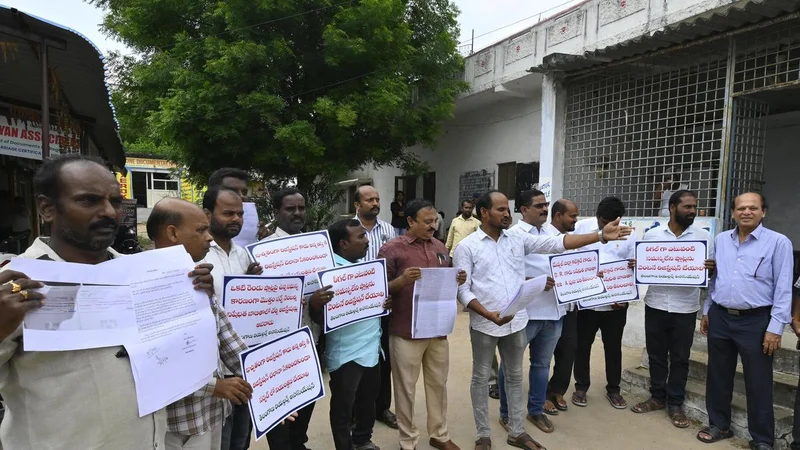
The deal is made, the buyer has been found, the price has been agreed upon, the documents are in order. Then comes the final step: registration. But for an increasing number of property owners, that is precisely where everything falls apart.
Many say they only discover that their land has been included in the prohibited list under Section 22A of the Registration Act when they walk into a Sub-Registrar Office (SRO) to complete what they believed would be a routine transaction. One of them is 40-year-old mason Udayagiri Prasad of Narapally in Medchal-Malkajgiri district, near Hyderabad.
Prasad had purchased a 66.8-square-yard residential plot in Survey No. 58 at Kachavanisingaram village in the district several years ago. When his niece’s wedding approached, he decided to sell the property to repay the ₹10 lakh he owed to his elder brother. But when he approached Narapally SRO, officials refused to register the sale, informing him that the land was included in the prohibited list maintained under Section 22A of the Registration Act. “I have all ownership documents but cannot sell my own property. I had to mortgage the property’s title documents to secure a private loan,” he says.
Across Hyderabad and surrounding districts, owners of residential plots, apartments, independent houses and private patta lands say they are facing similar hurdles after discovering that their properties have been brought under the prohibited list. The restriction often comes to light only after a buyer has been identified, a sale agreement signed and the parties approach the SRO to complete the registration.
Mekala Harshavardhan, 28, of Boduppal, ran into a similar problem. His sister and brother-in-law, a defence official posted in Kashmir, had purchased residential plots measuring 200 and 100 square yards in Survey No. 44 of Peerzadiguda village in Medchal-Malkajgiri.
He says the Uppal SRO refused to register the properties after finding that the entire survey number was categorised as Urban Land Ceiling (ULC) land under the prohibited list.
On July 29, the Sub-Registrar wrote to the District Collector seeking clarification on whether plot no.13 (Part) in Survey No. 44 could be registered or whether it was covered under Section 22A(1)(d). Verification of the Prohibition Watch Register reportedly showed that the entire extent of about 1.58 lakh square yards in Survey No. 44 stood notified as ULC land in the name of D. Malla Reddy. The registration process has been kept on hold, pending clarification from the Collector.
The problem extends beyond vacant plots. A resident of Peerzadiguda approached the Medchal-Malkajgiri District Collector after registration of her apartment in Survey No. 43 was refused because the entire survey number had been classified as ULC land. Following her representation, the Uppal SRO advised her to obtain a no objection certificate (NOC) from the Collector’s office before registration could be permitted.
Residents in several parts of the district, including Alwal, say similar issues have affected apartments and independent houses.
What is Section 22A?
Section 22A of the Registration Act was introduced to prevent the illegal registration of government lands, water bodies, forest lands, endowment properties, waqf lands and other protected public assets. It empowers the government to notify lands where registrations are prohibited, preventing fraudulent transfers and safeguarding public property.
Property owners and real estate representatives, however, contend that poor land records and weak coordination between departments have resulted in genuine private lands also being included in the prohibited list.
Officials familiar with the process said district administrations were asked to update records of prohibited lands about three-and-a-half months ago. In several cases, revenue authorities reportedly furnished only survey numbers instead of identifying the exact extent under government ownership. As a result, entire survey numbers were brought under Section 22A, rendering privately owned lands within them non-transferable despite owners possessing registered sale deeds, approved layouts and municipal permissions.
Developers cite a residential layout near Shamirpet police station that received approval from Hyderabad Metropolitan Development Authority (HMDA) in 2022 but was later included in the prohibited list, forcing the developer to seek denotification.
“Even buyers of plots in HMDA-developed and auctioned layouts are facing similar hardships, as those lands have also been included in the prohibited list,” says R. Srisailam, a realtor.
For affected families, the issue goes far beyond paperwork. Farmers who depend on land as collateral, middle-class families, retirees and NRIs say they are unable to sell or mortgage properties despite holding registered ownership documents. Many owners say the lack of prior intimation has compounded their problems. “There was no notice informing us that our property has been included under Section 22A,” says one property owner. “We came to know only after identifying a buyer, signing agreements and paying advance.”
Applications for NOCs, they say, often remain pending for months, forcing repeated visits to Revenue offices, submission of historical ownership records and considerable expenditure on legal assistance.
Realtors seek review
The Telangana Realtors Association (TRA) has urged the State government to undertake a comprehensive review of the prohibited list.
TRA State president Naragoni Praveen Kumar alleges that legally owned private patta lands had been wrongly included because of administrative lapses and inadequate verification of records. Registrations that were permitted earlier were now being refused in several areas, he says.
The association also alleges that registrations in some newly developed colonies were being withheld because the lands had been classified as waqf properties.
While supporting the government’s efforts to protect public lands from encroachment, it demanded the immediate removal of genuine private lands from the prohibited list, fixation of responsibility for wrongful inclusion, district-level grievance redressal centres, a time-bound mechanism for issuing NOCs, an online application tracking system with SMS and e-mail alerts, and greater accountability among departments responsible for maintaining land records.
The Telangana government introduced the Bhu Bharati portal after widespread complaints over lapses in the Dharani portal launched by the previous Bharat Rashtra Samithi (BRS) government.
However, problems relating to lands classified under Part B of the prohibited list continue, with complaints from both rural and urban areas over the wrongful inclusion of private properties. Over 18 lakh acres of agricultural land are included in Part B, while fresh additions of urban lands continue to expand the list.
The Part-B category, primarily governed by Section 22A of the Registration Act, originates from a 2006 State amendment to the Central Act following the recommendations of the Koneru Ranga Rao Committee on land reforms. It empowers the government to prohibit the sale, gift, transfer or mortgage of specified land parcels through SROs.
However, the government that introduced the amendment did not frame detailed guidelines for identifying prohibited lands, resulting in the present imbroglio. Officials say the absence of clear guidelines, inclusion of patta lands, removal of the ‘enjoyment’ column from registration records and reliance on outdated land records have led to mismatches between official records and the actual extent of land on the ground.
The use of outdated records for categories such as Bhoodan, waqf, ceiling surplus and assigned lands is another reason for the mismatch, experts say. Land laws expert M. Sunil Kumar says Telangana follows a deeds registration system rather than a title registration system, unlike what it is followed in over 90 countries. “Placing lands in the prohibited list does not necessarily reflect the ground reality,” he says, citing Kharij Khata lands that are restored to owners once tax dues are cleared.
Although the Congress government replaced the Telangana Rights in Land and Pattadar Pass Books Act, 2020, with the Telangana Bhu Bharati (Record of Rights) Act, enabling corrections at different levels instead of only through the Chief Commissioner of Land Administration (CCLA), issues relating to prohibited lands remain unresolved. Experts say District Collectors face a conflict of interest as they are tasked with protecting government land while also deciding ownership disputes, which are further complicated by unreliable land records and technical registration errors.
Although lands have periodically been removed from the prohibited list, they reportedly reappear because speaking orders confirming their clearance were never issued. The problem is said to be particularly acute in urban areas, especially Ranga Reddy and Medchal-Malkajgiri districts surrounding the Greater Hyderabad Municipal Corporation limits.
The way forward
The growing number of complaints has revived demands for greater transparency in the preparation of the prohibited list. Experts call for recording the reasons and documentary evidence for including any land under Section 22A and suggest introducing a ‘community audit’ mechanism, enabling residents of villages or wards to verify ownership claims.
Displaying the list of prohibited lands in Gram Panchayat offices and inviting claims and objections, they say, could offer a cost-effective way of resolving disputes.
They have also suggested that the government resolve disputes category-wise to make lands litigation-free in a phased manner. “The government can first clear disputes relating to lands assigned before 1956 and gradually move to subsequent categories,” Sunil Kumar says.
He also stresses the need for a proper adjudication mechanism at different levels so that disputes do not escalate to the office of the Chief Commissioner of Land Administration or the judiciary.
Meanwhile, Revenue Minister Ponguleti Srinivasa Reddy has reiterated that the government is committed to ensuring that no poor person or genuine landowner suffered because of lands included in the Section 22A prohibited list.
Chairing a high-level review meeting on August 5, the Minister said the government is pursuing the twin objectives of protecting the rights of eligible citizens while safeguarding government lands. He maintained that not even one cent of land had been deliberately added to the Section 22A prohibited list since the Congress government assumed office in December 2023.
The Minister has also directed officials to dispose of all Section 22A applications and complaints within the stipulated time, ensuring that no file remains pending. Every case, he says, should be examined on its merits, based on records and legal provisions, so that eligible landowners receive justice.
Referring to Telangana High Court’s directions, he said all Section 22A disputes should be resolved within the stipulated 45-day period. He also reminded Collectors that they were the final authority to review lands included in the prohibited list and urged them to strike a balance between protecting public rights and safeguarding government interests.
As the government promises time-bound resolution, thousands of property owners continue to wait for a certainty they believed they already had: the right to freely sell, mortgage or transfer land they legally own.
Published - August 07, 2026 07:47 am IST