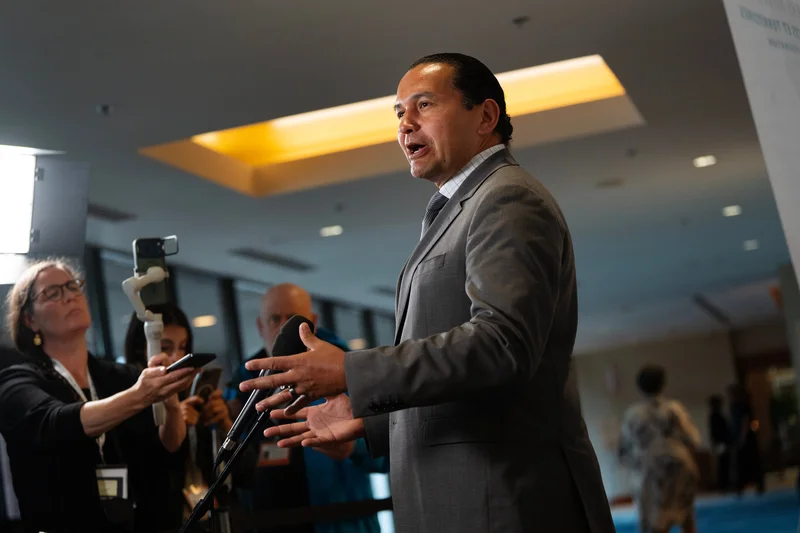

Manitoba Premier Wab Kinew addresses reporters on Wednesday in Charlottetown, where premiers are gathering for their annual meeting.Darren Calabrese/The Canadian Press
Manitoba Premier Wab Kinew says he’s open to the idea of a new pipeline from Alberta to Ontario, making his first public comments that would help clear the way for provincial co-operation on a proposal to carry crude oil across the country.
Mr. Kinew’s openness to such a project helps address a major hurdle for the proposed pipeline, which is still in its early stages of discussion. But there is also the question of whether the federal government will support it, and a lack of details about the costs and timeline.
The proposed 3,300-kilometre pipeline would travel across four provinces from Hardisty, Alta., to Sarnia, Ont., and would be able to move roughly 500,000 barrels of oil a day. It was announced in Calgary earlier this month by Alberta Premier Danielle Smith and Ontario Premier Doug Ford.
So far, there is no private backing for the proposal, but Mr. Ford has said he’s open to government financing.
At the time, Mr. Kinew’s voice was notably absent from the announcement, while Saskatchewan Premier Scott Moe was on record supporting it. Mr. Ford said the proposed route would provide Manitoba and the Manitoba-Crown Indigenous Corporation with the opportunity to explore the feasibility of a pipeline extension to the Port of Churchill in that province, which Mr. Kinew has championed as a major expansion project for his province.
Speaking at the premiers’ meeting Wednesday in Charlottetown, Mr. Kinew said his residents still have questions about the pipeline, but he’s willing to consider it.
“I’m open to it. I love Alberta, I love Albertans. So, willing to entertain the idea,” he said.
Mr. Kinew said he’s been talking to Ms. Smith, Mr. Ford and Mr. Moe about the idea over the past few months, as well as Indigenous leaders and residents.
“On the one hand, there’s always the questions that get asked about major projects these days. On the other hand, you know, having spent a few days in Portage-La-Prairie, Man., last week, I can tell you there’s probably a lot of people who’d like to work on a pipeline.
“I’m open to it, and if it’s going to make Canada stronger – great.”
He added that Indigenous governments need to be involved, workers need to be treated properly and environmental concerns need to be addressed.
The Alberta-Ontario proposal was revealed days after Ms. Smith and Prime Minister Mark Carney announced a deal and new southern route for a separate proposed pipeline that would run to British Columbia’s West Coast.
Both pipeline proposals are being positioned as projects that could be fast-tracked as part of the federal government’s push to boost national infrastructure and increase global exports in response to the trade war with the United States.
But unlike the West Coast pipeline, the Alberta-Ontario proposal has no formal federal backing.
It was also unclear who would build the new pipeline, potentially a major financial undertaking for a private backer at a time when domestic energy companies have shown little appetite for such risk.
Mr. Ford has said Ontario is examining potential costs and planning to complete a feasibility study for the new proposal, called the Northern Shield Energy Corridor, by the end of the year.
Th premiers are meeting in Prince Edward Island this week as U.S. President Donald Trump threatens to impose 50-per-cent tariffs on a host of Canadian products next month. Mr. Carney is joining the gathering later Wednesday evening and meeting with the premiers in person on Thursday.
Mr. Kinew said he expects to hear more details from the Prime Minister about negotiations with the U.S., and what the next steps would be if a deal with the U.S. cannot be reached by Aug. 19, when the new tariffs are set to kick in.
Some premiers have said they believe Mr. Trump’s deadline of increasing tariffs could present an opportunity for fast-tracking the negotiations around the United States-Mexico-Canada Agreement, known as CUSMA in Canada. Mr. Carney said Tuesday he and Mr. Trump have agreed to “intensify” trade talks.
Mr. Kinew, whose province is among those that have banned U.S. liquor from store shelves, said Mr. Trump is struggling domestically.
“I think the American President is very vulnerable right now. The cost of living is a political disaster for Donald Trump, and a lot of people in Canada are saying in order for us to get a CUSMA deal, we should give him a win,” he said.
“But I’m wondering whether we should.”