- New Zealand in holding pattern after second case of H5 bird flu
- Case numbers rising in Australia, which recorded its first mass mortality event this week
- Wildlife hospital sets up triage centre for use in case there is transmission of virus
- Poultry industry waiting and watching to see if protection measures can ease
- Conservation centre to reopen to public visitors
A wildlife hospital has set up an off-site triage centre to assess wild birds for signs of the deadly H5 flu, in case the country sees widespread transmission of the disease.
There have been no new cases in the three weeks since the second infection was confirmed in a New Zealand bird on 17 July. However, case numbers are on the rise in Australia.
So the hospital, as well as New Zealand's poultry industry, are playing a waiting game.
Hospital prepared for outbreak
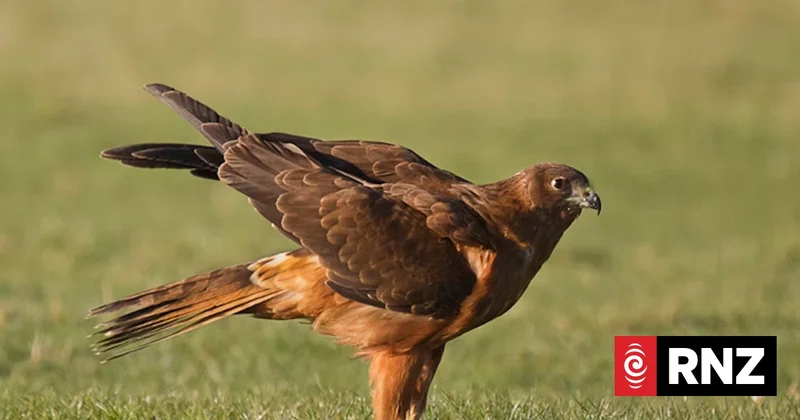
The second confirmed case of bird flu was in a kāhu, or swamp harrier, discovered in Carterton and taken to Massey University's Wildbase clinic in Palmerston North.
When a wild bird is brought there, staff put on full PPE, and the clinic has set up a triage area at a site a couple of kilometres away, behind the university campus. It is not in use yet.
The hospital manager, associate professor Megan Jolly, said it used facilities normally deployed for oil spills.
"We'll get people to bring any incoming wildlife up here and we've got our lovely tent set up at the moment as our initial point of examination," she told RNZ.
"If we have any suspicious clinical signs or anything like that consistent with [H5], then they can be euthanised in there and the body dealt with."
Signs of flu generally developed within a day, so a shed behind the tent would act as a monitoring area.
Warnings to brace for mass wildlife deaths as bird flu takes hold in Australia
"Our plan, should it kick off here on the North Island, is to triage through that tent and anything that's got something else that we could treat and doesn't have clinical signs consistent with [H5] will be held in temporary holding facilities in the shed for a few days."
Although New Zealand still has just two confirmed cases of the H5 flu, it's a different situation in Australia, which recorded its first mass mortality event this week.
Jolly said hospital staff were preparing themselves as best as they could for outbreaks here.
"We're physically at risk this time, as well as [dealing with] the mental toll of not being able to help animals we usually would, or euthanising large numbers of animals or potentially hearing of them or watching them die.
"All of my staff and myself are bird nerds, to different degrees. It's not something we're looking forward to."
Industry on watch
New Zealand's egg and poultry industry is worth more than $2 billion a year and employs about 10,000 people.
Poultry Industry Association of New Zealand executive director Fiona MacMillan said bird flu was unpredictable, so farmers acted quickly to protect the country's millions of birds.
"The initial response was to bring free-range birds inside, which was the right thing to do," she said.
"It was a very wise thing to do when you don't know where the disease is. It is probably the biggest risk to free range because they're outside and they're just exposed to more elements. More wild bird interactions can happen and that's where the disease comes in from."
The industry was watching developments in Australia closely, as well as monitoring the situation here.
"What we're keen to understand is what the data is telling us across the country. For example, you know that all the cases are in the lower North Island and you happen to be based right up north, you are probably less inclined to keep your birds temporarily housed inside.
"Those patterns are going to change over time. So we're just watching and waiting and talking to MPI really frequently."
Swift action would be required if a poultry farm discovered an infected bird, MacMillan said.
"All the birds in the farm have to be culled. That is a welfare decision as well, because if your birds have got bird flu they will suffer and it's not okay, so you do need to do the right thing and put those birds down.
"The farm then has to be thoroughly cleaned and that is quite an involved process. Depending on the age and size of the farm, it will require different approaches and different methods."
Farms would then have a stand-down period, typically of 28 days, before they could house birds again.
The association was also conscious of the emotional toll farmers could experience, so was in constant contact with them, MacMillan said.
What New Zealand can learn from a farmer who lived through H5N1
Wildlife centre likely to reopen
Meanwhile, a Palmerston North conservation centre that closed its doors a couple of weeks ago, mostly so it could do outbreak preparation work, is considering reopening to the public.
Central Energy Trust Wildbase Recovery manager Chris Smith said that work included biosecurity measures to protect the native birds there, such as pāteke and whio.
"We're looking at the moment at what it looks like right now and how we can get the facility open again to the public, which we think is pretty reasonable given the risk level.
"We're in a place that if it does come through again we'll be able to respond pretty much straight away as we're nice and organised now," he said.
"We put the animals into a controlled space, so it was covered from the air, but now that we don't see any indication of [flu] being spread around we're a bit happier to put them into their normal spaces."
Measures were also in place to protect the 150 exotic birds, including popular cockatoo Bubs, in the public aviaries next door. Temporary mesh was being installed to keep the birds further inside their enclosures, and roof coverings were getting extended.
"We're in a park - there are wild birds going around. There are ducks. We've got a pond not too far from us.
"There is an element of risk. We're not completely removing them from that," Smith said.
"What we're trying to do is minimise the amount of risk these guys are exposed to."
Ministry for Primary Industries chief veterinary officer Dr Mary van Andel said it had established regional quick-response teams for urgent notifications of possible cases, and had continued surveillance in Wellington and Wairarapa.
"This has included ground surveillance around Wellington and Wairarapa coastlines, as well as a helicopter survey of hard-to-access coastal locations. Ground surveillance is continuing in the region."
She said public notifications were an important part of surveillance, and people were asked to make a report if they saw three or more sick or dead birds. This can be done by ringing 0800 80 99 66 or online at report.mpi.govt.nz.