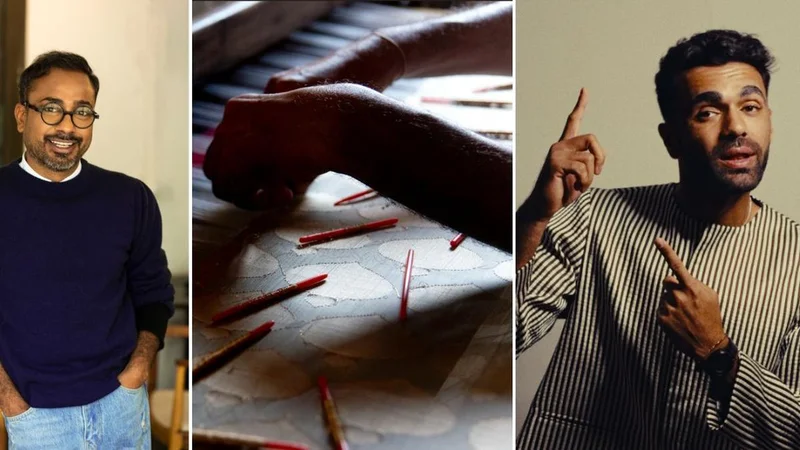
“Explaining handloom is like explaining religion, or the idea of India.” This was fashion and textile designer Sanjay Garg’s response when a Vogue reporter asked him to explain what handloom is to a novice.
While Indian textile secures a spot in the India-UK Free Trade Agreement, the future of handloom depends on more than just tariffs. It requires design, storytelling and global demand.
Homegrown designers like Garg have been putting local weaves on the global map. Through his label Raw Mango, Garg has helped position handloom within India’s luxury fashion.
To mark National Handloom Day on August 7, Raw Mango has collaborated with Bengaluru rapper and tennis player Adil Kalyanpur (A-KAL) on “Handloom Y’All”, a rap track celebrating India’s living textile traditions.
Edited excerpts from an interview with Garg and A-KAL:
How did this collaboration come about and who is this song really for — the fashion community, music fans, or people who’ve never thought about handlooms?
Sanjay Garg: This collaboration came about after we saw Adil’s rap around Women’s Day, which really spoke to us. We have always believed in collaborating with emerging artists and musicians, and felt that he would be the right fit for this.
For us, tradition is not something that passes with time. It is ongoing and constantly evolving. Nostalgia can be a part of tradition, but tradition itself is not fixed, it is an ongoing dialogue between the past, present and future. We see tradition as the future.
We have always believed in widening the circle of handloom. The people who already consume handloom are aware of its value; the larger question is how we bring more people into that circle. This song is really an attempt to do that, to introduce handloom to people who may not have thought about it before, in a language that feels contemporary and accessible.
Mahatma Gandhi made Khadi a powerful symbol of colonial resistance in India’s freedom struggle. What do handlooms symbolise for India in 2026; can fashion today still be a form of political or cultural expression?
Garg: For us, handloom can certainly be fashion, but it is also much bigger than that. It is one of India’s greatest strengths and an important part of our cultural identity. When we talk about Indian heritage, we often speak about our spices, colours, food and traditions, but textiles and handloom are equally fundamental to that story.
India has one of the largest handloom-weaving communities in the world and an extraordinary diversity of handwoven textiles. That makes handloom a very strong expression of who we are as a country. For us, this song is both a tribute to that heritage and an attempt to make people look at handloom as something living and relevant today, rather than something belonging only to the past.
Ahead of India’s 80th Independence Day, how does your song reinterpret the Khadi (and handloom) legacy for a generation that may know little about it history?
Garg: We wanted to keep the song simple and accessible rather than make it technically or academically heavy. There are some very basic but important facts about handloom that we wanted to put out there. My brief to Adil was to imagine that he was explaining handloom to a child who had never heard of it before. How would you introduce the idea to them in the simplest possible way? That became the starting point for the song.
Adil, how do you make a song about weaving and craft feel authentic rather than educational?
Adil Kalyanpur: The biggest challenge was that handlooms are a deeply traditional subject, and in today’s world they are not always seen as something “cool” or contemporary.
I like to rap for an impact so when I learnt that handlooms support millions of livelihoods across India and are such an important part of our cultural identity, I felt this was a story worth telling. That’s when the creative process really took over.
While rap is often associated with being rebellious or crude, I’ve always seen it as a great medium to communicate ideas, inspire conversations and create positive change.
Which handloom weave or textile tradition has the most ‘hip-hop energy’, and why?
Kalyanpur: Although I may be biased, my favourite handloom is Maheshwari, perhaps because that’s also my mother’s last name. And just like the weave she is very hip (and also high energy!)
Published - August 07, 2026 06:00 am IST