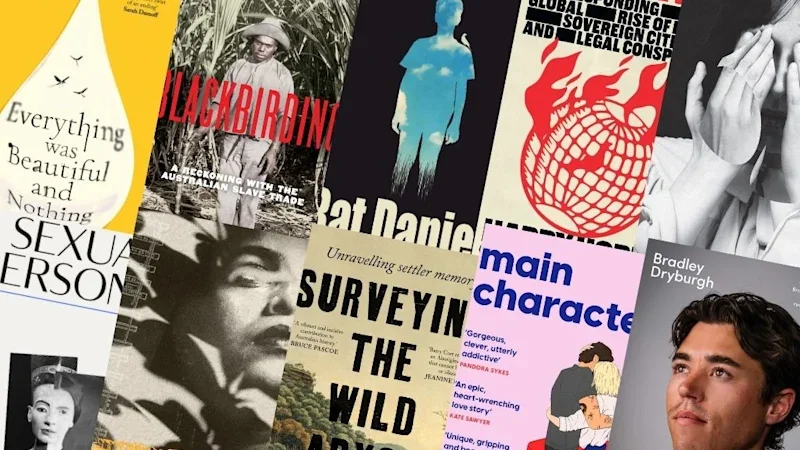
In fiction this week, it’s a feast of coming-of-age and otherworldly tales that range across Australia, India and even the afterlife, while our non-fiction books explore Australian colonial violence, our legal system and a re-issue of Camille Paglia’s controversial 1990 book Sexual Personae, which explores sexual decadence in Western literature and art.
Fiction
Last Day of a Prior LifeAndrés Barba Scribe, $30
A luminary of contemporary Spanish literature shines unsettling light on the ghost story in Last Day of a Prior Life. This slender, pensive horror novel begins with a real estate agent preparing a house for sale. After cleaning the kitchen, she discovers a seven-year-old boy sitting on a chair, unblinking… she tells him he can’t be there, and he waves goodbye with an anguished look but continues to appear – a sure sign, thinks the agent, that the house won’t sell. Clearly, the boy needs something from her, but what? There’s only one way to find out – and as the silent bond between the pair grows, the haunting, if that’s what it is, will lead the agent through the looking glass into a gothic wonderland where time behaves differently, the relation between past and present fractures, and another life beckons. Andrés Barba has won plaudits from prominent writers around the world, and this elegant and disturbing tale twists Black Mirror-like tropes – time loops and doppelgangers and suchlike – into a lyrical tale in which cruelty and beauty intertwine.
Main CharactersBobby PalmerHachette, $35
Contemporary romance can be written with many varieties of literary device as a hook. Bobby Palmer’s Main Characters chooses an unusual one. Viewing a love story from the outside in, the lovers in this one never get first-person status. Instead, the story of their relationship is told through myriad characters – a boss, a flatmate, a sibling, a pharmacist, and any number of others who encounter the couple from first glance onward. Clara and Seb are Londoners who work in the film industry – she’s an aspiring director, he’s an actor – and although there’s an intense and irresistible connection between them from the get-go, the course of true love never did run smooth. Betrayal looms when Clara casts Seb in her breakout film, and the spiky romcom vibe transforms into tearjerker. Some readers might miss the internal landscape of the couple. One interesting facet of Palmer’s premise, though, is how much can be inferred from what onlookers see, even if it’s only a crucial moment or detail, and there’s a strange intimacy to the novel’s voyeuristic ploy.
RailsongRahul BhattacharyaBloomsbury, $35
It’s full steam ahead for Rahul Bhattacharya, whose Indian epic Railsong arrives 15 years after his acclaimed last novel, The Sly Company of People Who Care. We follow Charu Chitol – a motherless, mixed-caste girl with a railway worker father, as she makes her way in the world. The novel covers the decades from the 1950s to the 90s, from the nationalist fervour following independence to the complex transformations of Indian society that ensued, and from a life on the margins (the family seeks refuge among the rural Asur community) to endless hubbub in the modernising metropolis of Bombay. Bhattacharya’s vision encompasses major events in Indian history and politics. It’s heaving with sharp and multivalent social observation, though the parts I loved most were focused intensely on Charu’s coming-of-age and her odyssey as a railway worker. There’s a vibrant supporting cast – notably Charu’s father, a would-be writer, and increasingly vocal socialist activist, who rejected his Brahmin heritage – and the book’s expansive scope and wit may remind some of V.S. Naipaul. Yet, it’s the freedom Charu finds on her own – however precariously, however shackled in other respects by oppressive forces – that will win readers’ hearts.
Rat DanielsAlex SawyerHachette, $35
Alex Sawyer was awarded the 2023 Richell Prize for an Unpublished Manuscript for Rat Daniels, and it’s a worthy winner – an unflinching coming-of-age novel with plenty of poignancy and grit, about two boys from different sides of the tracks. Jimmy Quinn meets Rat Daniels when they’re both seven, by a local creek in the Adelaide Hills. He’s everything the clean-cut, obedient Jimmy isn’t, and Jimmy is drawn to his rebellious charisma. As they grow into adolescents, the friends take different paths – Jimmy discovers a talent for basketball; Rat gets involved in the rural drug trade … he also develops an intense hatred of Davey Callaghan. When the Callaghan farm is targeted by a deadly arson attack, police are soon on the scene. Their investigation will lead Jimmy to search his memories of Rat to decide how well he knows his friend, who may well be a murderer. Dark themes including domestic abuse and drug trafficking surface, but it’s the close observation of the complicated bond between the boys, and how it will change, that lingers.
Everything Was Beautiful and Nothing Hurt Ben ReevesAtlantic, $35
Personifications of Death are hardly new to fiction. Just ask any Terry Pratchett fan. This book introduces a much more unassuming psychopomp. His name is Travis, and he appears to be an attractive, young, solitary cat dad living in a small English town. Loneliness is part and parcel of being – the cosmic avatar of Death and everything – yet it’s meaningful work and the opening chapter catches Travis in action. At the scene of a horrifying motor vehicle accident, Travis consoles a dying young driver, delivering him into silence without judgment. When he meets midwife Dahlia and her bright-eyed eight-year-old daughter Layla, Travis knows exactly what will happen, but finds himself drawn into the little family and treasuring each moment with them. Death discovering the preciousness of life? That’s ultimately the main game in Everything Was Beautiful and Nothing Hurt, and in that it resembles the subgenre of cosy magical realist fiction which focuses on psychopomps and philosophical approaches to mortality – Before the Coffee Gets Cold, among others – though with more intimate and less fable-like frame.
Non-fiction
Surveying the Wild Abyss: Unravelling Settler MemoryBarry CorrNewSouth, $50
If the word “epic” were not so closely aligned with Western mythology, it would be a fitting word for this monumental history of the Hawkesbury frontier war as a window on the nature of the settler mindset over the millennia. Drawing on primary sources, Barry Corr meticulously documents this brutal phase of Australian history, what it reveals about the settler mentality more broadly and how these injustices reverberate down through the generations as we, the beneficiaries of settlement, constantly seek to “erase the past, rework it, and perhaps to confront it.” Widening the historical lens through literature, philosophy, psychoanalysis and art, Corr probes how the failure of those in power to grasp why Aboriginal people rejected the “benefits of European civilisation” played out in the
form of dehumanisation and frontier violence. And how this lives on in the
Australian psyche as the struggle between remembrance and forgetting; the “blood-matted hair and bullet-broken bones” surfacing through the soil of “silence and suppression”.
Sexual PersonaeCamille PagliaScribe, $37
When Sexual Personae was published 35 years ago, it provoked a furore – especially among feminist scholars – and went on to become a bestseller. For Camille Paglia, sex and nature are “brutal pagan forces” and Western art is driven by terror of the “slow suck, the murk and ooze” of the feminine. Paglia’s brash, declamatory prose doesn’t so much argue a case as pile sweeping assertion upon sweeping assertion. In effect, biology is destiny. Instinct rules. “Consciousness is a pitiful hostage of its flesh-envelope, whose surges, circuits, and secret murmurings it cannot stay or speed”. Particularly striking is her own revulsion towards the workings of the female body: “Menstruation and childbirth are an affront to beauty and form.” Given the global, cultural and social shifts we have seen since the book was first released, it is perplexing that the publishers haven’t taken the opportunity
to reissue it with a contemporary analysis to provide context and perspective.
Paglia’s essentialism, reflected in her opening gambit that “no change in society will change nature”, did not reckon with the seismic upheavals of the
anthropocene.
Blackbirding: A Reckoning with the Australian Slave TradeRyan ButtaAffirm Press, $37
The term “blackbirding” came into use here in the 1870s to describe the practice of capturing, deceiving or coercing Pacific Islanders to come to Australia as labour, mainly in the sugarcane plantations of Queensland. It was a slavery sanitised and sanctioned by official euphemisms such as the Pacific Labour Trade or “the Polynesian Question”, even though the majority were of Melanesian heritage. In clear-eyed, measured prose, Ryan Butta tells the disturbing story of the “entrepreneurs” who introduced, profited from and attempted to legitimise this human trafficking. More than 60,000 Pacific Islanders were brought to Australia between 1860 and 1906. The harsh conditions they endured led to the deaths of almost 15,000 people. As Federation approached, momentum to do something about slavery in Queensland gathered. Ironically, this “dirty secret” could no longer be tolerated, says Butta, not because it was inhumane, but because it posed “a risk to the racial purity” of the newly federated nation.
OutlawedHarry Hobbs & Stephen YoungPenguin, $37
Around the world, people who feel that governments and the courts are not serving their interests are taking the law into their own hands. The result is “pseudolaw”: legal-sounding jargon, invoked as secret knowledge, that promises ordinary citizens a “get-out-of-jail-free card”, say Harry Hobbs and Stephen Young. For those oppressed by debt or facing foreclosure, the idea that they can outwit the state is seductive. Pseudolaw doesn’t deliver, but the theatrics of it generate a sense of empowerment, of being heard by a community of like-minded souls, even as it turns adherents into outlaws. If you struggle to understand the thinking behind legal conspiracy theories and the rise of sovereign citizens, Outlawed is a great primer. Particularly appealing is that Hobbs and Young don’t simply dissect – in a very engaging fashion – the allure and consequences of this high-sounding gobbledegook - they look to the flaws in society and the legal system that have fuelled it. What is needed, they say, “is a system that works for everyone”.** **
I Wrote My Own EulogyBradley DryburghSimon & Schuster, $35
One Sunday morning, Bradley Dryburgh was about to go training for a marathon when he started coughing up blood. It had happened before but the bleeding usually stopped within a minute or two. This time, he ended up in hospital – a place that was not unfamiliar to him as a 24-year-old with cystic fibrosis, liver disease and diabetes. CF has scarred his lungs beyond repair but with the support of his running mates, he crossed the marathon finish line to raise awareness of CF and went on to run more marathons. Dryburgh knew better than most that he could not take life for granted. This awareness inspired him to reflect on how writing his own eulogy might “serve as a mission statement” about his values and philosophy. When he and two mates read their eulogies on Dryburgh’s podcast, it went viral. Despite all the times he has been reminded of his mortality, his memoir is upbeat and brims with gratitude, not the least for what CF has taught him about the gift of life.
What else is happening in the book world?
- No books, no haircuts: Meg Mason reveals her childhood in a religious sect
- This novel has plenty of sex – but it’s far more than a racy read.
- These are all the reasons why you shouldn’t feel guilty about re-reading your favourite novel.
- Here are five thrilling and chilling new novels to keep you up at night.
- Our critic shares 10 of the best audiobooks of 2026 (so far)
The Booklist is a weekly newsletter for book lovers from Jason Steger. Get it delivered every Friday.