- See more Daily Mail on Google - save us as a Preferred Source
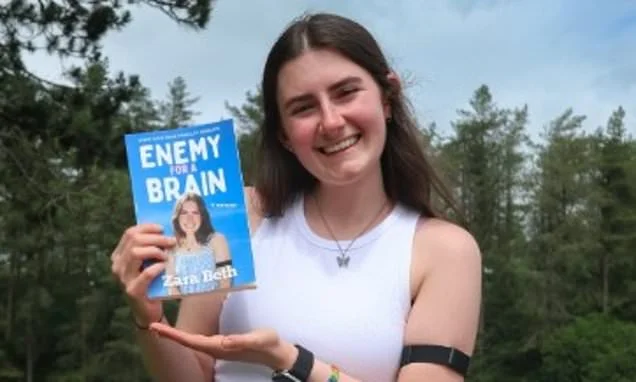
It sounds like satire. A young woman named Zara Beth, who describes herself as a ‘disability advocate and author’, posted a video revealing the problems she faces as a wheelchair user.
The 64-second clip, which has been viewed ten million times on TikTok and X, shows her arriving at Manchester Piccadilly train station, only to be confronted by a broken lift and a flight of about 30 steps.
The stairlift was not working either and a portable contraption brought by the helpful station staff was too small for Zara’s chair. So in the end... she had to walk up the stairs like everyone else.
It turns out that Zara is ‘ambulatory’, which means she chooses to use a wheelchair on days when her condition is more debilitating.
On her better days, her hobbies include gymnastics and roller skating.
Another of her videos shows her springboarding into a pit filled with foam, doing a somersault in mid-air.
Her disability means she doesn’t always have the energy for a full workout, she says, so she just practises on the balance beams or limbers up by doing the splits.
Zara tells her followers that she has also been clinically diagnosed with autism. I’m in no position to speak about the degree to which she suffers from the condition – which in its most extreme forms, of course, can render an individual nonverbal and entirely dependent on round-the-clock care.
Zara Beth, who describes herself as a disability advocate and author, is 'ambulatory' – she chooses to use a wheelchair
On her better days, hobbies include gymnastics and roller skating. She also posts videos of herself springboarding and somersaulting
It is, in part, this broad range of ways in which autism manifests that prompted Professor Dame Uta Frith, regarded by many as the world’s greatest expert on autism, to warn this week that the condition is now so over-diagnosed or indiscriminately applied that the word has become all but meaningless. ‘A catch-all for a huge variety of conditions, the definition widened to include people with no language or learning problems’, was how she described it.
This, she says, is leading to the ‘tragic neglect’ of that minority of people who do have severe autistic difficulties. Over-diagnosis is especially marked with people who do not identify as autistic until adulthood.
Incorrect application of labels can become ‘a self-fulfilling prophecy’, she adds, also warning that we are fast approaching the point where ‘the diagnostic threshold [is lowered] to zero’.
In other words, soon an autism diagnosis will not require any symptoms at all. And anyone can be disabled, just because they say so.
Autism isn’t Zara Beth’s only hidden disability. She also says she has Tourette syndrome and her TikTok page (with two million followers) features 21 videos in which she shows off her tics which, she says, are compulsive and involuntary – such as swearing and meowing like a cat.
I’m not for one moment suggesting that Zara doesn’t legitimately suffer from this condition. But like her difficulties with walking, her tics come and go.
The reaction to Zara’s videos online has been split. Some commentators have been predictably sceptical about the nature of her disabilities. But others are praising Zara. They say she’s challenging negative stereotypes of disability.
This is true if, like me, you subscribe to the old-fashioned notion that people do not usually consider their disability something to broadcast or shout about, rather a personal adversity to overcome.
Zara Beth roller skating. In addition to being a wheelchair user, Zara says she has autism and Tourette syndrome. But like her difficulties with walking, her tics come and go
Hundreds of thousands of young people are labelling themselves as disabled and making the label the basis of their persona, their public identity, writes Michael Simmons
For Generation Z, the cohort in their teens and 20s who were at school or university during the pandemic, disability has become melded with identity politics. To have a disability, whether mental or physical, has become a badge of pride. As with the trans movement, which proclaims people are automatically whatever gender they decide to be, medical symptoms and diagnoses are now a matter of personal choice.
And hundreds of thousands of young people are making that choice. They are labelling themselves as disabled and making the label the basis of their persona, their public identity.
Around half of NEETs – the 16-to-24-year-olds who are Not in Education, Employment or Training – report a disability or chronic health condition, such as depression and anxiety. According to data from the Youth Futures Foundation, which tackles unemployment among the young, the numbers registered as NEET have risen by more than a quarter of a million people since 2021.
At the same time, spurious disabilities can prove very useful to those on welfare. Claimants of disability benefits, unlike those who are merely unemployed, are not expected to look for jobs. They also receive more financial assistance to help with the additional costs of living with long-term conditions.
These benefits can be substantial – including provision of a car by the charity Motability, for those on the highest rate of mobility allowance.
Endemic abuse of the system is both outrageous and offensive. I take it personally: I do not regard myself as disabled but, throughout my childhood and adolescence, my schoolmates and many of the adults around me certainly did. And they wanted me to see myself that way, too.
I was born with cerebral palsy – left hemiparesis, to be precise – and wore a splint for years while I underwent surgical processes that the NHS now regards as too barbaric to employ.
My schoolfriends called me Pegleg and Spazzy, and made a game of hiding my splint when I took it off for swimming sessions. Happy days.
What I wanted, more than anything, was to be the same as everyone else. I’d be overjoyed for today’s schoolchildren if disability became merely a mild difference, as normal and unremarkable as green eyes or curly hair. But that’s not what so-called ‘advocates’ like Zara Beth are trying to achieve.
They want to be different and to make disability a mark of their specialness. And of course they post about it on social media, because that’s how they get noticed.
But, as Dame Uta says, this self-promotion comes at a cruel cost to others. Performative disability robs the genuinely ill of the support they desperately need. It uses all the available oxygen.
In such cases, this could conceivably result in other disabled passengers – who might not have the option to get up from their chair and walk – having to struggle on unaided. This could be part of the reason why some people argued that if Zara was able on this occasion to walk up the stairs, then her need for the lift was unnecessary.
And although I have no doubt Zara’s disability can be incredibly debilitating, I can’t help but worry that the next time they’re hailed by a young woman in a wheelchair who says she can’t get up a flight of stairs, the staff, assuming that they had seen the video of Zara, wouldn’t be human if they didn’t cynically wonder, while they were assisting her: ‘Really? Are you sure you’re not putting it on?’
The same thought is bound to occur to anyone queuing at the airport who sees a fellow flier jump the queue because they are wearing a sunflower lanyard, which indicates a ‘hidden’ disability.
Why should anyone who has diagnosed themselves with dyslexia, or a raft of other conditions, qualify for perks on a package holiday, you might wonder? Why indeed.
Michael Simmons is economics editor at The Spectator.