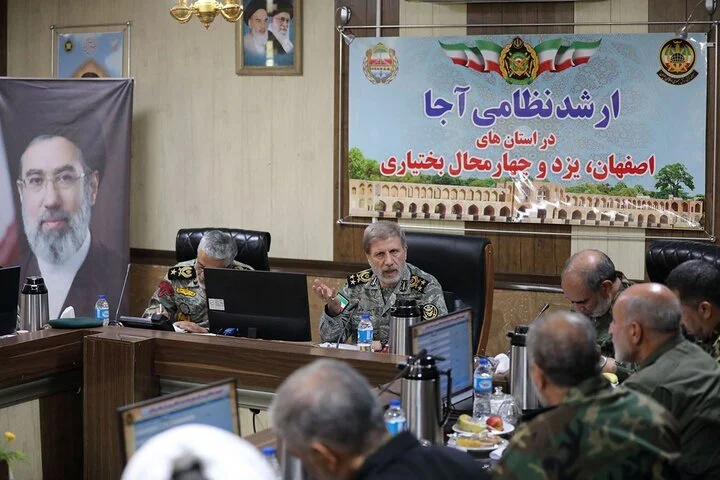
TEHRAN – Iran's Army Commander-in-Chief Maj. Gen. Amir Hatami said Tehran has "not even an Iota of Trust" in its adversaries, accusing them of pursuing both military and psychological campaigns against Iran while insisting the country's armed forces remain fully prepared for future threats.
Hatami made the remarks during an inspection of Army grounds, air defense and air force units in the central province of Isfahan, where he assessed operational readiness and addressed military commanders.
Speaking about the ongoing conflict, Hatami said Iran believes its adversaries sought more than temporary military gains. According to the commander, their ultimate objective was to weaken the Islamic Republic, undermine Iran's national unity and ultimately bring about the country's disintegration.
He said the Iranian people had resisted those efforts in the same way they stood against Iraq during the 1980–1988 Iran-Iraq War, adding that the alleged objectives of Iran's enemies had failed.
Hatami praised the performance of the Iranian armed forces, including both the Army and the Islamic Revolution Guard Corps (IRGC), saying they had carried out successful operations during the recent fighting.
He specifically revealed that an Iranian Air Force F-5 fighter had struck a military base protected by Patriot air defense systems and hosting F-15 and F-16 fighter jets before returning safely to base. He further added that, during the incident, opposing forces mistakenly shot down three of their own F-15 aircraft.
The army chief also referred to remarks of the chairman of the US Joint Chiefs of Staff, stating the American commander had acknowledged that US helicopters flying over Iran were fired upon by civilians using whatever weapons they had available. Hatami said this demonstrated that any attempt to deploy foreign ground forces inside Iran would encounter widespread public resistance.
Turning to the broader confrontation, Hatami argued that the conflict extends beyond the battlefield. He accused Iran's adversaries of conducting a coordinated campaign through military operations, media coverage, cyberspace and psychological warfare aimed at weakening public morale and creating despair among the Iranian population.
"We do not trust this enemy," Hatami said. "We never expected it to honor its commitments, and for that reason we did not lose a single moment in strengthening our combat readiness."
He said Iran's armed forces had continued enhancing their military capabilities throughout the crisis and expressed confidence that the country would overcome the current challenges. Hatami added that, in his view, Iran's adversaries would ultimately fail to achieve their objectives and regret their actions.