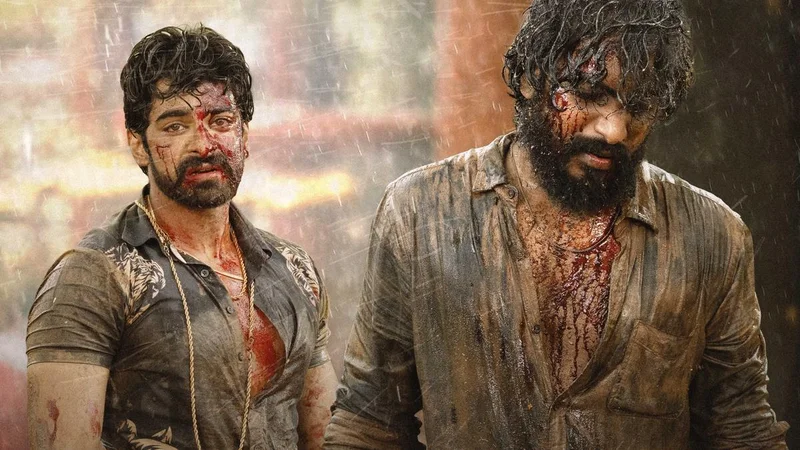
King Jackie Queen (KJQ) begins with a desperate voiceover that ties a man’s destiny to the place and the family he is born into. ‘Would Osama Bin Laden have chosen the same path if he were Queen Elizabeth’s son?’ it asks, pointing towards the trajectory of the action romance. The film charts the journeys of three flawed characters, who make contrasting choices to overcome their hopeless circumstances.
In terms of a basic outline, KJQ appears to be a simplistic love triangle, revolving around two best friends turned foes in a world of crime and a woman sandwiched between them. The film narrates the stories of Partha (Dheekshith Shetty), Jackie (Shashi Odela) and Bhargavi (Yukti Thareja) across as many chapters, capturing their worldviews in totality, paving the way for a dramatic conclusion.
Both the men, Partha and Jackie, lean on each other in their troubled teenage years. Partha grows to become a gangster consumed by power, and Jackie will do whatever it takes to secure it for him. Bhargavi, an actress tormented by her past decisions, is a source of instant appeal for the men. Partha seeks to control her, while Jackie goes all out to protect her.
KJQ has ambitious ideas, dealing with themes from classic gangster dramas. A bitter kingpin turns into a slave to the throne and loses his way. Another man, who calls himself his tireless soldier, craves to be human in a loveless life. A woman longs for companionship in a world full of skin-deep relationships, almost becoming the catalyst for their transformation, but instead destroying their lives further.
KJQ (King Jackie Queen) (Telugu)
Yet, for all the profound ideas it seeks to discuss, the world-building is shaky and largely problematic. Partha’s rise to power feels like a formality, without him being truly tested at any point. He and his men repeatedly go on killing sprees and silence their detractors. Beyond loud warnings, shootouts and large gangs, what exactly makes him powerful and why does he remain unopposed?
Partha’s impulsiveness comes to the fore in Dheekshith’s sparkling act, but his empire is built on a fragile foundation. As someone who has barely interacted with women all his life, he does not know what it means to be loved or to be vulnerable. He ultimately finds solace in marriage, but the film passes off marital rape as the starting point of a relationship that eventually turns into enduring care.
A shootout at a politician’s house, where he loses a loved one, serves as the trigger for Jackie’s reflection. However, the emptiness and ambiguity within him are explored only at a surface level through superficial dialogues. Bhargavi feels like an individual capable of making her own choices, but she is no different from the other women in the film, at the mercy of men.
Apart from Bhargavi, the film’s other representations of women include a single mother struggling to resist a police officer’s advances, a married woman running a sex trafficking cartel who also ropes her daughter into the flesh trade, and a wife who commits suicide due to her husband’s infidelity. It is hard to believe such regression continues to find takers in Telugu cinema.
The ending, heavily inspired by Mani Ratnam’s Nayakan, too, feels hardly original. Both the men indulge in long monologues, while the woman stands as a mute witness before tragedy strikes from an unexpected corner. KJQ is ultimately all about the men. They decide when and where to wield their power and exact revenge. The rest are mere furniture.
As a key character points out to Partha, ‘You don’t know how to love a woman, because you are in love with yourself, your ego and pride.’ That, ladies and gentlemen, is the crux of KJQ: fragile male ego, where men cannot take no for an answer.
Dheekshith Shetty is the only actor in the line-up committed to making something of a character who is a tornado of insecurity. You can sense the rage and restlessness in his veins, lending some personality to an unlikeable part. Shashi Odela appears as lost and clueless as Jackie, struggling to express his inner turmoil, wearing a blank expression throughout.
Yukti Thareja’s spunk comes through only in bits and pieces. Guru Somasundaram is royally wasted in an inconsequential role, while Muralidhar Goud, Surekha Vani and the boys playing the younger versions of Partha and Jackie display some restraint. Poornachandra Tejaswi’s songs are generally disappointing, barring the imaginative Tillana fusion. The cinematography does not leave much of an impression either.
Late filmmaker Kiran Kumar Meenuga’s KJQ could have been a cutting-edge, alternative interpretation of a crime saga if only it was more committed to exploring the conflicts of its lead characters, sans the apparent misogyny.
Published - August 07, 2026 03:04 pm IST