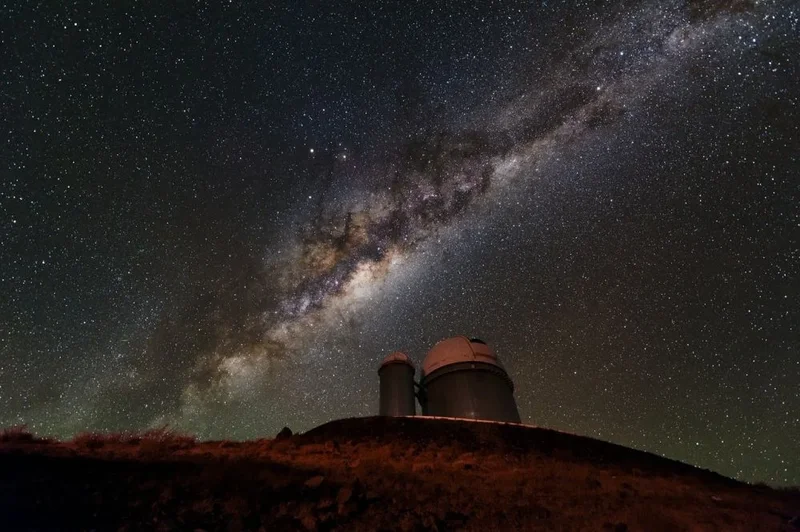
The Milky Way is ancient, and its first stars formed shortly after the Big Bang. It's been through a lot in its long life, including merging with other galaxies and absorbing smaller ones. Our observations of the cosmos confirm that, where we see multiple examples of galaxies merging and interacting. Piecing together the Milky Way's history of mergers and other events is key to understanding our galaxy, and by extension, other galaxies.
Not everything about the Milky Way (MW) is clearcut. Even with all of the scientific progress in astronomy, especially in the last couple decades, some of its features are still puzzling. One of its puzzles concerns its disk. It has two separate disk structures that rotate at different speeds.
The bulk of the galaxy's stars are in its spiral disk, or thin disk, but a much larger and more sparse disk surrounds that disk as a stellar halo, or thick disk. These halo stars originally formed in different galaxies, but were absorbed by the MW during mergers. The ESA's Gaia mission observed billions of stars in the MW and found that the thick disk rotates very slowly compared to the thin disk.
*This schematic shows the main features of the Milky Way, including both of its disks. Image Credit: By RJHall at English Wikipedia, CC BY-SA 3.0, https://commons.wikimedia.org/w/index.php?curid\=52696960*
Astronomers have worked hard to try to understand why. Since the thick disk stars are older, metal-poor, and follow eccentric or more random, chaotic orbits, they're evidence of a past merger. To dig into the connection between the slow rotation of the sparsely populated halo, and ancient mergers, a team of researchers used simulations. They presented their results at the Royal Astronomical Society's National Astronomy Meeting in Birmingham.
"Because we live inside the Milky Way, we can study it in more detail than any other galaxy, which makes it a key testbed for understanding galaxies more broadly." - Kirill Batrakov, Durham University.
The researchers, led by Kirill Batrakov, an astronomer from Durham University, used the Auriga simulations. The Auriga simulations are a set of cosmological zoom simulations aimed at understanding how galaxies form. The simulations take into account black holes, supernovae, dark matter, and gravity, and begin shortly after the Big Bang. Auriga simulations create sequences of scientific snapshots that reveal how events in a galaxy's history created the structures we observe today.
The researchers simulated 25 galaxies similar to the Milky Way, and let the simulations run for billions of years.
"Gaia observations have revealed that the Milky Way (MW) stellar halo has a weak net rotation of approximately 10-20 km/s, yet the origin of this rotation remains unexplained," the researchers write in their abstract. "Motivated by this finding, I investigated the rotation of stellar haloes over a redshift range of 0-2.5 in Auriga â a suite of magnetohydrodynamical cosmological zoom-in simulations of MW-like galaxies."
That redshift range covers roughly the last 11 billion years, so each simulation began with a MW-like galaxy about 2 to 3 billion years after the Big Bang. That range includes the era of peak cosmic star formation, the "cosmic noon" around z â 1-3. It also includes most of the major mergers these galaxies experience
The simulations that recreated the MW's slowly rotating outer halo shared three things in common: they formed earlier; they underwent a merger like the MW's Gaia-Enceladus-Sausage merger; and they experienced a disk-flip event.
"We already know that the Milky Way had a massive head-on collision in the past with a galaxy known as Gaia-Sausage-Enceladus (often simply called the Gaia Sausage). So, we think that the Milky Way disc likely flipped in the past," explained Batrakov, the lead researcher on the project.
"A disc flip also means most of the Milky Way's stars once moved on very different trajectories than they do today â possibly even our own Sun, meaning our 'stable' spot in the galaxy might not have been so stable for the Solar System's whole lifetime," Batrakov said.
We're inside the Milky Way, so that creates some difficulties in studying it. But our position also works in our favour. The ESA's Gaia mission has changed our understanding of the Milky Way by measuring billions of MW stars, something not possible to the same degree in other galaxies.
"Finding that its disc flipped adds a new chapter to that story, one we must account for when placing the Milky Way in a broader context of other galaxies." Kirill Batrakov, Durham University.
"Because we live inside the Milky Way, we can study it in more detail than any other galaxy, which makes it a key testbed for understanding galaxies more broadly," Batrakov said. "Finding that its disc flipped adds a new chapter to that story, one we must account for when placing the Milky Way in a broader context of other galaxies. What excites me the most is that this complex history can be reconstructed just from present-day observations."
The results also say something about the MW's dark matter halo. "These results suggest that the MW likely underwent a disc flip in its formation history, and that its DM halo likely rotates relatively slowly," the authors write.
This suggests a connection between the two. The stellar halo may have evolved alongside the DM halo as the MW continued accreting smaller galaxies throughout its history, just as it's doing now with the Magellanic Clouds and the Sagittarius Dwarf Spheroidal Galaxy.
Other research also supports the disk flip scenario. A 2025 paper in Astronomy and Astrophysics focused on the Milky Way's dark matter halo and used Gaia data to understand it. "We find tentative evidence that the Milky Way DM halo is twisted, consistent with alignment with the disc in the inner r â²â20 kpc, and becomes vertically orientated in the outer regions, consistent with the prediction of disc flip scenario," they write.
The reality of living inside a massive galaxy that has evolved over billions of years, contains hundreds of billions of stars, has undergone mergers, and has flipped its disk, doesn't touch our everyday lives. But it is reality, and intellectual curiosity drives us to understand it. Anyone who enjoys the scientific journey of understanding about our home galaxy should tip their hat to the European Space Agency's Gaia mission, which is revolutionizing our understanding of the Milky Way.