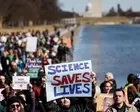
The Trump administration is waging an unprecedented war on institutions devoted to research and higher learning. While plenty of countries have harmed universities by imposing neoliberal logics on academia – creating artificial markets in the name of spurring professors to be more productive – the Trumpist subjugation of all science to political imperatives has no equivalent in a democracy; if anything, it is reminiscent of Stalin’s Soviet Union. The assault now also targets foreign students and any kind of international collaboration – a major blow to US soft power. Why are Trumpists engaging in what can only be described as an act of wanton self-injury?
Project 2025’s Russell Vought, the director of the office of management and budget, initiated the rule change that would make any federal grant subject to review by political appointees – including funds for science that so far have been allocated through judgment by first-rate fellow scientists. This measure would furnish Trumpists with a new weapon to threaten universities along the lines of: “Nice medical school you have there – pity if something were to happen to it because your administration had failed to come into alignment with the president’s priorities.”
Then there is the strategy recently presented by Trump’s science adviser, a former employee of Peter Thiel, with the unique distinction of having no relevant experience in research whatsoever. Michael Kratsios wants to shift decision-making from experts in universities to private corporations, which, helped by AI, are supposedly better positioned to spot potential breakthroughs. This constitutes a major break with the enormously successful approach the US took after the second world war: pour taxpayer money into basic, open-ended science which no private company would risk sponsoring – but with both citizens and American capital eventually benefiting from the inventions that came out of fundamental research. Kratsios wishes the government to adopt “the intentionality of a serious investor” in order to usher in a new “golden age of science” (declaring something “golden” seems enough to succeed in Trump-world). De facto, as critics have rightly pointed out, this seems a strategy to take money from what Trumpists perceive as their political enemies – universities – and shovel it to their allies in tech.
Meanwhile, the more directly ideological assault on universities continues. Having failed to tempt select institutions of higher learning with a “compact” to receive preferential federal treatment last year, Linda McMahon, the fake-wrestling-executive-turned-anti-education secretary, is now asking university presidents to pledge allegiance to the administration through statements on their websites: among other things, they are supposed to explain how they will increase “intellectual pluralism” (read: affirmative action for conservatives); deal with campus protest (read: police student speech the Trump administration does not like); and make education more provincial (serving America first) and instrumental (only immediate employability and vocational credentialism count) – and less critical of “our civilizational inheritance”.
In the spirit of Stephen Miller-type nativism, international donors are targeted no less than international collaboration in general; visas for PhD students are now limited to four years (an unrealistic time frame for many academic subjects), with possible extensions if students spend time and money on appealing to the Department of Homeland security (instead of doing actual research). The fact that many researchers in the past have stayed in the US after obtaining their doctorates, contributing to national wealth (just like America Firsters would presumably want) or went back to their countries with good feelings to the US – all that counts for nothing.
What explains such self-harm? Rightwing hostility to higher education is nothing new: from intellectuals supposedly being communist eggheads in the 1950s, to moral panics about “political correctness” in the 1990s and “wokeness” in recent years, there is the basic stance made explicit by JD Vance in 2021: “Universities are the enemy.” But Trump’s rule has brought together a novel coalition, one divided by many issues but united in their desire to destroy universities as we know them. Among them: the Maga hardcore with its traditional anti-intellectualism and nativism; the Silicon Valley oligarchs who imagine their companies replacing (and monetizing) university functions; and conservatives in name, but radicals in practice who want to take over higher education, but, failing that, would like to burn the whole system down.
Also novel, in the wake of Covid, is the commitment of so many on the right to the idea that, somehow, science and freedom are opposites, that not having ever to listen to people who know something better than you do is the essence of personal liberation. If that emotional fuel for the new anti-intellectualism were not powerful enough, there is a highly flammable desire for revenge – amply on display in the endless attacks on Anthony Fauci.
To be sure, Congress has not gone along with some of the major funding cuts for science Trump keeps requesting; even Republican politicians quietly resist when monies would stop flowing to their districts. And the new OMB rule, it seems, is being blocked in a funding deal reached in the Senate this week. But one cannot rely on such occasional pushback by one Republican or another, because none of them has offered a principled defense of the postwar model (in fact, given the conduct of the likes of the senators Thom Tillis and John Cornyn this week, it seems fair to say that “principled Republican” is fast becoming a contradiction in terms).
University leaders and prominent scientists have to hold the line in opposing possible “deals” with the Trump administration; everyone could have learned by now that Trumpists will not stick to their end of the bargain. More importantly, those seeing things wrong with peer review, for instance, or too much administrative busywork for researchers – and some of these problems are real – have to realize that Trumpists are the last who can be trusted to solve them.
- Jan-Werner Müller is a Guardian US columnist and a professor of politics at Princeton University