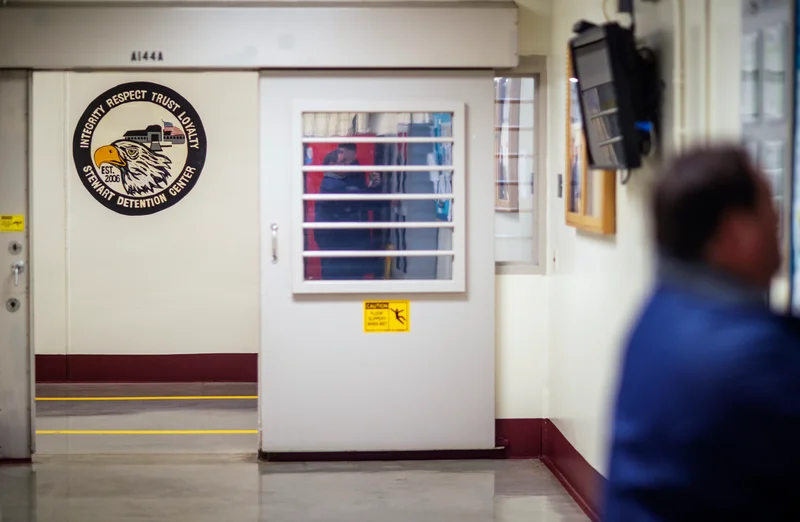
July 13, 2026, was the last day they heard the voice of Prisciliano Trejo Ricano. From the Stewart immigration detention center in Georgia, where he was being held, he called his best friend, Gerardo Cortez Zapata, at 1.30 p.m. He was very hoarse and his cough interrupted his words. That night, after 9.00 p.m., he spoke with his parents. They remember that his voice had changed as he felt sicker each day. Suddenly, he said a rushed goodbye.
“I’m going to see the doctor,” he told his father, Prisciliano Trejo. “My boy was happy, but he didn’t know he was going to his death. They took him and he didn’t come back,” the father said in a phone call with EL PAÍS. “He didn’t talk to me on the 14th. We spent the whole day worried. He didn’t talk on the morning of the 15th either. We thought bad news always comes quickly.”
Prisciliano Trejo Ricano, a 29-year-old Mexican, had been in the custody of U.S. Immigration and Customs Enforcement (ICE) since June 25. The Durham County Sheriff’s Office in North Carolina handed him over that day to immigration agents and from there ICE moved him 500 miles southwest, an eight-hour drive from his home and family, to Stewart.
Until July 3 his concern had been securing release on bond. But from that date his health began to worsen. Several cellmates had fallen ill with the flu the week before, including Prisciliano. Some improved, but he developed a cough that worsened over the next 10 days: a hoarseness turned into blood-tinged sputum, increasingly heavy each day. He also had a sore throat and fever; he noticed a rash, and his brother, Jorlee Trejo, recalled in a phone call that Prisciliano told him about a bruise that would not fade. Sick like that and in detention, he turned 29 on July 10.
By July 13, his friend Gerardo insisted he should seek medical attention again: “Only one doctor had seen him for a very short time over the weekend. He told him, ‘They will give you medication,’ but they never gave it to him.” Prisciliano, Gerardo remembers, told him that day he had tried to ask a Stewart detention officer for the medicines the doctor had prescribed: “He insulted him, told him ‘fuck off’ and ignored him.”
A Department of Homeland Security (DHS) spokesperson told this newspaper that Prisciliano Trejo tested negative for strep. The spokesperson says — without specifying dates — that he was given QC Mucus Relief Sinus, a generic cough medicine, and was treated with intravenous saline, amoxicillin, ibuprofen and Tylenol.
In his conversations with Gerardo Cortez and with his brother, the migrant told them that until July 13 the only medicines he had taken were those generously shared by his cellmates: a pill of antibiotic for bacterial infections (amoxicillin) and the occasional Tylenol. In a Facebook post on July 12, he himself confirmed that up to that day he had not received any medical treatment or medication.
His brother believes that by the time he got medical attention it was already too late: “They should have helped him sooner.”
Since Donald Trump began his second term with an aggressive campaign to increase migrant detention capacity, 55 people have died in ICE facilities, according to government figures. Human Rights Watch said in a recent report that it is the highest number in more than a decade; it is more than double the deaths reported during his first term.
The report cites conclusions from organizations such as Physicians for Human Rights. In medical reviews of 39 cases of deaths in ICE facilities between January 2025 and January 2026, they concluded that the government did not provide sufficient public information about the circumstances of the deaths or about medical care provided during detention to allow a definitive clinical assessment: “Although the available documentation was often sparse, it was sufficient to identify serious concerns about the care provided.”
They also concluded that in most of those cases medical experts suspected detained sick people received “inadequate or delayed” medical care, leading them to consider that “the deaths may have been preventable.”
Two days of silence
Prisciliano Trejo died on July 24 at around 7.00 a.m. in a hospital room, with his parents and his brother Jorlee by his side. But the journey to that hospital room is not clear to his family.
After communicating with them every day since he was transferred to the Stewart center, his failure to contact them for two days (July 13 and 14) worried them. “My mother has a co-worker who told her that when detainees get sick they put them in isolation,” Jorlee Trejo said, remembering the family conversations at home. “I thought he was recovering.”
On July 16, Jorlee received a phone call from a Georgia number. He answered:
—Are you Prisciliano’s brother? —asked a voice. It was immigration attorney Marty Rosenbluth.
—Yes —he replied fearfully.
—I have bad news. Your brother is in the hospital, he has cancer and he’s on a ventilator.
Rosenbluth told EL PAÍS that the oncologist who evaluated Prisciliano had said the young man had a type of leukemia that “can appear suddenly and be very aggressive.” The diagnosis surprised the Trejos, not only because the young man had been healthy until his detention, but because there is no family history of the disease.
Prisciliano Trejo Ricano had spent those two silent days in an emergency room in Columbus, Georgia, an hour from the detention center. The family does not know the name of that facility; no one could specify it. From there he was moved, intubated, four hours east to the intensive care unit at Wellstar MCG Health Emergency Department in Augusta. His family does not have precise details of the exact times of the transfers or of Trejo Ricano’s condition upon arrival at each of these facilities. So far, ICE has not contacted them.
Two physicians consulted by this newspaper explained that acute leukemias can be severe if not treated promptly. They said that if the doctor at Stewart prescribed amoxicillin to Prisciliano, as DHS reported, it was because a bacterial process was suspected. They said patients with leukemia have weakened immune systems that, when faced with any untreated infection, can worsen and carry a risk of death.
Upon arriving at the Wellstar hospital at night, the Trejo family could not see Prisciliano immediately. He remained in ICE custody.
Rosenbluth told EL PAÍS that shortly after he received a call from the agency notifying him it would release custody of Prisciliano so his family could visit him. “There had to be some negotiation; it was really a bureaucratic issue. That is, ICE had notified the hospital they were going to release him, but the paperwork didn’t reach the right people, so the process had to be expedited somehow.”
Meanwhile, in the Wellstar hospital corridor, Jorlee heard one of the Stewart agents still guarding his brother say that on July 14 Prisciliano was awake and had even signed papers.
When the family finally got into Prisciliano Trejo’s room, he was unconscious, intubated, with lines in several places on his body. He reacted when they took his hand and spoke to him, and he opened his eyes slightly.
“He saw me maybe twice. I told him I hoped he could wake up to know what happened to him,” his brother recalled.
“I want justice”
Prisciliano Trejo Ricano does not appear in ICE reports as the 35th migrant who died in fiscal year 2025 after falling ill in federal custody. Had he been included, his name would have appeared on the list after the Venezuelan Jesús Manuel Arenas, whose sister denounced that ICE did not provide the medications he required to treat several preexisting conditions he reported even from the time he was being arrested. He was found unconscious on a bus in which he was being transferred between detention centers. He died in the hospital.
Rosenbluth explained that once ICE released Prisciliano, his immigration court was changed to Charlotte, North Carolina. The young man had been protected by the Deferred Action for Childhood Arrivals (DACA) program until 2024, when he lacked the funds to renew the status that shielded him from deportation. In January he tried to recover it but could not.
The forensic investigation into his death is being conducted by Georgia authorities. Gerardo Cortez, who holds a master’s degree in biomedical sciences and a certification in emergency medical services, does not trust the evaluation this Republican-led state will make, given its cooperation with the Trump administration’s anti-immigrant policies on multiple fronts. “I suspect they will try to change the narrative about what happened to my best friend.”
Neither he nor the family trust the leukemia diagnosis. So far they have been unable to access the hospital’s full medical records to seek an independent opinion about the disease, to understand a brain hematoma Prisciliano had and to be certain of the cause of death.
The young man will be buried in his homeland, in Xochimilco, Puebla. Only two of the three brothers will travel to Mexico for the farewell.
“I want justice for my son, I want justice for what happened,” his father demanded. “We are going to fight,” added Jorlee Trejo, who has joined Gerardo in the search of answers. He has kept in touch with his brother’s cellmates at Stewart.
Although it hurts and he sees a difficult road ahead, Jorlee says it is now his responsibility to take the place his brother Prisciliano held at home. He was the oldest, the one who looked out for everyone. “We have to find a way to live without him. I never thought I would bury my brother.” It comforts him to know he is no longer suffering: “He’s happy in heaven and not in this world, where there are so many bad people.”