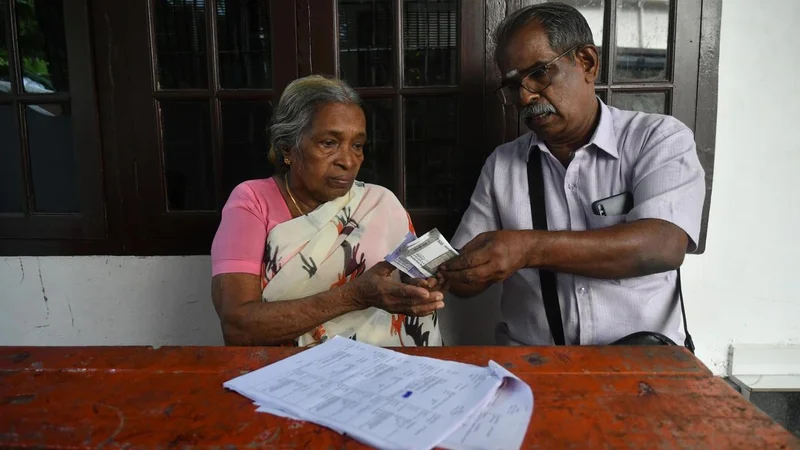
The Kerala government’s decision to shift fully to the direct benefit transfer (DBT) mode for the distribution of social security and welfare fund pensions comes three years after the Comptroller and Auditor General of India (CAG) flagged problems with the direct-to-home (DTH) system of distribution executed through primary agricultural credit societies (PACS).
Finance Department data also show that Kerala has been spending crores of rupees every year on incentives paid to individuals who distribute the pensions to homes under DTH via the PACS route.
In September 2023, the CAG, in a report submitted to the Kerala Legislative Assembly, had recommended that the State include more beneficiaries under the DBT mode, a recommendation the UDF government has now decided to implement.
As per a July 27, 2026 Finance Department order, the government has decided to remit the social security and welfare fund board pensions using the DBT mode via Aadhaar-linked bank accounts in all cases except those of “fully bed-ridden patients.”
Three years ago, the CAG had detected shortcomings and flaws in the manner in which social security pensions were being distributed in the DTH mode. The findings were part of the report ‘Performance Audit on Direct Benefit Transfer (DBT) of Social Security Pension Schemes’ laid in the Assembly in September 2023.
DBT, where the money is paid directly into bank accounts, and DTH are the two modes used by the Kerala government to disburse the social security and welfare fund pensions to close to 60 lakh people every month. The pensions are now paid at the rate of ₹2,000 per beneficiary.
However, the CAG had taken the stand that DTH payments via PACS do not qualify as DBT since it is not made directly to the pensioner. “Further, in respect of DTH disbursements, only the signature/thumb impression of the beneficiaries are obtained as acknowledgement by the agent which is kept in the PACS concerned,’‘ it noted. Absence of automated beneficiary-wise acknowledgement opens up the possibility of fraud, the report said.
The CAG report had also cited instances where the pension was paid via DTH mode even after the pensioner’s death.
The government also pays an ‘incentive’ to individuals who deliver the pension to houses.
In a written reply to the Kerala Assembly in October 2024, K.N. Balagopal, who was Finance Minister in the CPI(M)-led Left Democratic Front government, said the incentive was paid at the rate of ₹30 per beneficiary. In all, 10,082 persons were appointed for the distribution. According to Mr. Balagopal’s reply, the government had spent ₹34.11 crore in 2024-25 on incentives.
The spending on incentive for the previous years, as per the Assembly records, are as follows: 2016-17 (₹11.79 crore), 2017-18 (₹44.19 crore), 2018-19 (₹28.42 crore), 2019-20 (₹29.88 crore), 2020-21 (₹50.61 crore), 2021-22 (₹11.81 crore), 2022-23 (₹11.76 crore), and 2023-24 (₹34.11 crore).
In its July 27 order, the Finance Department cited flaws in pension payment and a letter from the Kerala Social Security Pension Ltd urging the government to shift fully to the DBT mode as the reasons for its decision.
Published - August 07, 2026 03:55 pm IST