This Letter Penned on the ‘Titanic’ Days Before It Sank Shares the Perspective of the Ship’s Second-Class Passengers
The letter, now up for auction, describes good weather and bustling activity as the “Titanic” prepared to set off across the Atlantic Ocean
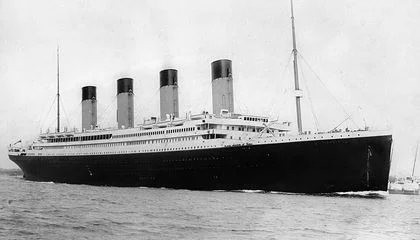
The RMS Titanic, photographed on April 10, 1912, the day that Henry Hodges dated his letter.
Public domain via Wikimedia Commons
#/media/File:RMS_Titanic_3.jpg)
On April 10, 1912, a man named Henry Hodges was a passenger of the RMS Titanic as it prepared to stop at Queenstown, Ireland, the mighty ship’s last port of call before embarking across the Atlantic Ocean on its maiden voyage.
Hodges’ first impressions of the Titanic were positive. That day, he penned a letter to his friend, a man named Hector, describing an animated mood on board, fair skies and a flurry of activity.
“You do not see anything of the movement of the ship, but the weather is very fine,” Hodges wrote. “On the top deck there are about 200 boys (from 20 upwards) marching round \& singing, others are playing dominoes \& cards in the saloons, some reading, some writing, everything is quite different to what you would expect to see at sea.”
Hodges ended the letter, written on official Titanic letterhead and posted in Queenstown, with an unfortunate simile: “I feel as tired as a dead dog.”
The letter written by musical instrument salesman Henry Hodges, dated April 10, 1912, is expected to fetch thousands of dollars at auction.
Henry Aldridge \& Son Ltd.
This jovial atmosphere did not last for the journey’s duration. On the night of April 14, the vessel hit an iceberg and sank. Hodges was among the roughly 1,500 people who lost their lives. He had spent £13 on his second-class ticket. This month, the letter that he sent is expected to fetch up to £35,000 at auction.
“This letter gives us a historically priceless snapshot into what life was like on board the most famous ship ever to take to the seas for a second-class passenger,” says Andrew Aldridge, the auctioneer in charge of the sale, reports Chloe Harcombe for BBC News. “He describes the ship and fellow passengers and how they passed the time. Yet a little over four days later the Titanic was lying at the bottom of the North Atlantic.”
Hodges ended his letter by writing that he is “as tired as a dead dog.”
Henry Aldridge \& Son Ltd.
The stories of the Titanic’s second-class passengers are underrepresented, Aldridge says.
“Everyone knows about third class, the emigration element, starting a new life. Everyone knows about the richest people in the ship of first class,” he explains to CNN’s Jack Guy. “But you know that the story of second class is one that really hasn’t been told that much.”
An estimated 284 second-class passengers were aboard the Titanic when it sank, 166 of whom died, according to research project Encyclopedia Titanica. These travelers were part of a rising professional class and were traveling to the United States to visit family or seek jobs. Their tickets were not cheap—Hodges’ fare would amount to about £2,000 in modern currency—and these passengers enjoyed amenities and meals that would have been considered first-class on other ships.
Hodges was a musical instrument salesman traveling to Boston for pleasure. His body was recovered by the Mackay-Bennett and was buried in Halifax, Nova Scotia.
Did you know? Foreshadowing
Last year, another
Titanic
letter, written by first-class passenger Col. Archibald Gracie, sold at auction for $399,000, nearly five times its expected price. Aldrige told
’s Rebecca Rosman that was likely due to one standout sentence: “It is a fine ship,” Gracie wrote on April 10, “but I shall await my journey’s end before I pass judgment on her.” Gracie survived the ship’s sinking.
Hodges’ letter is a centerpiece of the current online auction of historic maritime artifacts that closes on July 26. Other marquee artifacts include a rare U.S. Black Eagle silver dollar certificate, recovered from the body of Ernest Tomlin, who died when the Titanic sank and a hardbound souvenir book advertising two prized ships of the White Star Line, the Titanic and the Olympic.