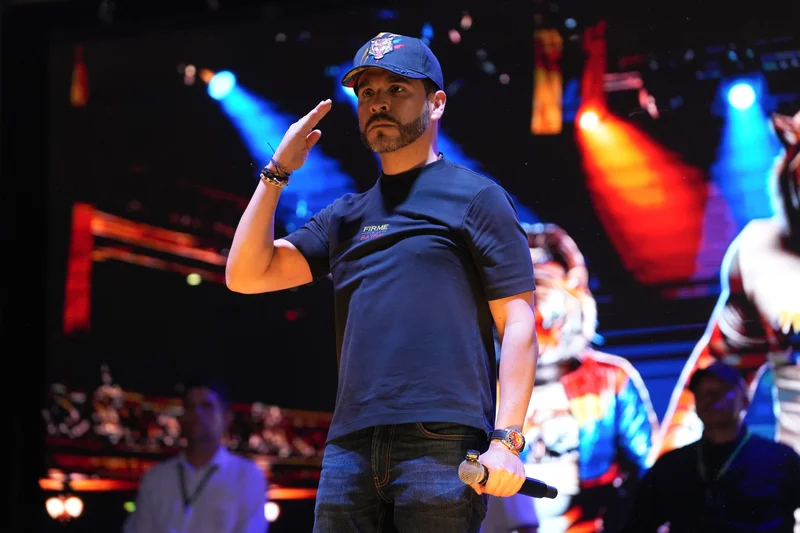
Every four years, August 7 is a very particular day in Colombia: the public holiday commemorating the battle that sealed the independence forces’ victory over the royalists in the wars of independence is also the moment when a new head of state takes office in a country with a long presidential tradition. In 2026 it is also the day the left hands over a power that eluded it for decades, and the day a president takes office with no prior political career — but with a promise to change Colombian politics: Abelardo de la Espriella, the theatrics-loving criminal lawyer who surprised voters in the first round of voting May and won again in the June runoff.
The incoming president is a fierce critic of outgoing Gustavo Petro, yet shares one of Petro’s most notable traits: an emphasis on symbolism. Four years ago, Petro reluctantly stood by the man who on that day relinquished the post, the right-winger Iván Duque; this time De la Espriella did not invite several ex-presidents, when in the past they had all been invited to the ceremony. De la Espriella also decided, in a break with precedent, to move the inauguration outside Bogotá and tried to hold it at a military garrison — a plan that Petro blocked by forbidding the armed forces and police from lending their facilities.
The outgoing president and members of his party in Congress, for their part, announced they would not attend the event; they have said De la Espriella is not a legitimate president, either alleging an election fraud that Petro insists on without evidence, or citing the new president’s dual Colombian/U.S. citizenship — which is lawful in Colombia but is strongly questioned by the left.
This is therefore not only a change of regime and political orientation — a pendulum swing that four years ago moved from right to left — but a much deeper polarization, with an incoming president who has talked about judicially pursuing the outgoing one. It is at once proof of the breadth Colombian democracy has achieved — able in a span of four years to bring to power both a former guerrilla and a right-wing outsider — and a test of how resilient its checks and balances are against the rancor that divides the two leaders.
That level of confrontation also tests one of Colombia’s regional trademarks: a tradition of institutional moderation and 70 years of peaceful transfers of power, without coups, expropriations or hyperinflation. The question this transition raises is whether that tradition can withstand sectarianism, baseless fraud allegations and the frontal clash between the outgoing and incoming executives, or whether today’s strain is only an early symptom of something deeper. That rancor goes beyond a mere shift in political trends — significant in itself when the incoming government combines elements of the far right, such as a foreign minister who embraces theories from the MAGA movement, or a housing minister who has been active as a Christian pastor, with elements more typical of the traditional right personified by former president Duque.
The acrimony is partly explained by the fact that De la Espriella is an unusual president for Colombia. His predecessors had been congressmen, ministers or presidential hopefuls for years; they were long-known figures in politics who had negotiated with, fought or even allied with their rivals. He, by contrast, at 47 was known for taking high-profile media cases and for having advised paramilitaries during their peace negotiations with the Álvaro Uribe government more than 20 years ago. But he had no electoral experience or history in public office, his background was private business, from criminal law to a rum brand.
That is why, when he burst on the political scene, it created a disruption, and why his campaign strategy — centered on political marketing more than ideology, though consistently marked by sharp criticism of the leftist government — proved effective. An amateur singer, Abelardo, as he is known, gained attention through a very contemporary digital strategy quite different from that of other candidates who, to varying degrees, had one foot in the internet world but lacked a fully developed digital persona like De la Espriella’s.
While other right-wing candidates grouped together and debated a mechanism to choose one of them, and the left organized around continuing Petro’s project, De la Espriella focused on specific sectors: retired military personnel, highly religious people and small business owners. That is how he won an electorate that in the past had supported candidates backed by former conservative president Álvaro Uribe. From there came the coalition that took him to the presidency — a coalition as varied as the team that will accompany him in power from today: activists, career politicians, business association figures, former congressmembers from established right-wing parties such as Cambio Radical and the Centro Democrático, and evangelical political leaders. What Colombia will learn starting today is De la Espriella’s character as a political leader and public administrator.
In all his roles the lawyer will face complex challenges, such as deteriorating security across large parts of the country, where illegal economies — drug trafficking, illegal mining and extortion — have fueled the growth of various armed groups that often fight each other violently to protect their revenues and exercise criminal governance that supplants the state in its most basic functions.
Faced with that situation — which revives traumas in a country that for decades endured a complex armed conflict — De la Espriella has responded with simple, high-impact formulas he will need to implement: building mega-prisons, refusing to negotiate with any armed group, and calling for the state to reassert its authority in the strongest terms. Experts say those approaches clash with a more complex reality, in which the opponents are not armies like the one the now-defunct FARC guerrilla tried to build at the end of the 20th and start of the 21st century, but groups that often subcontract or franchise illegal profits across multiple locations. They are more illegal corporate structures than guerrillas in the classical sense. The lack of a clearly known strategy to confront them underscores the open questions. Other problems, such as the large fiscal deficit left by the Petro government and the humanitarian crisis in the health sector, will also require rapid responses — a cocktail of challenges that would be demanding for any experienced leader.
To those challenges, De la Espriella adds an atypical one in recent Colombian politics: managing the opposition of an ex-president who has shown no sign of wanting to lower the rhetoric, who leaves office with relatively high popularity — around 40% — and who has made a career as an opponent more than as a government administrator. Petro departs the presidency accusing his opponent of electoral fraud, making De la Espriella’s start unusual for the country: it has not happened since the last century that an outgoing leader became, from day one of his successor, the most visible and belligerent head of the opposition.
Aware of all this, and conscious that his background could work against him, the incoming president has delegated much of the public leadership to his vice-presidential running mate, former commerce and finance minister José Manuel Restrepo. He is an economist respected in academic circles who has served as rector of three universities in Bogotá and Medellín and has a business background. He has begun to offer a degree of reassurance to business sectors and to more traditional, less antiestablishment conservatives than those directly represented by De la Espriella, and he can help lead a team and attract figures for key government posts. Although some nerve-center positions remain unresolved, such as the head of the National Planning Department or the presidency of Ecopetrol, the cabinet members that have already been named makes it clear that De la Espriella seeks a mix between a disruptive, attention-grabbing activist and a more boring but gravitas-laden technocrat.
It is a combination that also partly combines his own representation of the Caribbean — the region he originally comes from and which has not had a president in more than a century — with the more austere Andean interior that Restrepo embodies. Regional balance has been central to his pre-inauguration promises. De la Espriella has said he will seek to reduce the size of the state by 40%, cut taxes, and within his first three months capture or kill five significant leaders of different illegal groups. He has also said he will make Barranquilla — the main city of the Caribbean region and the location of his law firm’s headquarters — an alternate capital of Colombia, and that other major cities such as Medellín and Cali will also host government offices. That is a clear, symbolic way to reject what his close friend, partner and campaign strategist Carlos Suárez has long called “bogocentrism,” alluding to Bogotá.
De la Espriella has also announced that he will spend much of his time in the regions, listening to mayors and local residents, while Restrepo handles administration in Bogotá and makes the customary international visits. This is not only a vision of how to run the country but a political strategy: it has already earned him good relations with mayors and governors. Those centers of political power, distant from Petro, are key to building a national right-wing force that De la Espriella has begun to forge with the founding of his own party: Defenders of the Homeland.
How far will that party fly on its own? To what extent does De la Espriella represent the new right that already has prominent exponents in the Americas such as Javier Milei in Argentina, Nayib Bukele in El Salvador and Donald Trump in the United States? That remains to be seen. Colombia has a strong, diverse and powerful private sector; armed forces proud of maintaining their distance from politics and of not having staged a coup in more than 70 years; and regions with significant autonomous power. For now De la Espriella offers more promises and question marks than a clear path in any direction. What happens in the coming days will help determine whether he ultimately takes the course of a traditional right with new forms, or whether behind his revamped digital image lies a new era for the country.