Exclusive: ICC judges order Taliban case split from Afghanistan probe that covers US troops
Judges at the International Criminal Court (ICC) have ordered prosecutors to open a standalone investigation into allegations of gender persecution by the Taliban, separating it from the court's long-running Afghanistan war crimes probe that covered US nationals, Middle East Eye can reveal.
According to court documents obtained by MEE through independent sources, a three-judge panel in pre-trial chamber II issued the request to the Office of the Prosecutor in mid-July.
If prosecutors proceed, the Taliban investigation will effectively be split from a broader Afghanistan inquiry looking into alleged war crimes committed since 2003 by Afghan National Security Forces, the US military and CIA personnel, in addition to the Taliban and the Islamic State-Khorasan Province (IS-K) group.
The move is likely to raise questions about whether the court is seeking to ease tensions with Washington by signalling that it will no longer pursue allegations against US forces and their allies.
The chamber's communication came days after US Secretary of State Marco Rubio threatened to "dismantle the ICC, brick by brick", in remarks referencing the court's 2020 decision authorising an investigation into alleged crimes committed in Afghanistan.
Since February 2025, the US has imposed retaliatory financial and visa sanctions on court officials in connection with the Afghanistan and Palestine investigations, citing efforts to prosecute nationals or allies of the US.
The first target was Karim Khan, the former prosecutor of the ICC, who was controversially removed by member states last month after an 18-month long misconduct probe.
Also targeted were eight judges, three of whom - Kimberly Prost, Solomy Bossa and Luz Ibanez - were members of the 2020 Appeals Chamber that authorised the Afghanistan investigation.
The sanctions came despite the decision by Khan in 2021 to deprioritise the strand of the Afghanistan probe concerning US military and CIA personnel, as well as former Afghan government forces, in order to focus the investigation on the Taliban and the Islamic State-Khorasan Province.
The ICC already issued arrest warrants a year ago for Supreme Leader of the Taliban Hibatullah Akhundzada and Abdul Hakim Haqqani, the group's Chief Justice, for the crime against humanity of gender persecution.
The applications were prepared by a team of lawyers under the leadership of Deputy Prosecutor Nazhat Shameem Khan, who oversees the Afghanistan investigation, and Special Adviser on Gender Crimes Professor Lisa Davis, who authored the office’s policy on gender-based crimes.
The deputy prosecutor has been among those sanctioned by the US government over the past year, while Davis has filed and won a court case in New York shielding her from potential punitive measures by the administration.
MEE reported in December that diplomats at the ICC's annual Assembly of States Parties meeting in The Hague said the Trump administration had pressed the court to drop its investigations into Afghanistan and Palestine as a condition for lifting sanctions.
It also demanded states to amend the ICC’s founding treaty - The Rome Statute - to prevent the prosecution of nationals from countries that aren’t members of the court, such as the US and Israel.
At the end of its meeting, however, the assembly issued a declaration resisting those demands and rejecting calls to amend the Rome Statute, without naming the US directly.
'Materially different context'
The Afghanistan situation at the ICC dates back to November 2017, when prosecutors first requested authorisation to investigate alleged crimes committed since 2003, including by Afghan and US forces as well as the Taliban and the IS-K group.
That request was initially rejected by a differently composed pre-trial chamber in 2019, before the appeals chamber overturned the decision in March 2020 and authorised the investigation to proceed. The probe was suspended after a deferral request from the then Afghan government, and only resumed in late 2022, a decision upheld on appeal in April 2023.
In November 2024, six states - Chile, Costa Rica, Spain, France, Luxembourg and Mexico - jointly referred allegations of crimes against women and girls committed since the Taliban's return to power in August 2021, asking prosecutors to fold them into the existing Afghanistan investigation.
Weeks later, in January 2025, then-Prosecutor Khan applied for arrest warrants, arguing the gender persecution allegations already fell within the scope of the 2020 authorisation, and the warrants were later issued for Akhundzada and Haqqani.
Now, in their latest decision obtained by MEE, the pre-trial chamber II found that the post-2021 conduct by the Taliban is "materially different" from the armed conflict-related violence that defined the original, conflict-nexus investigation authorised in 2020.
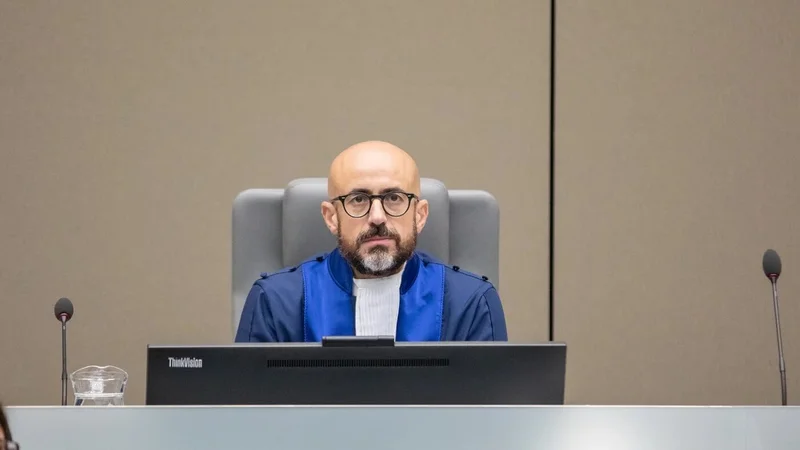
The judges on the chamber, Rosario Salvatore Aitala (presiding), Sergio Gerardo Ugalde Godinez and Haykel Ben Mahfoudh, directed prosecutors, if they still consider the legal threshold met, to open a wholly separate investigation based on the states' 2024 referral, and to notify the ICC Presidency of that referral, which the decision notes had not yet happened.
"The Referral concerns allegations of gender and political persecution through the adoption, implementation and enforcement of discriminatory decrees, policies and restrictions made possible by the Taliban's exercise of de facto governmental authority, rather than conduct allegedly committed by the Taliban as an insurgent armed group during the armed conflict," the judges said.
They cited the prosecutor's previous recognition that the conduct of the Taliban after seizing power in August 2021 was not based on armed attacks against the civilian population, but rather the imposition of "discriminatory rules and prohibitions on the population directly" and punishing those "whom they considered did not conform".
"The allegations in the Referral therefore arise in a materially different factual and institutional context, involve distinct alleged modes of commission, do not appear to be related to any armed conflict, and concern conduct occurring after the Taliban’s assumption of governmental de facto authority.
"In light of the above, the Chamber considers that the conduct identified in the Referral constitutes a sufficiently distinct subset of alleged events that, in the interests of the proper administration of justice and the orderly management of the Court's proceedings, warrants a separate investigation," they said.
Dormant investigation
The judges also flagged that the original Afghanistan investigation, the one that nominally covers alleged crimes by all parties, has now sat dormant for years, and pointed prosecutors towards a newly available procedure allowing them to formally close the situation record.
In a footnote, the chamber said: "Considering that more than three years have elapsed since the Chamber authorised the resumption of the investigation into the Situation in Afghanistan and that no proceedings are presently pending in relation to the conduct covered by that authorisation, the Chamber draws the Prosecution’s attention to the recently implemented regulation 66 ter of the Regulations of the Court, which allows the Prosecution to request the closure of a situation record when it does not anticipate any further investigatory or prosecutorial activities in relation thereto."
The office of the prosecutor has yet to make a decision on the closure of the original Afghanistan investigation or the opening of a new one.
MEE reached out to the office for comment but did not receive a response by time of publication.