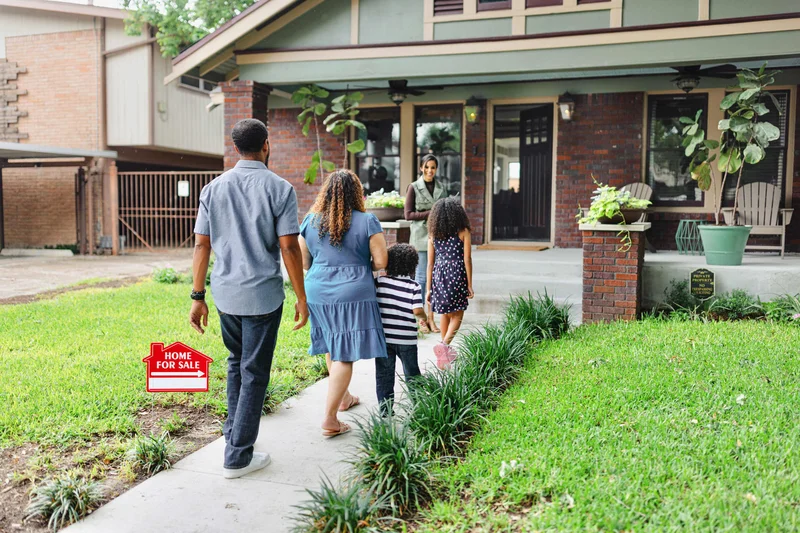
The availability of lower-priced homes for sale is increasing, but that doesn't mean buyers can afford them, new research suggests.
Sales of starter homes fell 5.4% in May compared with a year earlier, despite there being 4.5% more available, according to a report from real estate firm Zillow. The typical value of a starter home — defined as the lowest-priced third of properties — was $202,000 nationally in May, up 2.3% from the same month in 2025.
"Starter-home buyers have more choices, more price cuts and less competition … But the unfortunate reason for that advantage is that starter-home buyers are either unwilling or unable to purchase a home," said Kara Ng, a senior economist for Zillow and author of the report.
"Even with subdued rent growth, inflation is eating into other parts of household budgets, making it harder to save for a down payment," Ng said.
At the same time, sales of luxury homes — those in the top 5% of values and worth about $1.9 million nationally — were up 6.2% year over year in May, according to the report.
"The pattern mirrors a broader economic divide, with stock market gains supporting demand at the high end while rising everyday costs weigh on potential starter-home buyers," Ng wrote in the report.
In other words, the housing market mirrors a broader K-shaped economy, a term many economists use to describe the gap between higher-income households, who are experiencing stronger gains in wealth and spending, and lower-income consumers, who face financial pressures from the cost of living.
While home price growth has slowed, the median price of an existing home reached an all-time high of $440,600 in June — 49.2% higher than in June 2020 — according to the National Association of Realtors. June's median is 1.8% higher than a year earlier, a rate of growth far below the double-digit annual increases seen during the pandemic housing boom.
Higher mortgage rates also contribute to ongoing affordability problems for potential homebuyers, experts say. The average interest rate on a 30-year fixed-rate mortgage was 6.75% as of Wednesday, according to Mortgage News Daily. Rates had dipped below 6% in late February, but the onset of the Iran War and the accompanying specter of inflation pushed them higher.
"Buyers are also up against these nearly 7% mortgage rates currently, and can't afford to buy at these high rates and high prices," said Daryl Fairweather, chief economist for real estate company Redfin.
"Hypothetically, if mortgage rates were to drop to, say, 5%, that would make buying a home much more affordable," Fairweather said. "You would see instantaneously an increase in sales and more people buying and then more people selling.
"But I think it's pretty far-fetched at this point to rely on that happening," she said. "Interest rates are looking like they will be higher for longer."
The impact of an interest rate on the buyer's monthly payment can be significant. For illustration: A 6.75% rate on a $202,000 mortgage would translate into a monthly payment of $1,310 for principal and interest, according to Bankrate's mortgage calculator. At 5%, that amount would be $1,084, and at 3%, it would be $852.
Mortgage rates play less of a role for buyers in the luxury market, because they "can sell stock or liquidate assets in order to buy a home without having to even get a mortgage in the first place, or if they get a mortgage, they might not be deterred by the high interest rate," Fairweather said.
Property taxes and insurance, which are often included in a homebuyer's monthly mortgage payment, can also impact affordability, experts say. Those costs also have risen significantly since 2019, according to Cotality, a property data and analytics firm.
Meanwhile, the bipartisan 21st Century ROAD to Housing Act, which became law in July, is intended to increase the housing supply. It combines dozens of measures aimed at encouraging home construction, expanding access to financing and restricting purchases by large institutional investors.
However, it could be some time before homebuyers see benefits, experts say. As of 2025, there was a shortage of more than 4 million homes, according to Realtor.com, and many economists say it will take time to reverse that.
In the meantime, being able to afford to become a homeowner could mean giving up other economic benefits, Fairweather said.
"One of the dilemmas for young people is that they kind of have to choose: Do they want to live somewhere that has the best job opportunities … or do they want to live where home ownership will be much easier to access at a younger age, but they might not earn as much over their lifetime because of that choice," Fairweather said.