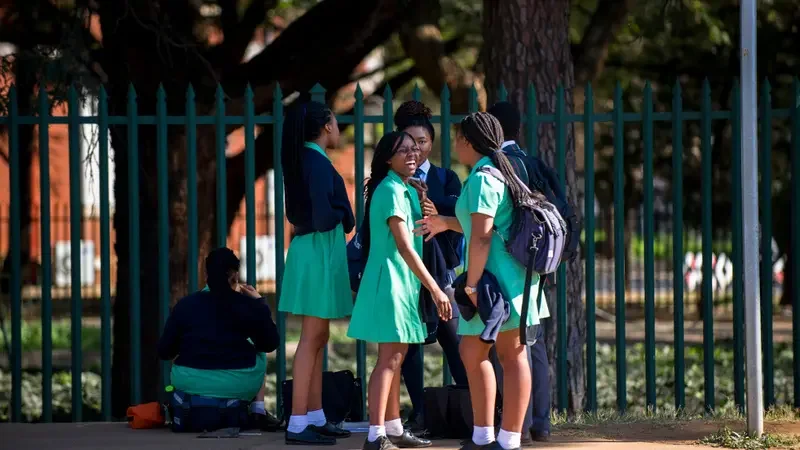
Seventy years ago, thousands of South African women marched to the Union Buildings to demand dignity and justice. Marking Women's Month is a reminder of how far South Africa has come but it also challenges us to question what freedom really looks like for a young woman growing up in South Africa today.
The signs of progress are encouraging. Girls make up most of South Africa's matric class, accounting for 56% of last year's candidates compared to 44% of boys. More young women are completing school, accessing higher education and entering careers that were once out of reach. But education alone is not equality.
For far too many girls, inequality is most visible in the healthcare they can — or cannot — access. Six out of every seven new HIV infections among adolescents in sub-Saharan Africa occur among girls, according to UNAids.
In South Africa specifically, adolescent girls and young women continue to carry a disproportionate burden of new HIV infections, with nearly 1 000 young women aged 15 to 24 acquiring HIV every week, according to the 2024 Thembisa HIV Model. The situation is now even more precarious thanks to recent US foreign aid cuts that have disrupted HIV services across the country. Shout-It-Now, the organisation I lead, is not immune but the imperative to continue our community-based services and digital health innovations to young people, especially girls and young women, is stronger now more than ever.
Young women are also more likely to experience gender-based violence. One in three South African women (about 7.3 million) has experienced physical violence in their lives while many continue to shoulder unequal caregiving responsibilities at home alongside the pressures of poverty and poor mental health, as stated in the Human Sciences Research Council's 2024 First South African National Gender-Based Violence Study.
The challenges do not exist in isolation; they overlap and reinforce one another, shaping whether a young woman can pursue opportunities and build the future she deserves.
Having just returned from the International Aids Society Conference in Rio de Janeiro that took place last month, it is clear that the global conversation is shifting. There is growing consensus that health programmes should no longer be designed around individual issues and diseases but around women and the complex realities of their lives.
Too often, I meet young women who can access HIV testing, contraception or HIV prevention pills (PrEP) through one programme but cannot afford menstrual products the following month. Others receive sexual and reproductive health information while struggling with depression, gender-based violence, economic precarity caused by unemployment or food insecurity. These are not separate problems requiring separate solutions but interconnected realities that require an integrated response.
This is why conversations about gender equality must move beyond individual interventions. Take menstrual justice for example, research suggests that around 30% of South African girls miss school during menstruation because of period poverty, inadequate sanitation or stigma. Every missed lesson is a reminder that equality is determined by circumstances many girls cannot control.
However, in South Africa, discussions often begin and end with access to menstrual products. While providing these is important, menstrual justice is about dignity and not just pads or period panties.
Girls need to feel confident enough to attend school every day and participate in sport without embarrassment. They must also have clean, safe sanitation facilities, accurate information about their bodies and trusted adults they can turn to without fear of judgement or shame.
The same principle applies to HIV prevention. We know that access to testing, PrEP, treatment, comprehensive sexuality education and youth-friendly healthcare saves lives, but the interventions are most effective when they exist alongside mental health support, economic empowerment, safe schools, supportive families and communities where young women can exercise real agency over their own lives. In other words, HIV prevention cannot succeed without gender equality.
Our work at Shout-It-Now has increasingly shifted towards integrated, youth-centred models of care that recognise the whole person rather than a single health issue. Through the various programmes, such as our the My Journey initiative in partnership with Networking HIV and Aids Community of Southern Africa, our GBV chatbot Chomi,, our government endorsed AI Companion Self-Cav and our newly launched Menstrual Justice Initiative, we are combining HIV prevention, sexual and reproductive healthcare, mental health support, menstrual health justice and education, GBV prevention and response, mentorship and safe spaces within one continuum of care.
Just as importantly, we are listening. Young women are consistently telling us that they want services that are convenient, confidential and free from judgement. They want tools and solutions to their mental health challenges. They want information they can trust and healthcare that fits into their lives instead of having to navigate fragmented systems.
This is where technology has an increasingly important role to play. Young women often seek health information online long before they visit a clinic, and so digital platforms, self-care tools and responsible AI are becoming essential components of modern healthcare.
There was lots of talk at the Aids Society Conference about how AI is emerging as a powerful tool in the HIV response. Its success will depend on whether it can move beyond pilot projects to deliver meaningful improvements in prevention, care and health systems.
All this reminds us that the true measure of equality is not the rights we enshrine in law but whether every young South African woman has the practical ability to exercise the rights every day.
Seventy years after the Women's March, freedom cannot simply mean the right to vote or the right to attend school. It must mean the freedom to access healthcare without barriers, to live free from violence, to manage menstruation with dignity, to be protected from HIV, to make informed choices about one's future and to pursue ambitions without circumstances determining your destiny. That is the unfinished work of gender equality.