Get the Popular Science daily newsletter💡
Breakthroughs, discoveries, and DIY tips sent six days a week.
By signing up, you confirm you are 16+, will receive newsletters and promotional content and agree to our Terms of Use and acknowledge the data practices in our Privacy Policy. You may unsubscribe at any time.
Broadly speaking, our solar system is simply a collection of planets, their moons, and other cosmic objects like asteroids existing in gravitational orbits around the sun. There are countless systems out there like it, too. But one stellar system about 72 light-years from Earth isn’t quite like anything else researchers have ever seen. In fact, astronomer Kevin Hoy would go so far as to describe CD-35 2722 as “super weird” compared to our corner of the galaxy.
“The system is somewhat hard to define using solar system-based words like ‘planet’ and ‘moon,’” the astronomer from Chile’s Universidad Diego Portales and the Millennium Nucleus of Young Exoplanets and their Moons (YEMS) recently said in a statement.
The system is detailed in a study co-authored by Hoy and recently published in the journal Nature.
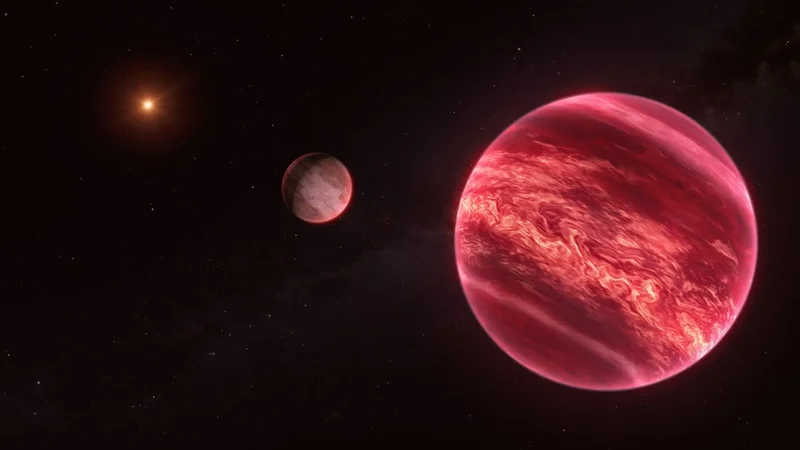
Hoy and colleagues recently aimed the European Southern Observatory’s Very Large Telescope (ESO’s VLT) at the young oddball system CD-35 2722 that centers on a star about half the mass as the sun. Orbiting this star is a brown dwarf, which is a type of gas giant that is larger than a planet, yet smaller than a star. In this case, the brown dwarf is about 30 times more massive than Jupiter—but it’s not alone. Orbiting that object is yet another entity with a mass equivalent to Jupiter itself.
“The exosatellite is clearly massive enough to be a planet, but it does not orbit a star, though it orbits an object that orbits a star,” said Hoy.
New ‘exomoon’ detection challenges cosmic labels
VIDEO
So is it a moon, or not?
“We have a clear delineation between the planets and the sun in the solar system, so defining things like moons is simple,” added YEMS director and study-coauthor Alice Zurlo. “In the CD-35 2722 system, where we are blurring the lines between stars, planets, and moons, the whole thing becomes more complicated to describe.”
According to their study, Hoy, Zurlo, and their team suspect their mystery may be an exosatellite or exomoon. These are naturally occurring planetary satellites located outside the solar system. Although researchers have documented over 6,000 exoplanets throughout the cosmos, the handful of exomoon candidates still lack enough evidence to prove their identities. If true, it would be the first of its kind ever confirmed by astronomers. For now, more observations are needed before astronomers can definitively classify the strange entity—but it’s also a matter of scientific semantics.
“Being the third wheel in this system makes us want to call it a moon, even if it is nothing like the small, rocky moons we have in our system.”
Regardless, the latest exomoon suspect marks a major moment in exploring the universe.
“As exotic as it is, this system is truly unique and represents a breakthrough: the first plausible detection of an exosatellite,” said Zurlo.
2025 PopSci Best of What’s New
The 50 most important innovations of the year