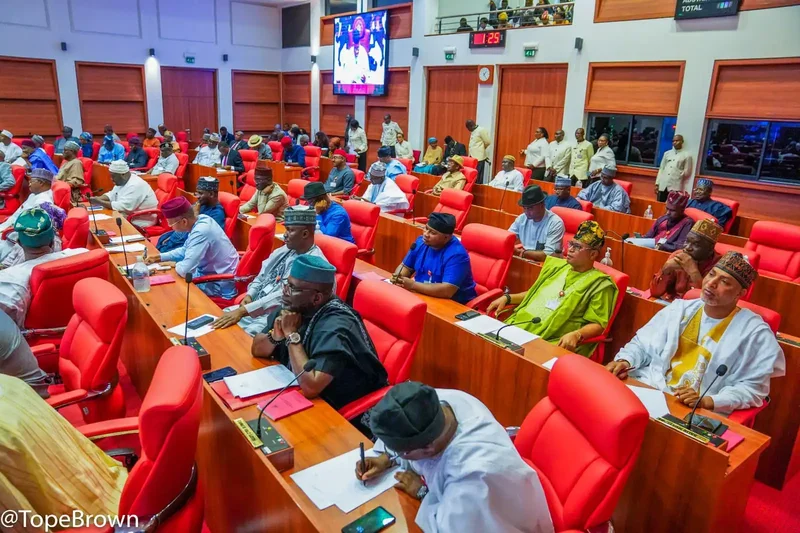
The Senate on Wednesday adopted a report by its Committee on Legislative Compliance detailing the implementation of resolutions arising from motions passed between July 2023 and December 2025.
The report, presented during plenary by the committee’s chairman, Garba Maidoki, assessed the impact of Senate resolutions and the level of compliance by ministries, departments and agencies (MDAs), particularly on issues relating to road rehabilitation, disaster management and other matters directly affecting Nigerians.
Mr Maidoki, who represents Kebbi South Senatorial District, said the committee tracked the implementation of the resolutions by the relevant agencies and found that many were either delayed or ignored.
He said that despite the committee’s efforts to ensure compliance, many MDAs repeatedly failed to respond, a situation he described as a disregard for the authority of both the committee and the Senate.
“Implementation of Senate resolutions is often delayed and sometimes ignored. The executive retains the final authority to issue directives for the implementation of Senate’s resolutions. Many MDAs ignore the committee’s requests for compliance information, thereby disregarding the powers of the Committee and the Senate in general.
“Some MDAs failed to implement the resolution of the Senate especially in cases of road rehabilitation and disaster management due to non-inclusion of funds in the budget for projects execution,” the committee chairman said.
Section 4 of the Nigerian Constitution empowers the two chambers of the National Assembly, the Senate and the House of Representatives, to make laws for the country’s peace, order, and good governance.
The core responsibilities of lawmakers include legislating through bills and motions, overseeing government agencies, screening and confirming presidential appointments, ratifying treaties, and addressing petitions from citizens and organisations.
Lawmakers also sponsor motions seeking legislative intervention on issues affecting their constituencies, including security, health, education and infrastructure. Such motions often contain resolutions directing the federal government or relevant MDAs to take specific actions. However, unlike bills, motions do not have the force of law.
During its investigation, the committee found that many of these resolutions were never implemented.
Unimplemented resolutions
One of the resolutions yet to be implemented is one directing the federal government to compensate the family of two-year-old Eromonsele Omhonria, who was killed by a stray bullet during a National Drug Law Enforcement Agency (NDLEA) operation in Asaba, Delta State.
The incident occurred on 13 July 2023 during an NDLEA raid in Okpanam, Oshimili North Local Government Area.
After the incident, the senator representing Delta North Senatorial District, Ned Nwoko, submitted a petition on behalf of the bereaved family in July 2023. The petition, signed by lawyer Matthew Edaghese on behalf of the boy’s father, Fidelis Omhonria, was later forwarded to the Senate Committee on Ethics, Privileges, and Public Petitions for investigation.
The committee, chaired by Neda Imasuen, recommended that the federal government, with presidential approval, compensate the family with N200 million and that the NDLEA should assume full financial responsibility for Eromonsele’s medical treatment, preferably abroad, to restore his sight.
The Senate adopted the recommendations, with Senate President Godswill Akpabio urging President Bola Tinubu to approve the compensation promptly as a demonstration of the government’s commitment to justice and accountability.
However, the Legislative Compliance Committee said the resolution has yet to be implemented.
“The National Drug Law Enforcement Agency (NDLEA) is yet to address the medical treatment of the child (Eromonsele Omhonria) shot in the eye by the Agency’s officer, due to its inability to access funds from the confiscated and forfeited properties account to facilitate the child’s treatment abroad,” he said.
The committee also referenced the failure of the Nigerian Railway Corporation (NRC) to comply with the Senate’s directive to reinstate its former employee, Paddy Ukpe.
“Agencies concerned with reinstatement of disengaged staff are not willing to comply with the Senate’s resolutions. A typical example is the lingering issue of the Nigerian Railway Corporation’s failure to reinstate its former staff, Engr Paddy Ukpe, despite the committee’s several interventions,” he added.
Mr Maidoki also observed that some lawmakers sponsor motions without thoroughly investigating the issues involved.
“Some agencies directed to implement senate’s resolutions lack the requisite statutory to do so. Sponsors of motions often did not investigate matters fully before seeking legislative action, and multiple prayers and motions relating to action to be taken by a single agency affect effective implementation of the resolutions adopted therefrom,” he said.
Recommendations
The committee recommended that the Senate impose budgetary or other sanctions on MDAs that fail to respond to or implement its resolutions.
The affected agencies include the Federal Ministries of Works, Health, Power, Petroleum Resources, Humanitarian Affairs and Poverty Reduction, Information, Environment and Solid Minerals Development, as well as the State Security Services (SSS) and the Nigeria Centre for Disease Control (NCDC).
Others are the Federal Inland Revenue Service (FIRS), Federal Roads Maintenance Agency (FERMA), Ecological Fund Office, Nigerian Railway Corporation, NDLEA, Federal Civil Service Commission and the Office of the Head of the Civil Service of the Federation.
After the presentation, the senate president commended Mr Maidoki for the comprehensive report and urged senators to study its findings carefully.
He subsequently put the report to a voice vote, and the majority of the senators supported it.