Principal Secretary (Municipal Administration & Urban Development) S. Suresh Kumar unveiled the government’s ‘green urban development agenda’ that comprises a financial incentive framework for sustainable buildings, Artificial Intelligence (AI)-enabled planning approvals, simplification of a slew of regulations and performance-based green certification.
It is aimed at building environmentally responsible and globally competitive cities under the Swarna Andhra- 2047 vision.
Foremost among those reforms is the offering of development charge discounts of 5% for silver-rated buildings and 10% and 15% for gold and platinum-rated buildings respectively, irrespective of their types of use (commercial, residential etc.), he says.
Participating as chief guest in the Green Andhra Summit-2026 organised by the Indian Green Building Council (IGBC) here on Friday, Mr. Suresh Kumar said a memo had already been issued by the government and the benefits would be available to eligible green buildings rated under recognised systems, including that of the IGBC, LEED India, TERI-GRIHA, and EDGE.
These concessions were in addition to the green-building incentives already being given under Rule No. 145 of the AP Building Rules, 2017, subject to fulfilment of the prescribed eligibility criteria.
This reform builds on the earlier government policy under which upcoming multi-storeyed green buildings were provided impact fee concessions of 10%, 15% and 20% for silver, gold and platinum ratings, besides corresponding incentives in the AP Real Estate Regulatory Authority’s project-registration fees.
Mr. Suresh Kumar pointed out that while allowing the development charge concessions at the building-permission stage on the basis of valid pre-green building certifications, the MA&UD Department mandated the certificates before the issue of the occupancy certificates, and provided for stringent recovery along with a penalty of 5% of the discount amounts in cases of non-compliance.
Green development should no longer be confined to premium commercial buildings or high-end residential projects, instead it should extend to ordinary houses, schools, hospitals, government buildings, industrial facilities, transit infrastructure, commercial establishments and townships, he added.
Sustainable capital city
AP CRDA Commissioner V. Vijaya Rama Raju said Amaravati was a representative of one of the most exciting opportunities to build a truly sustainable capital city from scratch as, through integrated planning, net zero buildings, renewable energy, smart infra, and resilient urban design, a futuristic city was being built. He also called upon the IGBC to come up with recommendations on white roofing solutions for the People’s Capital.
IGBC National Chairman C. Shekar Reddy said currently 17 States were giving incentives for IGBC-certified green buildings, which amplified the green building movement through 20,012 IGBC-registered projects accounting for over 16.33 billion square feet of registered green building footprint. This enabled India to achieve the world’s second largest green building footprint.
More than 40 new projects in Andhra Pradesh covering over one-crore sq. ft of built-up area were registered during the event, he stated.
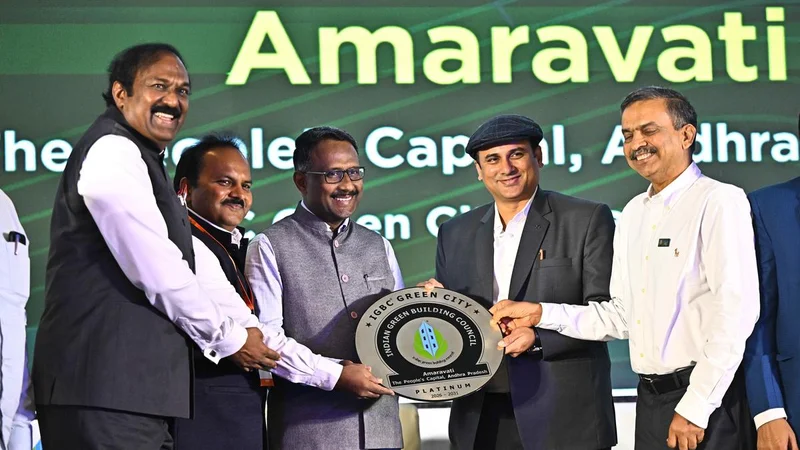
Later, the IGBC awarded Green Cities Platinum Certification (by design) to Amaravati for 2026-31, IGBC Net Zero Energy Rating (by Design) to APCPDCL’s corporate office building Vidyut Nilayam in Vijayawada, IGBC Green Existing Building Gold Rating to Best Western Plus Tejvivaan in Visakhapatnam, and IGBC Green Factory Building Platinum Rating to Sarda Metals & Alloys Ltd.
CII Vijayawada Zone Vice-Chairman Dasari Anvesh, IGBC Amaravati Chapter Chairman Vijaya Sai Meka and Co-Chairman Kiran Paruchuri were among those present in the inaugural session.
Published - August 07, 2026 09:02 pm IST