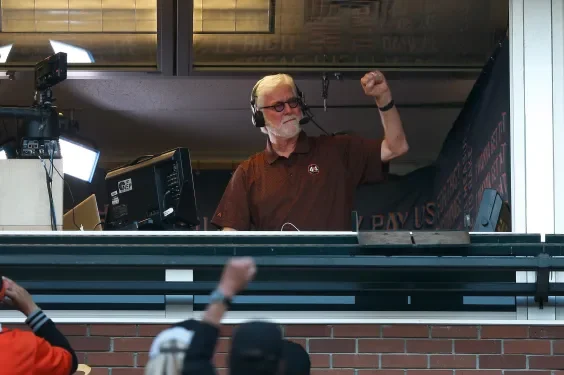
The San Francisco Giants don't get to announce anything fun these days, but it would be too cheap even by the prevailing clearance-sale standards to lump the latest bit of ill news relating to the team in with all the others, so we won't. Mike Krukow, the former Giants pitcher, longtime radio analyst, and general Pez dispenser of joy at the ballpark, is retiring at the end of the year. While that unquestionably sucks, it sucks in the best kind of way, because Krukow did the best job he could and for as long as he could do it. Because his best was exemplary, he goes out honestly and without any regret that he could have somehow been better; it sucks for everyone else, but not for him.
Krukow is 74, and has been working for the past 15-plus years with the degenerative muscle condition inclusion-body myositis, which has neutralized his ability to get from place to place. He has done all the games from his home in Reno over the past several years to minimize as best as can be managed the strain of the disease, but his ability to extract good feelings from the ballpark in good times, bad times, and these particular times has remained top-shelf work despite his distance from the games themselves. His longtime partner and friend, Duane Kuiper—36 years on the job, and now we're counting—had his own health scare last winter but remains on the mic, at least for the moment. As he explained to The Athletic's Andrew Baggarly, in his standard disarming way, "Maybe I’m happy he’s leaving. Did you ever think of that? It’s like the A’s and Giants with the A’s leaving. Now I’ve got the whole town to myself!"
The natural response to that is "Too soon, you hyena." But because Krukow would have cheerily signed off on the bit, so must we all. You learned, if you ever heard the two do a game together, that they played off each other with the ease that only comes from two people who could spend six months together over the course of three-and-a-half decades without finding reasons to strangle each other. Few ballplayers could do it for even 10, and ex-ballplayers are virtually never asked to do so; Kuiper and Krukow played together on the Giants for three years, beginning in 1983, and talked to each other in public for decades. The pair did it so masterfully because they somehow made kismet their personal fidget spinners, with a synchronous hum that defined their work and their town. One could barely tell that Krukow was three-and-a-half hours away from Kuiper or their other partners, Jon Miller and Dave Flemming.
Krukow in particular always wanted to break the game down to its simplest yet most compelling elements to anyone curious or inert enough to want to know. One writer, literally days into his new role as one of the team's beat writers in 1987, was walking through the clubhouse at the team's spring training headquarters in Scottsdale when Krukow, who had introduced himself the day before, walked over and said, "Come with me." Krukow led this writer onto the field and down the left field line toward one of the batting cages, one with a pitching machine. "Grab a bat and a helmet," he said without menace, and when the writer, then as now a coward with both a well-developed sense of danger and a rudimentary understanding of forensics, demurred, Krukow said, "Don't worry. I wouldn't kill you in February. Just get a bat and a helmet and get in the box." He then set up the pitching machine and shot three pitches toward the writer's strike zone, each more a blurry suggestion that a discernible baseball. "That was 85 miles an hour," he said at the end of presentation, "and almost everyone throws harder than that. Just remember that the first time you want to write that someone can't play."
The lesson was basic but telling. One could write, "Such-and-who made a terrible play," or "High-salaried guy is in a weeklong slump and here's the statistical proof," but it was not fair to write that a struggling player couldn't play. "Just so you know a little bit about how hard this shit is to do," Krukow said that afternoon in Scottsdale, looking as professorial in an undershirt, uniform pants, and shower shoes as anyone could manage. It is as useful a teaching tool today as it was then, only nobody uses it anymore. More's the pity in every sport.
Kuiper and Krukow spoke a language based on small little wisdoms like the above that brought the field and the clubhouse to audiences both in the park and in their cars, slangifying the day-to-day with a dry rub of their own making that somehow managed to escape becoming an in-joke in the pejorative or exclusionary sense. In short, the two played and produced a spoken album every day, and cut more than 5,500 of them in all. Even their worst performances were still better than nearly anyone else's. Two people who really and truly like each other having a good time talking about a baseball game sounds like an easy thing to replicate, but if it were that easy, there would be two other people as good at it as Kuiper and Krukow. As it happens, there aren't. At least for another 47 games.
Though the timing of Krukow's departure is entirely his, it almost seems serendipitous given the parlous state of baseball on the radio in general and especially the likelihood of an owners' lockout in 2027. He and Kuiper worked through the stoppage of 1994-95, but that was before they had fully hit their stride as partners. They had also done their share of forlorn seasons before then as players in Cleveland and Chicago before making it to San Francisco, where they worked nearly a decade at Candlestick Park, the place you think of when someone says the word "forlorn." They embraced all of it, and thinking of one without the other seems as nonsensical a day after Krukow's announcement as it would have 10, 20, or 30 years ago.
There has been a forceful but so far unsuccessful grassroots movement to see them get awarded the Ford C. Frick Award in tandem. The Frick is the Hall of Fame equivalent for the subphylum "baseball broadcaster," but it has only gone to one person per year for the entirety of its existence, with the single exception of the first year, 1978, when Mel Allen and Red Barber won it together. Picking Krukow over Kuiper or vice versa seems inherently to miss the point, both of the idea of a broadcasting award and also of what made them so inherently brilliant—that just wasn't how they worked, and that was made them great.
Not that baseball is incapable of missing the point on a nearly daily basis in an almost unlimited number of categories, but now that the end of their partnership is in sight, the necessity to break with such an absurd tradition seems both clear and obvious. They would surely see the preposterous hilarity in it, but each would also be as disappointed as delighted that such an accommodation could not be made, and not just for Kuiper and Krukow. They were both the exact opposite of soloists, and should not be treated as such. Baseball doesn't always find the logic in what seems irrefutably true, and is just as likely to fight it as it is to yield to that reality. The smart thing, the only thing, to do is to take what you get, try to be glad about it, and find the laugh where it reveals itself. Mike Krukow would have it no other way.