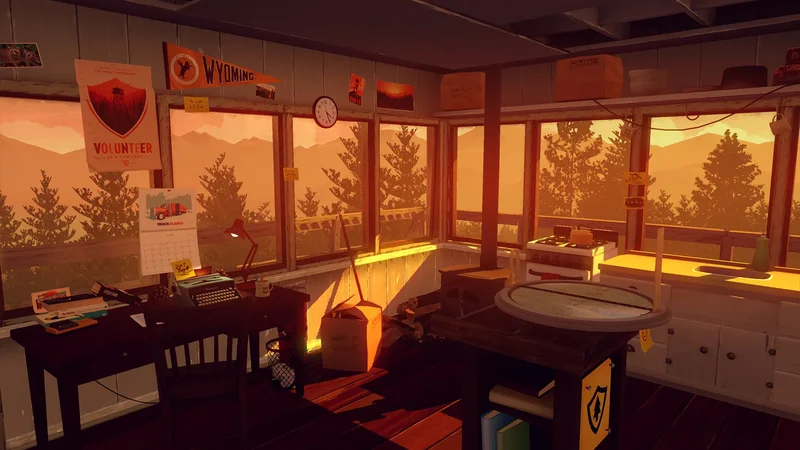
You don’t need to spend 50 hours with a video game in order for it to earn a permanent place in your heart. Sometimes, all you need is a few hours. That’s the case for Firewatch, a 2016 adventure game developed by indie studio Campo Santo. It was nominated for five Game Awards and one of Polygon’s favorite games of that year. It’s currently available on Xbox Game Pass, but not for much longer. It only takes four to six hours to experience in full, and it’s absolutely worth checking out — or revisiting — before it leaves Microsoft’s subscription service on Aug. 15.
Firewatch tells the story of a man named Henry, who works in Wyoming’s Shoshone National Forest in 1989, just one year after a devastating fire. His wife is seriously ill, she’s not going to get better, and there’s nothing he can do about it. Henry lives in an idyllic wooden watch tower that hovers above a vast and verdant sea of trees, keeping an eye out for smoke during the hot summer months. It’s the stuff off-the-grid fantasies are made of — except for, y’know, the whole grievously ill wife part.
Henry may have come to the forest seeking space and isolation, but instead he finds companionship. He takes assignments via radio from his supervisor, a woman named Delilah. His tasks consist of stuff like repairing a broken bridge, reports of misbehaving teens, and fixing faulty power lines. Turns out, Delilah is also seeking to wall herself off from the world. That shared understanding between the two forms the emotional core of the story, thanks to incredible performances from Rich Sommer (aka Mad Men’s Harry Crane) as Henry and Cissy Jones (Baldur’s Gate 3) as Delilah.
In a 2016 interview with Polygon about his role in Firewatch, Sommer observed that the desire to get away from it all and unplug from the world was a timeless one, as relevant to the late ‘80s as it was to 2016 — and today.
“I've said to my wife before, 'I never want to be on Twitter again,'" he said. "Sometimes, people feel very free to comment on my performance in things, my weight or my low level of attractiveness. I think that that's — people feel very free to do that behind the sort of anonymity of the internet, and that's not super fun for people who have a public presence. I use it sparingly. I chiefly am on Twitter to talk about board games. That makes life a little bit simpler. I try to take the bad in stride and the good as well and try to just stay afloat."
2016 was an incredible year for independent video games — in addition to Firewatch, this year also saw the debut of Stardew Valley, Hyper Light Drifter, and Oxenfree. And, even a decade later, Firewatch endures. It’s still worth playing today not because it’s yet another indie-game meditation on grief, but because it’s almost a form of interactive self-care. It’s a case study in how to settle into a new version of yourself that you never imagined being. It’s a fortifying, never cloying reminder that when you’re going through hell, usually the best and only solution is just to keep going.