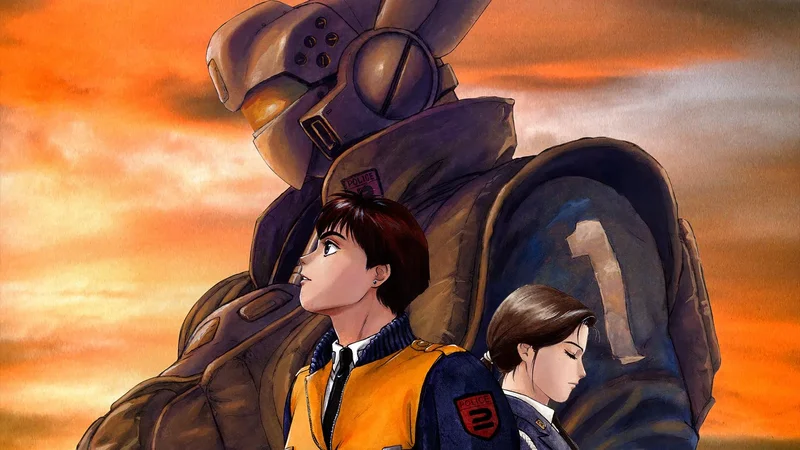
Mecha anime comes in many flavors. A grounded franchise like Mobile Suit Gundam explores the repercussions of bringing mass-produced military hardware to a civilization ravaged by war, while a coming-of-age story like Tengen Toppa Gurren Lagann takes a more stylized, over-the-top approach to a shonen adventure. Some, like Macross, blend the spectacle of fighter-jet mechs with the power of pop music, while others, like Neon Genesis Evangelion, filter the adolescent experience through a deeply abstract and existential gaze.
Then there is Mobile Police Patlabor, Masami Yūki’s iconic mecha franchise, which has spawned a beloved anime, two OVAs, three memorable films, and a dedicated line of merchandise (among other things) over the years. The franchise is currently having a resurgence, thanks to the Patlabor EZY trilogy, whose first installment — titled Patlabor EZY: File 1 — hit Japanese theaters on May 15.
While this new era of Patlabor brings fresh stories to the fore, the pinnacle of the franchise can be traced back to Mamoru Oshii’s Patlabor 2: The Movie, which released in theaters on Aug. 7, 1993. The film is largely unavailable to stream or rent on mainstream platforms, making it a coveted title that is only legally accessible via physical Blu-ray copies.
The events of Patlabor 2 are a direct follow-up to the Oshii-helmed Patlabor: The Movie (1989). The first film is set in 1999, during which Tokyo is undergoing a major redevelopment program. Its operational center is a massive man-made island called the Ark. Mecha units aren’t only used for combat in this world, since some aid in heavy construction work and are referred to as Labors.
Once thousands of Labors activate due to defective software in the midst of a fast-approaching typhoon, officers of Special Vehicles Section 2 race against time to avert a city-wide catastrophe. Among them are Noa Izumi and Asuma Shinohara, members of the Tokyo Metropolitan Police Department who use their patrol mechs, or Patlabors, to help save the day.
Patlabor 2 opens in 2002, an era of sociopolitical instability due to the sudden military takeover of Tokyo. Protests erupt across the city, and some factions, like the Japan Air Self-Defense Force, are blamed after the Yokohama Bay Bridge gets destroyed by a missile. Chaos erupts soon after, prompting Section 2 members Kiichi Goto and Shinobu Nagumo to assemble a squad to take down the terrorist threats before it is too late.
Mecha anime routinely grapple with political themes to ground their fantastical core in everyday reality. Gundam has extensively explored the price of cyclical conflict and how it manifests as senseless atrocities that feel brutal and devastating. Code Geass: Lelouch of the Rebellion examines the cruelties of a tyrannical empire and highlights how the seeds of revolution can be planted by the unlikeliest of candidates.
Patlabor 2 uses the franchise’s established framework to expose the illusory nature of peace in a nation that is constantly fighting proxy wars and nudging its populace towards global conflict. Instead of focusing on the mighty Patlabors, the film is preoccupied with bureaucratic corruption and the tense friction between the police and the military. Japan’s post-war anxiety gets dissected with great nuance, as Oshii criticizes the Cold War-like “pseudo-peace” that willfully ignores the violence that erupts in other nations.
Oshii, who brought the distinct aesthetics of Ghost in the Shell (1995) and Angel’s Egg (1985) to life, delivers Patlabor 2 with a similarly dreamlike quality. The film uses a moody, muted color palette to convey the moral rot at the center of Tokyo, creating a sense of artifice and alienation even as we pan over dense cityscapes and intricate backdrops. It still delivers some flashy spectacle with plenty of mecha action, but the film shines whenever it lingers on oppressive command-room environments and the stillness that comes with turning a blind eye to corruption.
Mobile Police Patlabor has come a long way since Oshii’s staunchly political and prescient story about state surveillance and security. Take Patlabor EZY: File 1, set in the 2030s when AI automation has rendered Labors and Patlabors obsolete. The Special Vehicles Section 2 unit still exists, tasked with protecting the city in an age when technology is a double-edged sword.
No missiles fly this time around, since technological warfare has evolved into a much more subtle tool that devalues human labor and causes widespread sociopolitical instability. State surveillance doesn’t feel as overt and oppressive as before, since it is inconspicuously woven into every part of everyday life. While peace is still a questionable sentiment, the anxieties of a post-AI world feel different than one where automation solely meant improved efficiency.
Even without the latest installments to recontextualize its complex themes, Patlabor 2: The Movie continues to be a timeless addition to the franchise lineup. It is a visually stunning piece of art that has something meaningful to say about technology reducing the devastation of war into an impersonalized statistic, like that of a death count on a digital screen.