Colombia’s Amazon Mining Ban Lands Three Days Before a Pro-Drilling President
Colombia · Environment
Key Facts
- The instrument.Resolution 0961 of 2026, signed by the Environment Ministry on 4 August, published 5 August — three days before the new government took office.
- The area.483,283.55 km², about 42 percent of Colombia’s continental territory, across 61 municipalities in ten departments.
- What stops.No new mining concessions and no new oil or gas contracts anywhere in the Amazon biome.
- What continues.Existing titles run to the end of their contracts — but cannot be extended.
- The weak spot.It is a ministerial resolution, the easiest instrument to undo, and the incoming environment minister says it will stay “on paper”.
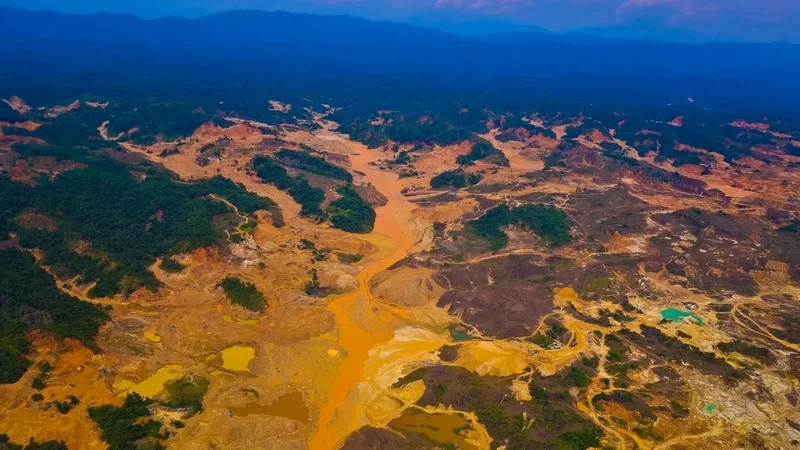
Colombia’s Amazon mining ban closes an area roughly the size of Spain to new extraction, signed by an outgoing government days before a president who campaigned on drilling takes office.
The Colombia Amazon mining ban arrived with three days to spare. On 4 August the Environment Ministry signed Resolution 0961 of 2026, declaring the entire Colombian Amazon a permanent reserve closed to new mining concessions and new oil contracts. It was published the next day. This afternoon, Abelardo De La Espriella — who campaigned on reopening exploration — takes the presidential sash in Cali.
What the Colombia Amazon mining ban covers
The resolution delimits 483,283.55 square kilometres — about 48.3 million hectares. The ministry calls it roughly 42 percent of Colombia’s continental territory. Read that carefully: it is 42 percent of the country, not of the Amazon.
Sixty-one municipalities in ten departments fall inside. All of Caquetá, Putumayo, Amazonas, Guainía, Guaviare and Vaupés, plus parts of Meta, Vichada, Cauca and Nariño.
No new mining authorisations, no new hydrocarbon contracts — with narrow carve-outs for formalisation files already in the pipeline, and for hydrocarbon areas already in exploration, which may proceed to production. Companies holding a valid title with the required environmental permits can operate to the end of their contract — but there is no extension. That is the part that bites. It does not stop current production; it shortens the life of everything already there. Indigenous rights and the national parks regime are untouched.
How fragile is it
Very. A ministerial resolution is the easiest of Colombia’s legal instruments to undo. El Espectador reports the new government could modify or repeal it through a fresh administrative act. María Aponte of Holland & Knight says mechanisms such as direct revocation could be examined, subject to the requirements and limits the legal order sets.
The incoming environment minister, Fabio Arjona, is blunt about his view. “Regulating is not governing,” he told El Espectador, arguing that sweeping mining exclusions mostly encourage illegality. He expects the declaration to stay on paper.
There is one procedural counterweight. When the ministry first announced this at COP30 in Belém in November 2025, the Interior Ministry ruled it needed prior consultation with 566 ethnic communities. That ran through June and July and was protocolised on 19 and 20 July. Whether repeal triggers the same prior-consultation requirement is unresolved, and it is the question that decides everything.
Not everyone in the green camp is cheering
Margarita Flórez of the Asociación Ambiente y Sociedad calls the measure easily dismantled and notes that illegal gold mining and mercury do far more damage than licensed operators. Alejandra Laina of WRI Colombia makes the same point: the resolution restricts legal activity while the forest is eaten by what was never legal. It is a real legal act with real consequences for permit holders, and it may do very little for the trees.
What it means if you live in or invest in Colombia
If you have upstream exposure, the production hit is small — Colombia’s oil comes from the Llanos and Magdalena Medio, not Amazonas. The sting is the renewal ban: any Amazon title now runs to expiry and stops, which changes reserve-life assumptions today, before any court rules.
The wider signal matters more. A ministry closed 42 percent of a country by resolution 72 hours before a handover, and the successor has promised to revive exploration nationally — though his environment team says not in the Amazon. In Colombia, whether a permit survives now depends on who is in office rather than on what the law says.
For residency, property and visas, nothing changes. This is a story for the extractive, carbon and conservation sectors — and for anyone running conservation or tourism projects in Leticia, Putumayo or Guaviare, where the resolution is a legal hook that did not exist last week. Colombia is now the first Amazon country to close its whole share of the biome, while Brazil went the other way and began drilling at the Morpho well in October 2025. This is general information, not legal or investment advice.
Frequently Asked Questions
What does Colombia’s Amazon mining ban cover?
Resolution 0961 of 2026 closes 483,283.55 square kilometres, across 61 municipalities in ten departments, to new mining concessions and new oil and gas contracts.
Do existing mines and wells have to stop?
No. Holders of valid titles with the required environmental permits can operate to the end of their contracts. What they cannot do is extend them.
Can the new government reverse it?
Possibly. It is a ministerial resolution, the weakest of Colombia’s legal instruments. Whether repeal would require repeating the prior-consultation process is unresolved.
Does this affect my visa, residency or property?
No. It is an environmental and permitting measure with no bearing on immigration status or property rights.
Is 42 percent the share of the Amazon protected?
No. It is roughly 42 percent of Colombia’s continental territory.
Sources: Colombia’s Ministry of Environment and Sustainable Development (Resolution 0961 of 2026); Diario Oficial; El Espectador; El Tiempo.
This article was produced by The Rio Times’ automated newsroom system. How we use AI · Report an error