The way forward for Wellington councils remains unclear, despite agreeing to submit amalgamation proposals to ministers this weekend.
Despite hours of productive discussions on Friday, a consensus across all parties could not be reached.
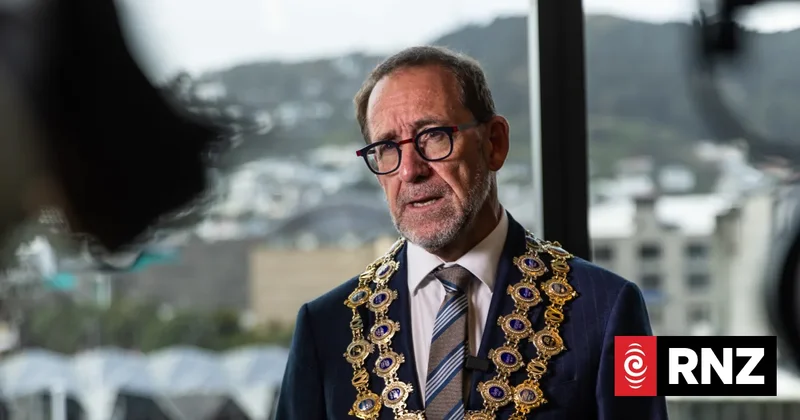
Wellington Mayor Andrew Little said it was too early to know what changes would look like but he expressed optimism.
"I'm confident with the discussion that we've had today there is a lot of goodwill between the councils in the Wellington and Wairarapa region, and depending on what the government decides, regardless of whether it's one or two proposals they agree to, we've got a good chance of putting something good together for the region," he said.
He said there would be a number of benefits to amalgamation in the long run - inlcuding a stronger voice for the region, standardised processes and more cohesive economic and social strategies.
He said past amalgamation had not caused places to lose their distinctive characteristics.
"People's connection to their place, people's connection to land isn't dependent on who's administering their rights and who's issuing their dog licence and those sorts of things.
"It's about what happens in those areas, and that comes from communities."
But he said it might take time for benefits to become evident, "but it shouldn't stop us trying".
He said balanced economic management was already happening through the Greater Wellington Regional Council, to everyone's benefit.
But the details around amalgamation had not been laid out: the next step is ministers deciding which proposals to take forward.
"Obviously, if we do get approval from ministers to proceed with whatever change happens, then council is going to have to communicate well and effectively to their communities. But in practice, nothing changes before 2028.
"Until the detailed work is done and again until ministers approve the detailed work, which will be the next phase, we won't know what things look like."
And the fight is not over for Kāpiti Coast District Council, whose proposal to become a singular authority was shot down by the other councils on Friday.
Mayor Janet Holborow said Kāpiti is looking to form a unitary authority under current legislation as the Head Start programme for reforming local governments had not been passed into law yet.
"We'll be talking to our local MP, to ministers, to MPs from the opposition, just to make our position very clear because we've done the analysis and we've done the work and we know that Kāpiti is in a strong position to form a unitary authority."
She said as a unitary authority, Kāpiti could run its own services and set its own rates, "so that we're not subsumed into the problems of Wellington or any other council".
She told RNZ the council was also exploring possible mergers with Horowhenua and Palmerston North.
"We simply haven't had time to do that in this rushed process."
Holborow said if a structure were imposed on the council, "then we'll always just be putting our best foot forward on behalf of our community".
She said only 18 percent of residents in Kapiti were in favour of merging with the rest of Wellington.
But its views were acknowledged in the proposals put forward.
"It's obviously tough to include everyone's different views, but we've done the best we can collectively to make sure that everyone's views are incorporated, including ours, which was not to support the proposal," said Mayor Peri Zee.
She said she hoped the inclusion of Upper Hutt's opposition would let the council have an out from mergers later as discussions progressed.
"For Upper Hutt, the costs and benefits are quite different than other places: we have low rates already, quite an efficient council, and we wanted to protect our local democracy.
"So we heard that loud and clear that those were the key concerns for our community, and this proposal doesn't meet those concerns largely."
She said the council would fight a merger one step at a time as there was still much uncertainty over the reforms.
"I think there's certainly concerns with local government and even widely acknowledged concerns with local government, particularly around funding and financing. I don't know that this solves that problem."
Wellington City Councillor Diane Calvert said she was surprised to see the council endorse a region-wide propposal.
"On Thursday, Wellington City Council voted that our preference was that there should be two unitary authorities within the Wellington region, one for the Wairarapa and one for the metropolitan area, whoever was in that area, but primarily Wellington City, Porirua, Lower Hutt and Upper Hutt."
She said Wairarapa and the metropolitan Wellington area had different needs and ressources.
"And we're quite different. We're totally different catchment areas. We are divided by, geographic divide - not just a line on the map from one street to the next. So, there is quite a distinct difference," she said.
She said there needed to be more consideration over funding models and how councils would best benefit from amalgamation.