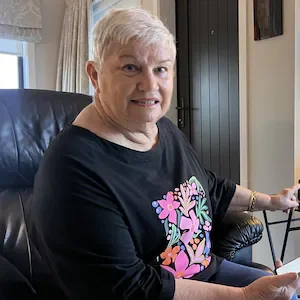
If the power goes out for too long, Margaret laughs – she would be “lost”.
The next thing on her list to upgrade is her vacuum cleaner, to a robot.
“A good thing about AI and technology in general is that as you’re getting older and things are harder to do, you can get AI to help you do it,” she said.
Margaret said using AI also made her life “fun”.
Recently, she used an AI music app called Suno to create a song for her granddaughter’s 21st birthday.
She fed the app details and words she wanted included, chose a genre and voice and let the programme turn it into verses and a chorus.
The song was a surprise gift.
“There were a lot of tears,” Margaret said.
She also uses AI for quizzes, to settle family arguments over facts and to explore new ideas.
On a trip to Japan last year, she used a travel app called Find Penguins, which let her family follow where she was each day and later turned her travel diary and photos into a printed book.
“You tap your diary in each night, put photos in and at the end of your trip, a book is produced without too much effort,” she said.
The travel app and AI music app were some of the digital tricks Margaret shared with this 36-year-old reporter, who surprised her 65-year-old mother in Brazil with a custom-made birthday song.
The lesson here? Never assume who’s teaching who.
And Margaret is far from the only older Hawke’s Bay resident embracing new technology.
She was among 43 people, aged 60 to 92, who attended Love Heart Social Learning’s first Hawke’s Bay AI workshop in June, led by educator and Love Heart Social Learning co-founder Frances Valintine, who said learning it helped give seniors the confidence to feel connected to the world.
She said older people were often underestimated.
“I think other people make them feel left behind,” Frances said.
“Too many people put them in a box, saying they are of a certain age. My experience is that a lot of them are all over AI.”
Frances said AI could help older people research holidays, create personalised cards, understand basic health information before seeing a doctor, or stay mentally engaged.
But she also warned about the risks, saying AI “doesn’t have a scamming ability as it’s just generating a probability response”.
But “people are using AI to do a deepfake, to pretend to be someone and all that ... every interaction we have online with someone we don’t know should be assumed is a scammer”.
Love Heart co-founder and managing director Fee Webby said the programme was designed for people aged over 60 who were still curious and wanted both learning and connection.
“We need to make sure that we keep people cognitively engaged and we know the importance of ongoing learning for the brain to keep them stimulated,” she said.
“But also, more importantly, is that face-to-face connection.”
For Margaret, technology does not replace people.
“I still think there needs to be human interaction,” she said.
She is not interested in a future where robots replace nurses or carers entirely, although she can see the benefit of technology helping with physical tasks as people age.
For now, AI is simply a companion in her day.
And when she is ready to sleep, Margaret doesn’t reach for a switch.
She simply calls out and the system turns off the TV and lights.
“Alexa, good night.”
Rafaella Melo has more than 10 years of experience as a journalist in Brazil. She has worn many hats, from radio and TV presenter and producer to magazine editor before joining the Hawke’s Bay Today team as a multimedia journalist.