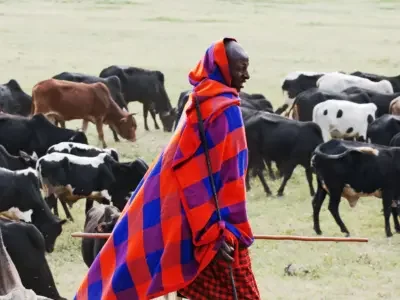
This article by Gabriel Kanuti Ndimbo and Evaristo Haulle was originally published by Peace News Network on July 13, 2026. An edited version is republished on Global Voices as part of a content partnership agreement. This post is also part of Global Voices’ August 2026 Spotlight series, “Indigenous Rights.” You can support this coverage by donating here.
In northern Tanzania, the struggle over land conservation has become more than an environmental dispute. It is a question of peace, justice, identity, and survival. Our recent research article examined how the Indigenous Maasai communities of the Ngorongoro Conservation Area (NCA) and the Loliondo Game Controlled Area (LGCA) have been repeatedly displaced under the guise of conservation, environmental protection, and modernization.
The government, through its coercive apparatuses such as the police, has repeatedly displaced Maasai communities of the NCA and LGCA, saying that the Maasai are overburdening the area and putting a strain on environmental resources. This displacement has led to violent confrontations between Maasai residents and security forces. The article’s central message is clear: For sustainable and peaceful development, conservation should be people-centered.
The Maasai have lived in these areas for decades after being moved from what is now Serengeti National Park in 1959. At the time, they were resettled in Ngorongoro and Loliondo with the understanding that they could continue their pastoral way of life while coexisting with wildlife.
Today, however, they face renewed pressure to leave. The International Union for Conservation of Nature (IUCN) argues that growing populations, livestock numbers, farming, and permanent settlements threaten fragile ecosystems. From this perspective, relocation is presented as necessary to protect biodiversity and tourism resources.
Conservation has become a tool for ‘green grabbing’
Yet the Maasai and many human rights advocates see the situation differently. They argue that conservation has become a tool for “green grabbing”: The taking of community land in the name of environmental protection while opening space for tourism, hunting, and investment interests. In Loliondo, Tanzania, the government’s proposed demarcation of 1,500 square kilometers (579 square miles) from village land has become a major source of tension. In 2022, attempts to enforce the demarcation led to confrontations between Maasai residents and security forces, causing injuries, arrests, the death of a police officer, and a Maasai man going missing after being shot in his legs. In 2024, a government decree to delist several villages deepened fears that communities were being pushed out without genuine consent.
For development to be peaceful, the most important issue is not whether conservation matters. It does. Tanzania’s wildlife and landscapes are globally significant, and protecting them is a legitimate concern at the national and international levels. The deeper question is how conservation is done. When communities are treated as threats rather than partners, conservation becomes militarized. When social services are reduced, villages are delisted, movement is restricted, or people are pressured into relocation, “voluntary resettlement” loses its meaning.
Peace cannot be built where communities feel unheard, criminalized, or separated from ancestral land.
The Maasai response challenges the idea that pastoralists are simply destroyers of nature. They present themselves as “guardians of the land” — people whose culture, livestock systems, medicinal knowledge, sacred sites, and seasonal movement have long been connected to the ecosystem. This does not mean every local practice is automatically sustainable, nor does it deny that population growth and land-use changes create real environmental pressures. But it does mean that solutions must be negotiated, evidence-based, and respectful of Indigenous traditions and knowledge.
Why green grabbing should be treated as a peacebuilding concern
Displacement also carries hidden costs. For the Maasai, land is not only an economic resource. It is tied to identity, spirituality, memory, and social reproduction. Moving people away from sacred spaces, grazing routes, medicinal plants, and ancestral landscapes weakens culture and community cohesion. It may also shift conflict elsewhere, as displaced pastoralists search for land and water in farming areas, increasing farmer-herder tensions in other regions. These very tensions have led to ongoing violent conflict in Nigeria and other parts of the continent.
This is why green grabbing should not be treated only as a conservation or land-rights issue; it is also a peacebuilding concern. Regarding farmer-herder conflicts, for example, tensions often intensify when pastoralists are forced to move to other areas, grazing corridors are blocked, water points become contested, and farmers and herders are forced into unplanned competition over shrinking resources.
In Tanzania, such pressures can deepen mistrust between pastoralists and farming communities, especially where land-use planning excludes pastoral voices. Protecting Maasai land rights, therefore, is not only about historical justice. It is also about preventing conflict from moving from one landscape to another.
A peaceful way forward
A peaceful way forward requires a new conservation compact. First, the government needs to guarantee meaningful participation and free, prior, and informed consent before any relocation or land-use change. Second, conservation planning should involve key stakeholders, including Maasai elders, women, youth, pastoral experts, local government, conservation scientists, and other land users. Third, any relocation needs to be genuinely voluntary, legally transparent, fairly compensated, and supported by adequate services. Fourth, dialogue-based approaches should be given priority in solving problems. Finally, conservation policy needs to recognize that conservation serves human development and that local communities are conservation partners.
The Maasai case is not only a Tanzanian story. It reflects a global challenge: how to protect nature without dispossessing those who have lived with it for generations. True and peaceful conservation should protect land, wildlife, culture, dignity, and peace together. When people are told to leave their homeland in the name of saving nature, the world must ask: Whose nature is being protected, and at what human cost?