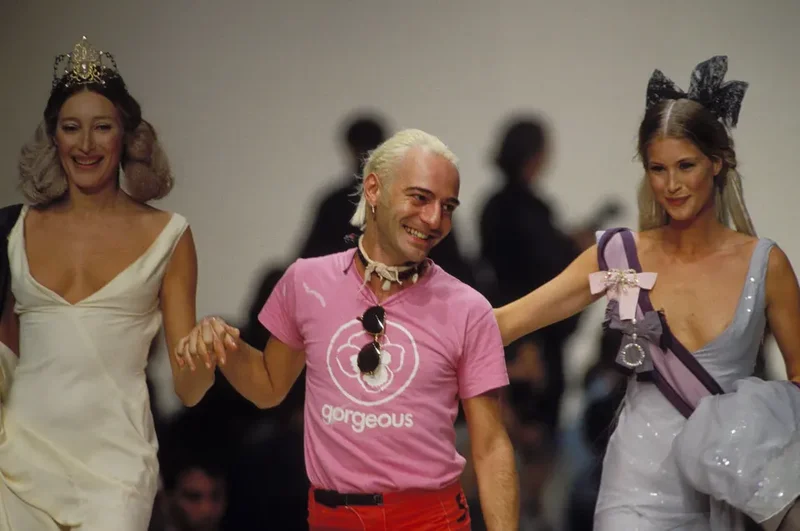
John Galliano has always been a designer whose collections tell stories, he always names them and nothing happens that isn’t a part of an overarching narrative, mostly fully flushed out stories based on fragments of history. He has always been a couturier, even before that moniker was official, and his haute couture has always been much closer to fine art in the Venn diagram which compares traditional arts with high fashion.
Understanding this, it is totally on brand that the prêt-à-porter (aka ready to wear) collection Galliano presented for Spring/Summer 1994, Princess Lucretia, has a backstory that reads like a novel. And like any of the work in the designer’s backlist, from his 1994 Tolstoy collection to the Edwardian Evening collection he created for Christian Dior couture in Fall 2005, the work is a braid, strands of fascination in which only he has been able to see a throughline, but which have always come together in a manner that illustrates the brilliance of Galliano’s specific flavor of * enfant terrible*.
For his fairytale princess collection the couturier first took inspiration from an article he’d found in Vanity Fair, or at least the lore of fashion history starts this story with that seemingly innocuous event.
The feature that Vanity Fair had published was written by Peter Kurth, back in January of 1993. The piece commemorated the 75th anniversary of the execution of the last czar, Nicolas II, and his family, and explored that event through the lens of the 1989 discovery of the czar and his family’s skeletal remains in Yekaterinburg.
It is very likely that the next spark of his idée fixe was the DNA testing mentioned which connected the Russian imperial family to Prince Phillip, Duke of Edinburgh, which probably inspired at least the start of the subsection referred to as Princess Lucretia’s Highland Fling.
It wasn’t just the Romanov’s though, or their familial relations, there was a layer of Leo Tolstoy’s Anna Karenina, she’s a running theme in Galliano’s work, a muse of sorts, as well as a very committed series of allusions to the bias cut gowns by Madeleine Vionnet which forever changed fashion in the 1920s.
The romanticism of it all, the unexpectedly overlapping histories, the mysteries associated with bones, the hoop skirts; it all amalgamated in the mind of a young designer who very well knew how to exorcize his fixations with a parade of decadence that was normal at the time but which hasn’t been plausible since the haute couture shows of the mid 1990s.
There was a Jeremy Healy soundtrack and it opened the presentation with Opus 60, aka Lieutenant Kijé, by Sergei Prokofiev, which was composed in 1933. But, because this was a John Galliano collection (and there was almost no one besides Alex McQueen back then who was as hardcore committed to a theme as John), there was a track woven in that added the sounds of wolves howling, not too far off in the distance.
The show’s models, all of whom were the designer’s personal friends, included Carla Bruni, Naomi Campbell, Shalom Harlow, Kate Moss, Claudia Schiffer, Nikki Taylor, Christy Turlington, and they were instructed to look back over their shoulders every time they heard a wolfy call. Every lady was happy to oblige and it cannot be overstated how much this detail adds to the whole show’s majesty.
Broken into chapters of a sort, the exhibition of the couturier’s latest work followed his subject princess, maybe based loosely on a what-if fantasy about the Princess Anastasia, through her various exploits as she searches for love and a place to finally call come.
Lucretia was obviously given her name on purpose, but to get into the de Medici theme would feel over-indulgent to this writer, my Lovely Readers. She has a ‘Highland Fling’, decked out in a series of robes à la française, diamonds, at least according to the narrative, hidden away in a seam of her boustier. The volume is beyond excessive but it is marvelous, every gown a fantasy made real, every pigtail or polka dot consistent to the fairytale world of the designer’s imagination.
The collection is all modified ball gowns, panniers, stripes, micro kilts, everything purposefully eclectic, even the powdered wigs and especially all the running in heels by some of the most famous models of all time. Galliano told MTV, after the show, that the whole thing had been scripted and that “a narrative was firmly in place”.
Those who were lucky enough to receive an invitation that winter were sent invitations rolled into scrolls, tea-stained and hand-written, specifying which tent in Cour Careé du Louvre to report to on October 8, 1993.
Now, when this all was happening, a lot was at stake, this was not simply the next presentation from an established haute couture house. It was about 10 years since Galliano had presented his 1984 graduation collection for Central St. Martins, Les Incroyables, (inspired by the French Revolution, so yes, there is a pattern) which had captured the attention of some major names in the luxury fashion world. But things had been rocky and had recently taken a hard turn downhill. Just a season earlier he had been forced to skip a season. The temperamental modiste had not been able to secure the funding to produce a collection; he’d lost his backer, Faycal Amor, their business arrangement had ended earlier in 1993 and at least one party chose not to renew it. This is the sort of thing that snowballs, obviously there were repercussions with immediate effects; the designer lost his workspace, he could not afford to produce a new collection, let alone a venue to show it or the funds to cover the massive, I mean truly immense, quantity of expenses which are unavoidable when staging a haute couture exhibition officially scheduled on the Paris Calendar.
Princess Lucretia, his official and very public comeback, and the only way it was possible was because of the designer’s nearest and dearest. His production team was all supporters and collaborators past and present. Like McQueen, Galliano’s $10,000-a-day-models were willing to walk for him gratis, or for a greatly reduced rate. The runway itself was basically empty, plain, basically a John Galliano anachronism, and even if the choice was made to cut costly corners, the blankness it created also made for a useful juxtaposition, a very high contrast when paired with the clothing which walked down it. Intentional or not, the space forced all focus on the clothing, and the models who wore it, all of whom were super into the performative aspects of this particular haute couture show. Even for those of us who, for some unfathomable reason are not fascinated by high fashion history, this is an incredibly entertaining watch. It is theater, and that says an awful lot about the mind behind all of this.
Andre Leon Tally attended, with La Wintour, who had some large scale plans for the young designer, Vogue very much liked John Galliano, and it’s mistress made certain he was introduced to ladies like Nan Kemper, the sort of client he would need if his brand had any hopes of survival. Obviously things went as planned.
The collection was then featured in an editorial spread, Galliano Chéri, by Cathy Horyn for the February 1994 issue of Vanity Fair. That same month, Debbie Deitering was photographed by Ellen Von Unwerth for the March 1994 issue of US Vogue wearing Galliano for an editorial named The Piano Lesson.
Galliano won British Designer of the Year at the British Fashion Awards in 1994 for this collection. And there is a very literal straight line between Princess Lucretia and Barnard Arnault’s decision to ask him to design for Givenchy in 1995, making the couturier the first British designer to be chosen to lead a major haute couture house.