As I drive south from Johannesburg, the landscape rumples slowly. At first, dusty flatlands are barely wrinkled. Then hills covered in cornfields or nodding cows appear. Only beyond Bethlehem do I spot mountains looming above the tops of lush undulations.
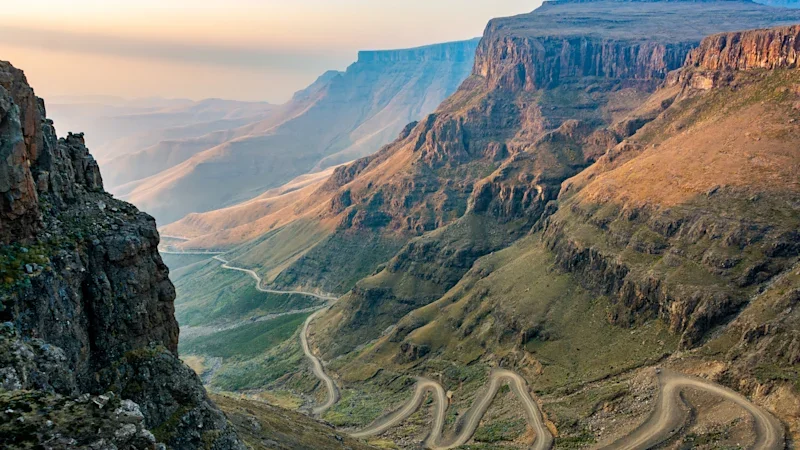
Already I see they’re like no mountains I’ve encountered before. Peaks are jagged, and tabletop mountains a horizontal contrast. The Drakensberg make thatched-hut villages and neatly tilled fields seem as small as toy-train sets.
The next morning, I drive into Golden Gate Highlands National Park. Antelope graze on startlingly green hillsides beneath eroded orange sandstone that by late afternoon blazes with colour.
Already I’m impressed, but that only shows my naivety, like someone ignorant of fireworks agog at a sparkler. The two-hour drive onwards on the R712 and R74 takes me into Little Switzerland and over the Oliviershoek Pass.
I grew up in actual Switzerland, which I still consider one of the world’s most splendid countries. Mountains have to be extra-special to impress me, but the Drakensberg are astonishing.
Get exclusive travel deals delivered straight to your inbox. Sign up now.
The Zulus call them uKhahlamba or Barrier of Spears. The Afrikaners name them the Dragon’s Mountains. Every bend provides another photo opportunity, but even a wide-angle lens can’t fit it all in.
The Drakensberg runs for well over 1000 kilometres down eastern South Africa but is nowhere better than along the north-west border of Lesotho, where they culminate at 3282 metres above sea level. Their highest peak is in Lesotho – Thabana Ntlenyana, at 3482 metres.
You’ll need a week to properly enjoy them, given the distances and lure of hiking. Roads are good but unlit at night – although, given the scenery, you have no reason to drive in the dark.
Hiking in these outsized landscapes is often for the very experienced and sometimes involves clambering up chain ladders nailed to cliffsides. Two dozen day walks in Royal Natal National Park do, however, provide easier options on paths shared with baboons and odd-looking antelopes. The only dangerous animals are snakes.
I follow the Tugela River through sweet-scented alpine grasslands and get stupendous views of the Amphitheatre, an escarpment of brutally majestic proportions, over which waterfalls plummet in the wet season. It makes the Blue Mountains or Flinders Ranges look insignificant.
You don’t need to hike at all to be overwhelmed by scenery. Drive the unnumbered country road that runs 65 kilometres to Bergville via Mkukwini and Dukuza and a string of peaks jagged as sharks’ teeth rises above a magnificent sweep of rolling agricultural fields the whole way.
One annoyance is that main roads run parallel to the Drakensberg foothills, with tortuous side roads leading into otherwise disconnected valleys. If you’re only going to do one, take the road to Giant’s Castle: the last 10 kilometres before it peters out is one of the most gobsmacking drives you’ll ever enjoy.
Giant’s Castle is a 60-kilometre detour one way from Estcourt, slowed by hairpin bends, potholes and village kids who skip on the tarmac, so consider staying in national-park accommodation at the valley head.
You won’t want to rush because the landscapes are sensational, and so is the legacy of the San: 3000-year-old rock art depicting archers hunting antelope, bush pigs and other animals.
On the way back, a longer detour away from Estcourt towards the town of Mooi River is well worth it. Stop off at Kamberg Nature Reserve for more rock art and, needless to say, more extraordinary landscapes: rearing buttresses, colossal cliffs, peaks that poke at the clouds.
The scale is epic. Take this circuit through the Drakensberg and I’m going to call it: you’ll never see better mountain landscapes again.
THE DETAILS
Related Article
STAYThe Drakensberg has a huge variety of hotels, B&Bs and campsites. In Clarens, Protea Clarens offers contemporary luxury with mountain views, and has a restaurant and outdoor swimming pool. Rooms from ZAR2423 ($210) a night. See marriott.com
FLY + DRIVEQantas flies to Johannesburg from Melbourne via Perth and non-stop from Sydney. The Drakensberg can be accessed from Clarens a 3.5-hour drive south, with driving the only viable way to get around other than on an organised tour. See qantas.com
MOREvisitkzn-sa.com
southafrica.net
The writer travelled courtesy South African Tourism.