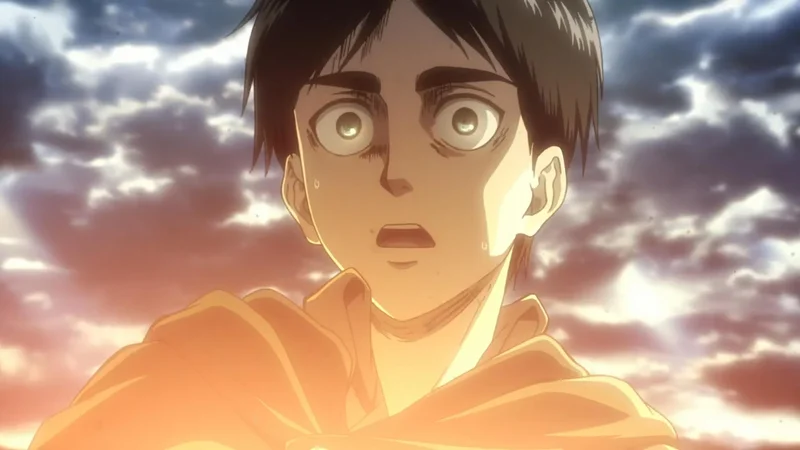
From his first introduction, Eren Yeager from Attack on Titan is not your typical wide-eyed, optimistic shonen protagonist. While characters like Goku from Dragon Ball or the titular Naruto chase dreams of greatness and recognition, Eren is consumed by an all-consuming rage against a world that has caged him. He is loud, stubborn, impulsive, and violently uncompromising. Above all, Eren wants to tear apart the system that made survival feel impossible in the first place.
That raw, unhinged intensity is what makes his defining mantra so chilling in hindsight. When Eren Yeager first screams, "If you lose, you die. If you win, you live. If you don't fight, you can't win!" it feels like the ultimate shonen battle cry. It represents everything audiences love about a determined anime protagonist: an unbreakable will to survive, a refusal to surrender, and the belief that even impossible odds can be overcome. It’s the kind of dialogue you expect to hear right before the hero unlocks a new power and saves the day. Yet, as the series peels back the layers of its world, the meaning behind Eren’s words shifts. What at first feels like a desperate hero’s declaration of resilience slowly transforms into the foundation of a far more dangerous ideology.
The quote comes during one of Eren’s earliest moments of true desperation. It’s not during a battle against the Titans, but during a flashback to his childhood. Nine-year-old Eren is forced to fight off human traffickers to save Mikasa, coming face-to-face with the kill-or-be-killed reality of his world long before Wall Maria ever falls. As he’s being choked by a grown man, his anger and fear reach a breaking point. In the throes of death, Eren realizes that survival isn't guaranteed simply because people want to live. To him, those who refuse to fight will perish. This violent awakening becomes the bedrock of Eren’s belief system. In his mind, freedom and safety must be taken through action, no matter how brutal.
This philosophy becomes the engine behind nearly every decision Eren makes. During his military training, he repeatedly clashes with people who are more willing to accept the world as it is, including Jean, who initially has no interest in throwing his life away for humanity. Trost finally puts Eren’s philosophy to its first real test when the Colossal Titan breaches the district’s outer gate, trapping thousands of civilians inside as the newly graduated cadets are thrown into their first real battle. With Titans pouring into the city and the military’s inexperienced recruits quickly overwhelmed, Eren watches his friends die around him and realizes that all the training in the world means nothing if he freezes when it matters most. His childhood mantra is no longer just something he believes; it becomes a philosophy he has to live by.
Early on, Eren seems like humanity's perfect weapon. His words reflect the desperate conviction of a boy who recognizes the inherent cruelty of his environment, one he refuses to bevictimized by. Humanity has spent generations hiding behind massive barriers, walling themselves off in the hopes of surviving, while accepting a fragile, passive existence. Yet, to Eren, living in constant fear isn't living at all. His determination to fight back — first against human monsters, and later against the Titans themselves — is what makes him the catalyst, willing to challenge a stagnant world. Eren fights because he believes there is absolutely no other choice, a concept emboldened in him through immense suffering.
Attack on Titan is a masterclass in pulling apart our simple understanding of good and evil. As the story expands, the overarching enemy of the series is no longer just mindless monsters raging outside the walls. The world beyond Paradis is complex, populated by ordinary people caught in a cycle of hatred, making Eren's belief that victory only comes through violence much harder to justify.
The ultimate tragedy of Eren’s character is that he never abandons the philosophy behind his original line. If anything, he weaponizes it on a global scale. Eren’s definition of what it means to “win” metastasizes into something monstrous. The boy who once wanted nothing more than to slaughter Titans to protect humanity eventually decides the only way to secure freedom is through overwhelming force against anyone who threatens it.
Eren’s transformation is what makes his childhood battle cry so unforgettable. The words remain exactly the same, but their meaning has been completely inverted. A phrase that once represented courage and determination morphs into a reflection of Eren’s inability to imagine a future built on anything other than conflict. His absolute desire for freedom leaves no room for mercy or compromise.
In the end, Eren Yeager’s coldest quote was never just a battle cry to inspire his allies. It was a haunting warning hiding in plain sight — a glimpse at the terrifying logic that could turn a boy desperate to be free into someone willing to destroy the world to achieve it.
Attack on Titan is streaming on Crunchyroll