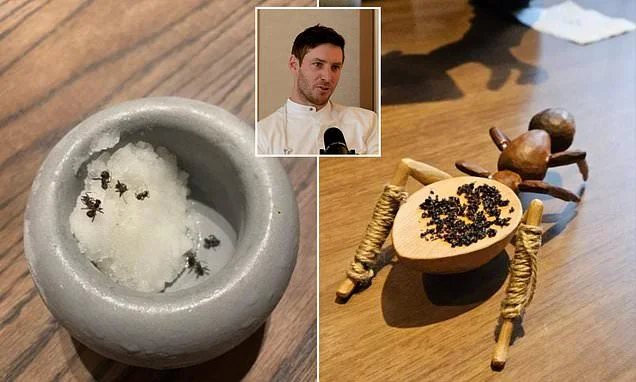
A Michelin-starred celebrity chef is facing up to a year in prison after he was accused of sprinkling ants on desserts.
Joseph Lidgerwood, an Australian chef who appeared on Netflix's Culinary Class Wars, is accused of using the insects as a garnish in his restaurant Evett, in the trendy Gangnam district of South Korea's capital Seoul.
Prosecutors, who are also seeking a 20million won (£10,100) fine against the establishment's parent company, have accused Lidgerwood and the restaurant of importing and serving as many as 49,000 ants to customers since 2021.
They were used as a topping to eye-catching desserts, photos of which shared to social media tipped authorities off.
The restaurant claimed during prosecutors' investigation that the chef used 'ant acidity in dishes while working in the US and Europe, and was unaware that it was illegal in Korea.'
This, authorities say, goes against South Korea's food laws, which only permit 10 insect species approved for human consumption, which includes grasshoppers, locusts and two-spotted crickets.
Businesses in South Korea that want to use unapproved insects like ants have to first get temporary approval from authorities, which prosecutors said the two Michelin-star restaurant did not do.
The restaurant's owner admitted that ants were being served, but said that they were only used in a 'small part' of the eatery's 15-course menu and that diners were told they could opt out for non-ant toppings, instead using fermented vinegar and edible flowers.
The ants were used as a topping to eye-catching desserts
Photos shared to social media tipped authorities off about the use of ants
Joseph Lidgerwood (pictured), an Australian chef who appeared on Netflix's Culinary Class Wars, is accused of using the insects as a garnish in his restaurant Evett
Health authorities also found the restaurant used ants that contained 'up to 55 times more heavy metals than typical edible insects'.
Heavy metals, like arsenic, lead and mercury, are not dangerous in trace amounts. But with prolonged exposure, or if consumed in large amounts, they can be harmful, especially to children and pregnant women.
The restaurant also said that only about 60 per cent of customers chose the ant topping, also disputing prosecutors' assertion that the eatery made 120million won (£61,000) in revenue from selling the dessert in question.
Sentencing for the case is scheduled for September 2.
The Michelin Guide gives up to three stars to restaurants using a range of metrics, including ingredient quality, flavour mastery, cooking technique, chef's personality and consistency.
Two stars, as was given to Evett, shows the restaurant's cooking is 'excellent' and 'worthy of a detour'.
Ants are also eaten, and often prized, in several Asian, African and Latin American nations.
For example, weaver ants and their eggs are used in Thai and Cambodian cooking, while queen ants are prized as caviar in Colombia.
In Tokyo, the celebrated Danish chef Rene Redzepi, who co-founded the world-famous Noma restaurant, created a tasting menu dish covered in live ants at a pop-up.
And Brazilian chef Alex Atala, who owns the Michelin-starred DOM restaurant, offered a dish of a pineapple cube topped with a raw Amazonian leaf-cutter ant.