- See more This is Money on Google - save us as a Preferred Source
My wife and I are joint leaseholders of a flat on the ninth floor of a 10-storey block containing 64 flats. We're in our eighties.
We extended the lease in January 2024, and it was registered with HM Land Registry in January 2025.
While reviewing the lease recently, I discovered the landlord has constructed a new building on land falling within the area defined as the estate in my lease.
The development comprises 20 starter-home flats and replaced 10 parking spaces, seven garages, and communal open space including grassed areas, trees, and hedges.
I was never consulted about, nor made aware of, any amendment to the lease to reflect this significant change to the estate.
As I understand it, the lease is a binding contract and material changes to the estate would normally require agreement between the parties.
Planning records show that the application for the new building was submitted in 2018, when the site still consisted of garages, parking spaces, and communal land.
Despite the redevelopment, the definition of the estate in my lease has remained unchanged since the 1980s.
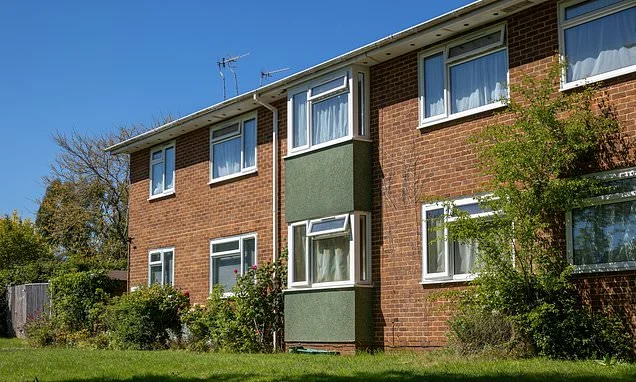
New-build woes: A This is Money has lost a parking space and communal grounds due to a new block of flats (stock image)
It was unchanged when the previous leaseholder acquired the flat in 1992, when I purchased it in 2002, and again when I extended the lease in 2024, even though the new building had already been completed. The 2024 lease extension still refers to garages that no longer exist.
Residents of the new building now have exclusive use of a garden created on land that previously formed part of the estate shown in my lease plan.
As a result, I have lost use of the parking spaces and enjoyment of the former communal open space.
I am concerned not only about the current implications, but also about potential difficulties when selling the flat in future.
Although the Land Registry title plan now shows the new building, the lease itself still reflects the previous layout, including garages that no longer exist. I would be grateful for your advice on my legal position.
Jane Denton, of This is Money, replies: The aftermath of buying a leasehold flat can be stressful and full of unforeseen pitfalls. Some people have no trouble with their leasehold status, but for others it can be a nightmare.
With developers seeking to cash in, it is becoming increasingly common to see existing estates of flats developed further. As well as new estates within estates springing up, in some case extra levels of flats are being added on top of existing ones.
You or a solicitor will need to scrutinise your lease carefully. The crux of the matter centres on whether you as a leaseholder were granted rights over the estate in respect of the parking space and communal grounds, which now do not exist.
If you were granted such rights, your landlord would have questions to answer in relation to the new development.
But the lease may also have also granted the landlord the right to altar and develop the estate.
With many leaseholders facing problems, the government wants to radically change how flats are owned.
Under its Commonhold and Leasehold Reform Bill, new leasehold flats will be banned and replaced with commonhold, a system where residents collectively own and manage their buildings.
James Naylor is a partner at Naylor Solicitors
James Naylor, a partner at Naylor Solicitors LLP, said: If I could give you a simple answer, I would. Unfortunately, the short answer is: it depends. The longer answer? It depends on the lease.
In this case, it really does. The starting point is to examine exactly what rights the lease grants and what powers the landlord retained.
Particular attention should be paid to how the estate is defined, whether leaseholders were granted rights over parking areas, garages, gardens or other communal spaces, and whether the landlord reserved the right to alter, redevelop or build on parts of the estate.
The terms of the 2024 lease extension may also be important, particularly as it was completed after the redevelopment had already taken place.
Did the lease grant you specific rights over the areas that have since been redeveloped, or did it merely identify them as forming part of the estate?
That distinction matters because land can form part of the defined estate without leaseholders necessarily enjoying a right to use every part of it.
Did the landlord reserve a right to redevelop those areas without obtaining the consent of leaseholders? Has the redevelopment interfered with any rights to parking or communal amenity space expressly granted under the lease?
Put another way, was the landlord simply rearranging furniture within a room it still controlled, or did it remove something the lease had already promised to you?
It is worth remembering that a lease plan may become factually out of date following redevelopment.
However, a plan that no longer reflects what exists on the ground is not, by itself, evidence that anything unlawful has occurred.
Equally, however, if rights granted to leaseholders have been removed, restricted or substantially interfered with, there may be grounds to challenge the position.
Planning permission would not necessarily answer that question, as planning rights and private leasehold rights are separate matters.
Before reaching any conclusions, the relevant documents should be examined. Only then will it be possible to assess whether the landlord was entitled to carry out the development, whether your rights have been adversely affected and whether there may be practical consequences when you come to sell.
And that brings us back to the beginning. The short answer is still: it depends. The longer answer is still: it depends on the lease.
Whether the landlord acted within its rights, and whether you have any remedy, largely depends on what the lease says and the rights it grants.
Manjinder Atwal is the director of housing and property litigation at Duncan Lewis
Manjinder Atwal, director of housing and property litigation at Duncan Lewis Solicitors, said: Discovering that your lease refers to an estate layout that no longer exists is understandably concerning, particularly if you're considering selling your flat at some point.
However, an out-of-date lease plan does not automatically mean your lease is defective or that your property has become harder to sell, although it is something that deserves a closer examination.
The starting point is your lease itself. While it defines the estate, many leases also give landlords the right to redevelop parts of an estate or make changes to communal areas.
But if your lease grants you specific rights over parking spaces, garages or areas of open land, those rights cannot necessarily be taken away simply because the landlord decides to build on them.
What makes your situation unusual is the timing. The new building had already been completed when you extended your lease in 2024, yet the lease appears to describe an estate that no longer existed. That raises understandable questions about why the documentation wasn't updated and whether the lease accurately reflects the current position.
Before assuming the worst, ask your landlord for an explanation. Find out whether there is a deed of variation, supplemental lease or any other legal document that records the redevelopment and explains how existing leaseholders' rights were affected.
It is possible that the position has been regularised elsewhere, even if your lease itself wasn't amended.
If no such documents exist, the next question is whether you have actually lost legal rights or simply lost amenities. There is an important distinction.
A landlord may be able to alter the appearance of an estate if the lease allows it, but removing rights granted under a lease is a much more significant legal issue and cannot simply be done by default.
Given the value of your home, this is one of those situations where a relatively small investment in specialist legal advice could save a great deal of uncertainty later.
A solicitor can review the lease, the Land Registry documents and the planning history to establish whether your rights have been affected and, if they have, what remedies may be available.
If the landlord has exceeded the powers granted by the lease, you may be entitled to challenge the position or seek compensation. Either way, it is far better to resolve any uncertainty now than for it to become an issue when you come to sell.