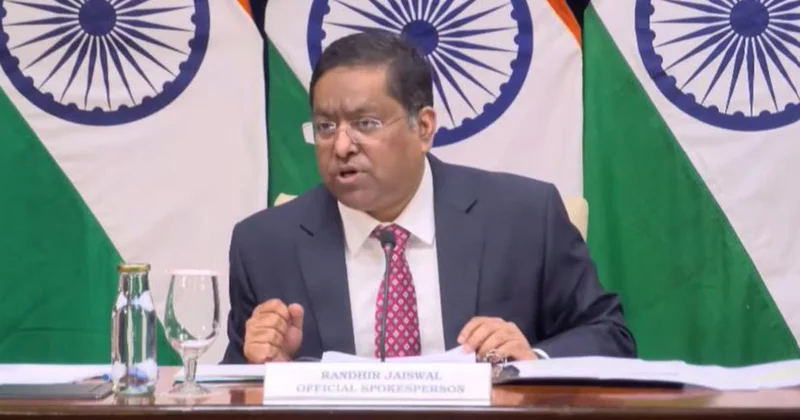
The Indian government does not endorse remarks made at a press conference held by former Bangladeshi Prime Minister Sheikh Hasina in Delhi, particularly those relating to Dhaka, the Ministry of External Affairs said on Friday.
The ministry also said that New Delhi had no role to play in the event, reiterating that it was organised by a private media entity.
Hasina’s comments
During an audio-only virtual press conference at the Foreign Correspondents’ Club on Wednesday, Hasina said that she was determined to return to Bangladesh in December to put the country on the “right track” despite the risk of imprisonment or even a death sentence.
The event marked Hasina’s first live public media appearance since she fled to Delhi in August 2024 amid widespread protests against her government.
She also demanded that the ban on her party, the Awami League, be lifted and political prisoners be released. The former prime minister urged the international community to support the people of Bangladesh in their struggle for democracy and justice.
Hasina described India as a “great friend” of Bangladesh. She said that India always stood by her country in times of difficulty.
The Awami League leader also dismissed reports of back-channel talks with the Bangladesh Nationalist Party government about her return. “I may be detained, I may be sent to prison,” she said, adding that Dhaka may try to “enforce verdicts issued in fabricated cases”.
Bangladesh’s International Crimes Tribunal in November sentenced Hasina to death for crimes against humanity in connection with the deadly crackdown on protesters in 2024. In February, a court sentenced her to 10 years’ imprisonment in two corruption cases relating to alleged irregularities in the allocation of land in a government housing project in Dhaka.
Event hurt ties, says Dhaka
The event on Wednesday drew a sharp reaction from the Bangladeshi Ministry of Foreign Affairs, which said that it was outraged that Hasina had been allowed to speak to the media in Delhi. Such events are detrimental to relations with India, it said.
The Bangladeshi government said that it “deeply regrets” that the programme had been allowed despite having conveyed its concerns to New Delhi about the “likely ramifications of this event on the reset” of bilateral relations.
“Upholding the spirit of the July Revolution, our people have firmly resolved that our nation will never again go back to the dark days of fascism and that Bangladesh will never be a client state,” the Bangladeshi foreign ministry said.
It added that Bangladesh wants to maintain a “constructive, mutually beneficial and forward-looking” relationship with India based on “sovereign equality, mutual respect, non-interference in each other’s internal affairs, and national dignity”.
Hasina’s son Sajeeb Wazed had also attended the event virtually.
He said that Bangladesh could become “another Pakistan” and that persons linked to terror organisations had been released from prisons. He also claimed that Dhaka had given Pakistani intelligence agency, Inter-Services Intelligence, a free hand in Bangladesh.
On Friday, in response to a reporter’s question about whether the situation in Bangladesh, as claimed by Wazed, is a matter of concern for India, the external affairs ministry said that New Delhi constantly monitors “whatever activities take place in our region, particularly in our neighbourhood”.
“At the same time, we assess everything from the perspective of our national security, and we take whatever steps we deem appropriate for us,” the spokesperson added.
Dhaka has repeatedly demanded that Hasina be extradited. It has also expressed concerns about the ousted leader being allowed by the Indian authorities to address her supporters from Delhi.
New Delhi has previously said that it was for Hasina to decide whether she wants to return to Bangladesh.
Massive student-led protests erupted in Bangladesh in July 2024 against a controversial quota scheme for government jobs and later snowballed into a broader agitation against Hasina’s government.
Written by Nachiket Deuskar. Edited by Sara Varghese.
We welcome your comments at letters@scroll.in.