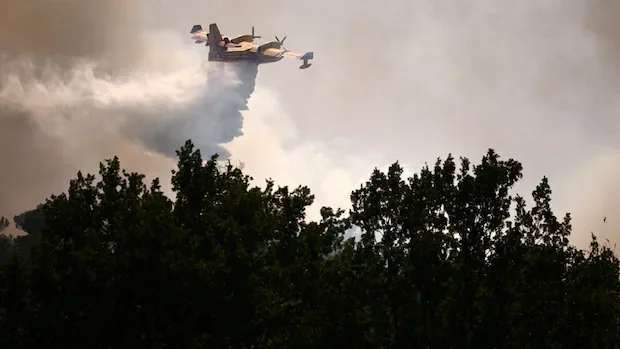
The world wants more Canadian-made water bombers. Can Canada build them fast enough?
Canadair water bombers are the best in the business, but competition could be on the horizon
As France battled what President Emmanuel Macron called its worst wildfire crisis since the Second World War, his government faced swift criticism over whether it was prepared for the scale of the fires.
But another, less likely target soon came into view: Canada.
"We don't have enough Canadairs," said Didou Deyres, vice-president of the forest fire defence department in Le Porge, where 183 homes burned in late July after flames swept through the pine forests outside Bordeaux.
France has 12 of the distinctive yellow water bombers, but Deyres said only seven were flying at the height of the crisis.
Had more firefighting capacity been available sooner — "on the ground and in the air" — things may have been different, he said.
Asked whom he blamed, Deyres smiled: "Canada."
"We have to work together with Canada to modernize the planes."
Deyres's answer was tongue-in-cheek, but it points to a real pressure building across Europe: demand for Canadian-made water bombers is growing faster than De Havilland Canada can deliver them.
Drought and successive heat waves have fuelled destructive fires across Europe, putting greater pressure on governments to expand their aerial firefighting fleets.
European countries have ordered 22 new Canadair 515 aircraft from De Havilland Canada since 2022. But after production of the aircraft line was dormant for nearly a decade, the first newly built planes are not expected to begin reaching European customers until 2028. France is expected to wait until 2032 for the second half of its order of four, according to the company.
France's Interior Minister Laurent Nuñez said in June that he hoped those deadlines would be "respected."
The hand-built planes are unmatched in the firefighting aircraft market and are built to last for decades. They are agile even at low speeds and scoop water directly from lakes and other suitable bodies of water before returning quickly to a fire.
The aircraft can scoop roughly 6,000 litres of water in about 12 seconds.
"They really are the backbone of most European firefighting operations," said Neil Sweeney, De Havilland Canada's vice-president of operations. "The last few weeks have reminded everybody just how important these aircraft are."
The Canadair line had been dormant since 2015, when its former manufacturer, Bombardier, stopped building the aircraft with no orders pending. By the time De Havilland launched the new Canadair 515 program in 2022, much of the supply chain had disappeared, forcing the company to re-establish sources for the roughly 50,000 parts needed to build each aircraft, a process that takes about 10 months, according to one expert.
"The supply chain disappeared," said McGill University aviation management expert John Gradek. Suppliers had moved on, tooling had been dismantled and thousands of specialized parts once made for the aircraft had to be sourced again.
France's existing fleet has also come under strain this season. Although Canadairs are designed to remain in service for decades, Gradek said France has been flying its aircraft almost continuously during peak fire season, increasing maintenance demands.
After scooping water from the Seine River while fighting a fire in the Fontainebleau forest near Paris, pilot Grégory Prats complained that France had spent 2 billion euros ($3.2 billion Cdn) cleaning the river in time for the 2024 Olympics but had not invested enough in its firefighting fleet.
The question now is whether De Havilland should expand production before more governments commit to buying aircraft.
Sweeney told CBC News that De Havilland would build another production plant if it could sell 50 planes to Canadian governments.
But Gradek argues the company is being too cautious.
"Risk averse — and that's the Canadian way, right?"
Rather than waiting for governments to place more orders, Gradek said De Havilland could do more to modernize and streamline production. He argues the company needs to invest in greater manufacturing capacity if it wants to maintain its commanding position in the market.
No 'handouts'
Gradek also questions why the company hasn't entered into a public-private partnership with the federal government.
"This is an aircraft that would basically be able to address an evolving national emergency. And if it's a national emergency, we need national support," he said.
De Havilland sees it differently.
Sweeney said the privately held company is "not looking for handouts and not looking for subsidies — just orders."
Building another production line would require hundreds of millions of dollars in investment, he said.
"It's not like an automobile. You don't really build them on spec," he said. He noted that the planes are customized for each country ordering them.
Still, Gradek worries De Havilland risks losing the commanding position Canada has built over decades by waiting for firm orders before expanding production.
"The world loves your airplanes," he said. But with wildfire seasons growing longer and governments scrambling to rebuild their fleets, he argues Canada cannot assume that dominance will last.
"You have to go out there and spend the money to build these plants and the orders will come."
Competition on the horizon
That pressure is already emerging. European aerospace companies and startups, such as Positive Aviation and Kepplair, are racing to develop competing firefighting aircraft. France has taken matters into its own hands as well, retrofitting an A400M military transport aircraft to be able to dump up to 20,000 litres of water or fire retardant.
None of the new entrants has the Canadair's decades-long operational record, and Sweeney said De Havilland is aware of the competition. But the efforts underscore what Gradek sees as a narrowing window for Canada's only producer of large, water-scooping aircraft.
"The world is not going to wait for Canada," Gradek said.
WATCH | Canadairs went back into production in 2024:With files from Reuters