The upper stage of a SpaceX Falcon 9 rocket has been stuck in a highly elliptical orbit for months, and in August, it’s due to smash into the Moon. Fortunately for astronomers, the impact will likely be observable, and they plan to take full advantage of this opportunity.
A new paper that has yet to undergo peer review describes what astronomers should be able to see when the rocket crash lands near the Einstein Crater at 2:44 a.m. ET on August 5. According to the authors, the impact will occur on sunlit terrain near the Moon’s eastern limb from the perspective of Earth. Ground- and space-based observatories should be able to capture the impact flash, ejecta plume, and the resulting impact crater.
“Both professional and amateur astronomers are encouraged to attempt observations of this event,” the authors write.
Incoming!
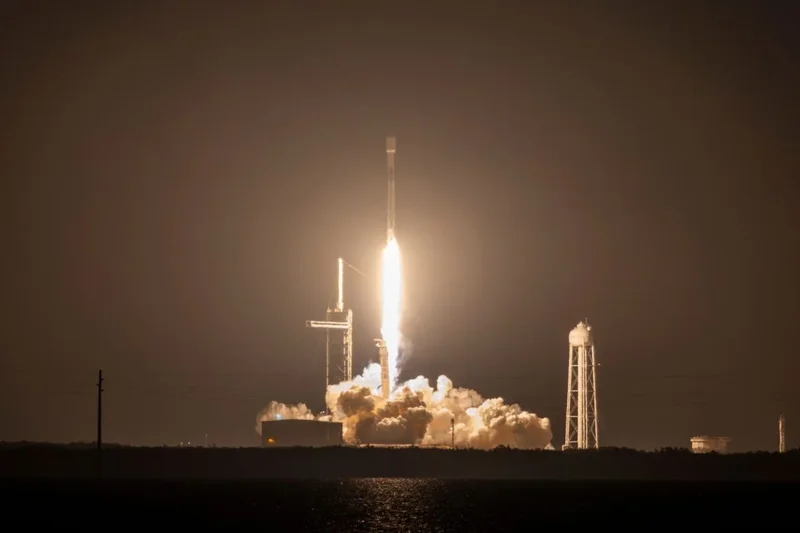
The doomed rocket is the spent upper stage of a Falcon 9 that launched from NASA’s Kennedy Space Center on January 15, 2025, carrying Firefly Aerospace’s Blue Ghost lander and ispace’s Resilience lander. After setting the landers on a Moon-bound trajectory, the upper stage failed to reenter the Earth’s atmosphere.
Bill Gray, an independent orbital analyst and creator of the Project Pluto object-tracking software, alerted the world to the impending crash in April. He used his program to analyze the upper stage’s orbit and predict its future path, calculating the date, time, and speed at which it will most likely make impact. He expects the rocket to slam into the Moon at more than 5,400 miles per hour (8,700 kilometers per hour). That’s seven times the speed of sound.
Grey is a co-author of the new paper, which is currently available on the preprint server arXiv. He and his colleagues fed his tracking data into an advanced physics simulator. This allowed them to gain a much clearer picture of what the impact could look like.
The rocket is roughly 39 feet (12 meters) long, 13 feet (4 meters) wide, and weighs about 8,800 pounds (4,000 kilograms). Because it’s essentially a hollow metal shell, modeling suggests it will be crushed on impact, punching a new 66-to-98-foot-wide (20-to-20-meter-wide) crater into the lunar surface. It will also kick up a lot of dust, the resulting plume stretching several miles above the surface.
Immediately before the crash, the upper stage will pass within a few kilometers of the Korean Pathfinder Lunar Orbiter spacecraft, according to the new paper. That spacecraft carries a suite of science instruments that could potentially gather some data on the rocket as it careens toward the surface, but that remains to be seen. Unfortunately, NASA’s Lunar Reconnaissance Orbiter will be flying over a different part of the Moon at the time, so it won’t be in a position to use its ultraviolet instrument to study the gases kicked up by the impact.
How to observe the crash
Observers on the ground will need to use a telescope in total darkness to get a clear view. With an expected impact time of 2:44 a.m. ET, that means only observers in South America and low-to-mid-latitude North America will be able to really see the crash. While one could try to see it during daylight hours, it will be challenging, according to the hours.
The position of the Moon at the time of impact will also introduce some geographical constraints. The Moon must be above the local horizon for ground-based observers to see the crash, so that excludes folks in Hawaii and Alaska.
“As seeing is better when the Moon is higher in the sky, conditions will favor observers in North America away from the West Coast,” the authors write. They encourage observers to do some practice runs on the day before the impact to ensure that they know how to get the best view and check that their equipment works.
The opportunity to record an artificial impact in real time could help astronomers learn more about the dust and plume dynamics from lunar impact events and the hazards of artificial space debris impacts. It will also allow them to test a method for pinpointing where an object will strike the Moon, which could help prepare for future lunar seismic experiments.