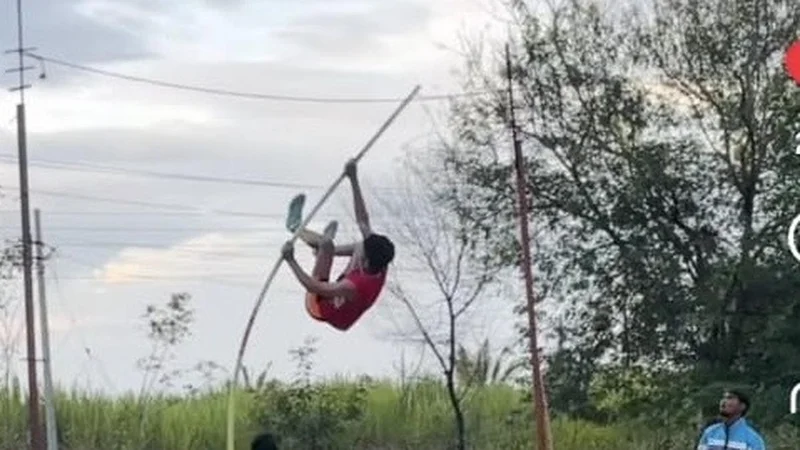
At 7 a.m., Anis Shikalgar (33) leaves his house to live out the changes he has made in his life. Speaking over video call from his home in Ankalkhop village in Sangli district, waving his hand, he said: “Five years ago, at 7 a.m., I used to reach the mazoor adda [a daily-wage labour market]; now I go out to give fitness training.”
Once a wage earner, Anis has become a pole vault trainer and fitness coach for students in Ankalkhop and nearby villages in Sangli district, Maharashtra. Pole vault, part of the Olympic programme since 1896, is an athletics event in which an athlete uses a long pole to launch themselves over a horizontal bar set at height.
The athlete plants the pole into a box at the base of the standards, uses the pole’s bend-and-recoil energy to convert horizontal speed into vertical lift, and clears the bar before landing on a cushioned mat.
Anis, who had to give up his dream of representing India, became a coach for underprivileged children instead. “I was 27 when I started practising pole vault; it was too late. I saw children in my village turning to addictions easily, so I approached one student to train with me as a runner — but he insisted on learning pole vault.”
Anis’ journey began at 19, when he first took up cricket coaching while studying at an Industrial Training Institute (ITI). Financial constraints pushed him into construction work. It was around this time that he met veteran athletics coach Sham Bhosale, who would become his mentor eight years later. In 2019, while training to run for Army recruitment selection, destiny instead took him towards pole vault.
Mr. Bhosale introduced him to the sport. Anis competed in the senior category in 2020 and finished fourth — the moment he realised he had missed his chance to represent the country, having started too late.
Pole vault demands sprinting, gymnastics and technical body control. Rather than quitting the sport, Anis began teaching students free of cost. He currently trains 12 students, including Atharv Mirajkar, who has competed at U-17 level and is preparing for U-19 — the first athlete from Anis’ coaching to compete at state level.
“My work started getting attention after Atharv’s achievement,” he added.
Finances and equipment
Pole vault requires landing mats costing ₹2 lakh to ₹4.5 lakh and a fibreglass pole costing around ₹1 lakh, imported, or around ₹60,000 for an Indian-made one. For a daily-wage earner, this was out of reach, so Anis began making his own safety mats from scrap material — discarded bike seats, foam, sponges and soft riverbank soil.
He received some assistance from students’ parents, donations from villagers, and money he earned giving personal training to a child from a well-off family. His YouTube videos have also brought in some support.
After his personal training sessions, Anis works at his cousin’s factory, earning ₹2,000 a week, and in the evenings he and his students practise at the Ankalkhop ground.
In his coaching
Anis focuses on strength training and instils gymnastic skills to build speed and flexibility. One distinctive feature of his coaching is having students study videos of the legendary Ukrainian pole vaulter Sergey Bubka and learn from his technique.
He trained Atharv using similar methods. Atharv represented the state at the 69th National School Athletics Championship in 2025, finishing fourth, and now aims to qualify for the Asian Championships.
Anis says his biggest breakthrough has been training a female student, Nandini Motgate. Her mother says: “My child has become disciplined. She has her own routine after school and doesn’t wander around aimlessly. I hope she makes a name for herself — and for us.”
Anis’ ultimate goal is to train his students to meet the five-metre qualification standard. While grateful for local support, he notes that rural Maharashtra still lacks quality athletics infrastructure.
Published - August 08, 2026 01:48 pm IST