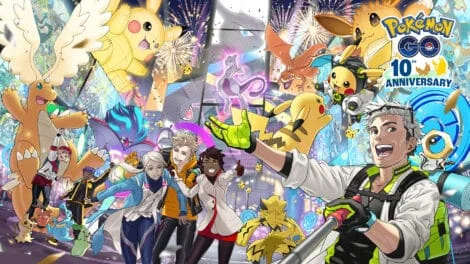
Ten years of playing Pokemon GO
When I was a kid, I used to pray to God to make Pokemon come true in real life. I guess God — who famously works through mysterious ways — sort of made it happen through Pokemon GO.
I remember when the first teaser of the game was dropped in 2015 (September 10th, to be exact). The prospect of catching Pokemon during real-life explorations got me super excited — jaw-dropped, heart pumping with adrenaline, jumping for joy, stuff like that.
Almost a year later, beta tests were conducted in 2016. Eventually, the game was released officially in July of that same year. However, it would not officially reach the online shores of the Philippines until August 6. When it launched, Pokemon changed the world for the nth time.
Article continues after this advertisement
Pokemon GO’s First Year
To say that Pokemon GO was a cultural phenomenon would not reveal how huge it was when it launched globally.
As the first AR game for many, it was a technological marvel for mobile gaming. The promise of bringing beloved Pokemon to the real world via AR technology was a novelty that attracted most, if not all, players. That despite having only released an incomplete roster of first-generation Pokemon at the time, with Gen 1 legendaries like the trio of Kanto Birds and Mewtwo and the mythical Pokemon Mew missing in the game.
I remember the first week when Pokemon GO went online in the country. When the school bell rang marking the end of classes, when workers punched out from work, or even during midday breaks such as for lunch, Pokemon GO got everyone outside.
People walked everywhere, their eyes glued to the game, pacing, brisk walking, or sometimes even sprinting to the next spawn on the map.
Article continues after this advertisement
When a rare Pokemon — such as Chansey, Snorlax, or Lapras — spawned, people would swarm and form a mob to its location. Some would shout to their friends, “A wild Arcanine is just around the corner!” It was a wild thing to witness, even wilder to reminisce. During those moments, eyebrows would be raised as clueless bystanders wondered what was happening.
As for me, I had a solitary experience at launch. At the time, I was still a high school student, and it was 11:30 a.m. on a Saturday, with only a home WiFi to connect to (meaning I’m confined to where the signal reached).
After downloading the game, then catching my first starter (it was a Charmander), I had a posting spree on Facebook, sharing my experience to my friends who were online. I even egged on my first hatched Pokemon, which took me two kilometers of walking in circles while trying to stay connected to my home WiFi, as it turned out to be a Ratata.
Article continues after this advertisement
RELATED STORY: Choosing between Mega Mewtwo X and Y in Pokemon GO
Pokemon GO’s Hype Waning
A few months after its release, the novelty of Pokemon GO waned. Eventually, only the true, dedicated fans continued playing the game.
Even so, the boredom of repeatedly doing the same thing over and over again slowly got to everyone. It also didn’t help that some of the game’s mechanics were inconvenient.
I remember when earning PokeCoins through gyms was downright toxic. Everyone would stack gyms with 10 Blisseys, which took forever to take down and effectively gatekept the gym from other players.
Thankfully, the game has since revamped this mechanic. Players are now forced to place a variety of Pokémon, gyms are capped at just six Pokemon at a time, and holding a gym beyond the eight-hour limit offers little to no incentive.
That said, there are times when Pokemon got too boring during the first few years. Admittedly, I too had a few dry spells that led me to not open the game for a few months before coming back.
Then, a few game-changing updates changed the game forever.
Shinies, Raids, Trades, and Everything Else That Changed Pokemon GO
The first major update to Pokemon GO that fundamentally changed the gameplay was the introduction of shiny forms, a feature most fans wanted since day one.
The first shiny Pokémon introduced to the game were Magikarp and Gyarados during the Water Festival in 2017. Since then, most events have featured shiny Pokemon some way — either by debuting new shinies or by increasing the shiny odds for certain Pokemon during the event.
Some players became avid shiny hunters, with shiny checking (i.e., tapping on a Pokémon to see if it’s shiny) becoming their preferred way to play the game. There was even one player whose personal quest was to catch a hundred shiny Shinx — which he eventually did.
Then, Raid Battles came. In a nutshell, Raid Battles are the equivalent of boss battles in Pokemon GO. As Raid bosses became stronger and required more people to defeat, fragmented communities — once separated by in-game teams like Mystic, Valor, and Instinct — eventually came together under local community groups.
Back then, we started with normal raids. Then, with the debut of Mewtwo, we had special gyms designated as EX Raids. Some of the well-known Pokemon GO content creators, such as Brandon Tan, became popular during this time.
When the COVID lockdowns were at their height, remote raiding became possible. Today, we have different types of raids, as well as Max Battles for Dynamax and Gigantamax Pokémon — which are still basically boss battles — and Super Mega Raids for the new Mega Evolutions from Pokémon Legends: Z-A.
With real-world communities forming, the next update focused on in-game relationships and interactions, with the Friendship and Trades update.
Of course, trading in the game is one of the most requested features besides shiny Pokemon, especially considering trade evolution lines like the Gengar line were already present.
To trade Pokemon, you need to have another trainer as a friend. When it launched, you just needed friend codes to add them, which means you can add anyone, anywhere, anytime.
Borders gone, my first few in-game friends came from all over Asia-Pacific, players from Japan, Australia, and Thailand. Some of those early friends are still active, while others may have possibly moved on to other things in life. I have not met any of them in person, but all of them have become Lucky Friends. This means that our next trade is guaranteed to turn our Pokemon into Lucky Pokémon, which have better reshuffled stats and are cheaper to power up. More reason to find and meet them in real life, I guess.
The last important update I want to talk about is the player-versus-player (PVP) modes.
When PVP was added, it was the last promised feature based on the original trailer to be added. Suddenly, players became more competitive, now caring for Pokemon stats whenever they caught something.
Of course, I too caught the PVP bug as well. My first Pokemon GO tournament was the city-wide Mayor’s Cup 2019 in Cebu. After that, I’ve held my own against some of Cebu’s best at the time in local tournaments, became my university’s Pokemon GO champion during the intramurals, and eventually wrote Pokemon guides (which you can read on this website).
**Pokemon GO Communities **
With the game design being community-centric, Pokemon GO communities formed like Foongus in the wild — just about everywhere.
If you play Pokemon GO in hotspot areas, chances are you’ve met the local community. Every month, the Community Day events gather players in each locality, some competing for the most shinies caught.
The Pokemon GO Community Ambassador Program was a welcome addition to the game’s grassroots ecosystem when it was first introduced in 2022. Community Ambassadors provide flair, prizes, and an all-around inclusive atmosphere to every member and visitor of their community.
In Cebu, there are two major Pokémon communities: Pokémon GO Team Cebu and Cebu’s United League of Trainers. Each has its own subcommunities, from locality-based groups to PvP-centric ones.
The region’s dichotomy eventually became the subject of my college thesis, but that’s a story for another day. The point here is that, despite these divisions, the two communities co-exist peacefully. Their members come together during gameplay, with the division seemingly invisible to the average group member.
And that’s exactly what Pokemon GO is all about. Everyone coming together to play the game. They may be Christians, Muslims, Catholics, young, old, a local, or a foreigner; everyone gathers in one place to play the game.
Ten Years of Spinning PokeStops, Throwing Pokeballs
A decade later, I still find myself staring at the loading screen, spinning PokeStops, throwing curveballs for additional EXP, and sharing impressive catches in Pokemon GO community group chats.
Some of the people I played with have moved on. Two Pokemon GO friends, including Cebuano AR Photographer Neil Jason “DStarblader” Nogra, passed away. Others are still here, saving their precious raid passes for the next Raid Day or letting their GO Plus+ do the catching due to their hectic lives.
The game has changed over the years, from its pretty simple gameplay of just catching Pokemon to the resource-intensive mechanics of today.
If the game has taught me anything, it’s all about the memories we’ve made along the way, as cliché as that sounds. From the home WiFi-bound gameplay to traveling Luzon, Visayas, and Mindanao, Pokemon GO was, and still is, a huge part of my daily life. Pretty sure this applies to other players who have been playing since August 6, 2016.
Ten years later, I may not remember every Pokemon I caught, but I’ll always remember the people, places, and memories that came with them.
RELATED STORY: Pokemon reveals 30th anniversary event lineup, new pop-up store