What Pakistan's defence pact with Saudi Arabia and Turkey means for the Middle East
A new security pact between Pakistan, Saudi Arabia and Turkey is reshaping the Middle East's strategic map, bringing together three of the Muslim world's most influential powers under a collective defence framework.
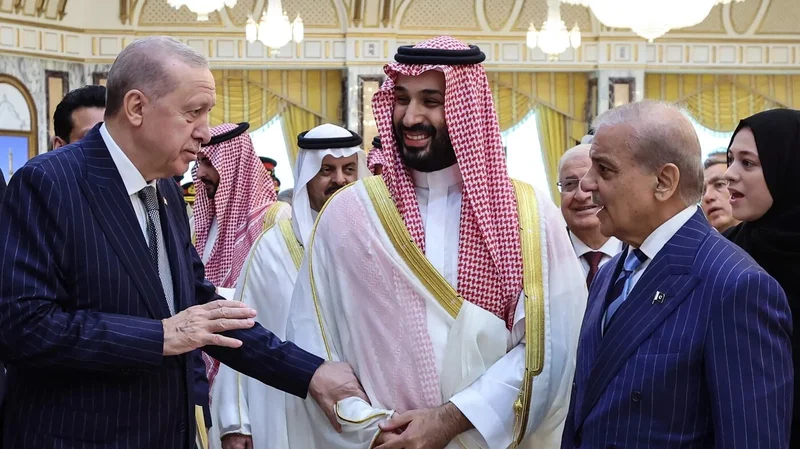
Named after the holy city where it was signed on Friday, the Mecca Joint Defence Agreement stipulates that an attack against one member is an attack against all three.
Echoing Nato's Article 5, the clause gives the pact immediate geopolitical significance, even as the joint statement leaves specific military commitments vague.
For Pakistan, the world's only nuclear-armed Muslim-majority state, the accord marks a striking departure from its traditionally cautious stance as a regional mediator.
By standing alongside Saudi Crown Prince Mohammed bin Salman and Turkish President Recep Tayyip Erdogan, Islamabad is positioning its armed forces as a potential security guarantor at the heart of an emerging axis spanning South Asia and the Gulf.
The pact signals a potentially significant shift. As the long-standing regional order anchored by Washington comes under increasing strain amid war and shifting alliances, Middle Eastern powers are seeking to take greater control of their own security, with Pakistan's nuclear and conventional military capabilities potentially providing a new anchor.
The deal also comes as the Middle East's traditional security order faces unprecedented strain.
The US and Israeli war on Iran has transformed the regional strategic landscape, with direct strikes reaching Saudi territory and commercial shipping severely disrupted across both the Strait of Hormuz and the Red Sea.
"All three countries have a shared economic and security interest in preventing further escalation, which ultimately compelled them to sign the pact," a Pakistani security official monitoring the region told Middle East Eye on condition of anonymity.
Disruptions to shipping through the Strait of Hormuz have affected supplies of Saudi energy and fertilisers, sending shock waves through the global economy. Import-dependent countries such as Pakistan and Turkey have been among those particularly exposed to the disruption.
'All three countries have a shared economic and security interest in preventing further escalation, which ultimately compelled them to sign the pact'
-
Pakistani security official
But the security calculus is even more consequential.
Both Saudi Arabia and Turkey have experienced attacks linked to the broader regional conflict, while Islamabad and Ankara remain deeply concerned about cross-border instability spilling over from their lengthy frontiers with Iran.
Ankara faces an additional security dilemma: the prospect that the arming of Iranian Kurdish militias by external powers could unravel its fragile, hard-won peace process with the Kurdistan Workers' Party, or PKK.
The wider conflict has also emboldened Iran and its Houthi allies in Yemen, who have escalated direct attacks on Saudi territory.
For Gulf leaders, the failure of traditional US security guarantees to deter such strikes has raised questions about Washington’s reliability as a security partner.
The result is a decisive push by regional heavyweights to construct defence arrangements that rely less on external guarantees.
Former Pakistani ambassador Asif Durrani described the pact as the "first concrete building block of an emerging regional security architecture", arguing that it signals a move towards greater regional ownership of security.
"If this momentum continues, it could open the door to addressing decades-old conflicts, including the enduring Palestinian issue, through a more regionally driven approach,” Durrani wrote on X.
Analysts emphasise that the pact is not an isolated development, but rather the culmination of deepening trilateral cooperation.
Michael Kugelman, senior fellow for South Asia at the Atlantic Council, described the pact as "a logical outgrowth of deepening security ties" among the three countries in recent months.
It builds upon existing foundations. Riyadh and Islamabad signed a bilateral mutual defence agreement in late 2025, which saw roughly 8,000 Pakistani troops, fighter jets and air defence systems deployed to the kingdom, while Turkey remains a major defence supplier to both nations.
For Washington, the pact could be particularly welcome.
With its major focus on collective regional deterrence, with an eye to Iran, "it'll be received well in Washington, which wants to see more burden-sharing from top allies", Kugelman said on X.
An economic lifeline in military uniform
For Pakistan, however, the pact is about more than geopolitics. It is also deeply connected to the country's economic vulnerabilities, analysts said.
The pact marks a notable shift for Islamabad, which spent recent months positioning itself as a diplomatic bridge between Washington and Tehran.
While Pakistan helped broker the Islamabad Memorandum of Understanding in June to temporarily halt regional hostilities, subsequent escalations narrowed its neutral stance. For a government battling persistent inflation and fiscal distress, strategic defence policy is now increasingly inseparable from financial necessity.
Historically, Pakistan has leveraged its military strength to secure economic backing, particularly from the US and Saudi Arabia.
This collective defence framework institutionalises that model, allowing Islamabad to monetise its operational capabilities, ranging from joint training and troop deployments to arms exports, in exchange for vital Gulf investments, energy concessions and diplomatic support.
For Riyadh, Pakistan offers access to a large, experienced military with decades of combat and counterinsurgency experience. For Islamabad, closer security cooperation with Saudi Arabia offers the prospect of investment, financial assistance and a stronger economic relationship with one of the region’s most powerful states.
"In this sense, Pakistan's military strength is becoming an economic asset as well as a strategic one," the security official told MEE.
Saudi money, Turkish technology, Pakistani military power
The emerging partnership also brings together three distinct forms of strategic power.
Sheharyar Khan, a political analyst and senior adviser at Pakistan’s Ministry of Law and Justice, described the emerging combination as one in which Saudi Arabia provides the financial power, Turkey contributes technological innovation, and Pakistan supplies core military capability.
'Together, the three countries could form a security partnership whose capabilities extend far beyond traditional troop deployment'
-
Sheharyar Khan, political analyst
"Together, the three countries could form a security partnership whose capabilities extend far beyond traditional troop deployments," Khan told MEE.
Each state brings a complementary asset. Saudi Arabia, home to Islam’s holiest sites, provides vast capital, energy market dominance and regional diplomatic weight.
Turkey, which operates Nato's second-largest military, has an advanced and increasingly self-reliant defence industry, including expertise in unmanned aerial systems, electronic warfare and precision-guided munitions, reducing reliance on foreign suppliers.
Pakistan contributes a massive, combat-hardened army and the Muslim world’s sole nuclear deterrent.
The risk of entrapment
Yet the agreement also carries significant risks for Pakistan, experts said.
Iran's response to the pact has been swift and critical.
"The Saudis should know that a paper agreement with Turkey and Pakistan does not bring them security, just as years of unilateral milking of the Americans did not bring them security," Ebrahim Rezaei, a member of Iran's parliamentary National Security and Foreign Policy Commission, wrote on X, dismissing the arrangement.
The response underscores Islamabad’s fundamental dilemma: deepening involvement in Gulf defence architecture risks fracturing its delicate, traditionally cautious relationship with Tehran.
Analysts warn of "entrapment", the danger of Pakistan being dragged into foreign confrontations that do not serve its own national interests.
Historically, Pakistan has avoided direct entanglements in Middle Eastern power struggles. Its parliament famously declined to join the Saudi-led Yemen coalition in 2015 because of domestic political and sectarian concerns.
Home to a large Shia minority, some of whom see Iranian clergy as political and religious guides, Pakistan must also ensure that closer alignment with Saudi Arabia and Turkey is not perceived at home as an anti-Iranian stance that could inflame internal sectarian fault lines.
'Muslim security bloc'
The agreement has sparked intense debate over whether it could evolve into a broader, multi-nation security bloc across the Muslim world.
Retired senior Pakistani military official Muhammad Saeed suggested that additional Muslim countries from the region, and potentially beyond, could eventually join the framework.
But he cautioned that military power alone would not determine the success of such an arrangement.
"For Muslim states, the real and collective strength will not come only through military capabilities but primarily through long-term investments and collaboration in knowledge, innovation, discipline, character, and tolerant interpretation of sectarian sentiment," he wrote on X.
The prospect of a more cohesive security grouping has already attracted attention in Israel.
In February, former Israeli Prime Minister Naftali Bennett explicitly warned against Turkey seeking a "hostile axis" with Pakistan's nuclear capabilities, "to surround Israel".
Analysts, however, argue that Pakistan's nuclear status inevitably changes the strategic calculations surrounding the pact.
For Saudi Arabia, closer defence ties with Islamabad could provide an additional layer of deterrence at a time when the kingdom faces threats from Iran while also navigating its relationship with Israel.
The India factor
The pact also has implications far beyond the Middle East.
For Pakistan, closer ties with Saudi Arabia and Turkey could provide a strategic counterweight to India.
While Saudi Arabia maintains extensive economic and trade ties with New Delhi, the collective defence framework further strengthens Pakistan's role as a security partner for key Gulf powers.
Although India's Ministry of External Affairs responded cautiously, saying that New Delhi was "closely following developments", Indian national security analysts are monitoring the situation with growing concern.
"While most are obviously seeing this from a Middle East lens, it impacts other theatres as well. Pakistan's conflict-laden relationship with India [is] at the top of that list," Kabir Taneja, executive director of the Middle East programme at the Observer Research Foundation, a New Delhi-based think tank, wrote on X.
Former Foreign Secretary Kanwal Sibal, in a post on X, described the pact as "a very negative development for Indian interests", suggesting that India expand its strategic options with the United Arab Emirates, Israel, Greece, Cyprus and Afghanistan.