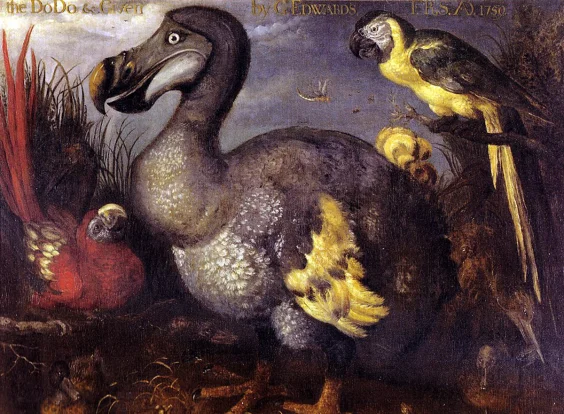
Dodo birds got a bad rap from the very start. When European sailors landed on the Indian Ocean island of Mauritius, they thought it looked foolish waddling around on the ground with little fear of humans. Thus, they could only think to call it one thing: a “dodo.” Even Linneus in 1766 classified it as Didus ineptus.
Granted, it was the size of a turkey and completely flightless despite its wings. But a recent study published in the Zoological Journal of the Linnean Society shows that dodos weren’t as inept as they appeared.
Led by researchers at the University of Lethbridge in Canada, the study explored the sensory abilities of the dodo (now classified as Raphus cucullatus), which went extinct in 1662. To do so, they scanned three dodo skulls housed in natural history museum collections in Denmark and the United Kingdom. Two of the specimens constituted the only complete dodo skulls found to date, the internal cavities of which revealed contours of the dodos’ brains.
Read more: “How History Did the Dodo Wrong”
“Although the dodo’s brain disappeared centuries ago, it left an imprint on the inside of the skull,” explained study co-author Christy Anna Hipsley from the Natural History Museum Denmark in a press release. “By digitally reconstructing those spaces and comparing them with the brains of living birds, we can begin to piece together how the dodo sensed, behaved, and interacted with the world around it.”
Pigeons and doves (order Columbiformes) are the dodo’s closest living relatives, and therefore, a relevant comparison point. By comparing the dodo’s brain imprints with those of 36 living Columbiformes, the researchers found the forebrains, which handle memory and cognition, to be proportionately similar in size. Pigeons have remarkable cognitive abilities, such as long-term image recognition; so, the behavior of dodo birds that wobbled over to 16th-century sailors may have stemmed more from their predator-free history than any lack of intelligence.
One distinction of dodo brains was their smaller optic lobes (more than 3.5 times tinier than those of pigeons), indicating vision that works in low light (for example, dawn, dusk, and the dead of night). Furthermore, the high-domed skulls of dodos were reminiscent of certain owls. Their olfactory bulb imprints also hinted at keen senses of smell that, coupled with a pronounced upper beak for probing their surroundings, would have supported low-light activity as well.
Nothing dumb about that.
Lead image: Roelant Savery / Wikimedia Commons