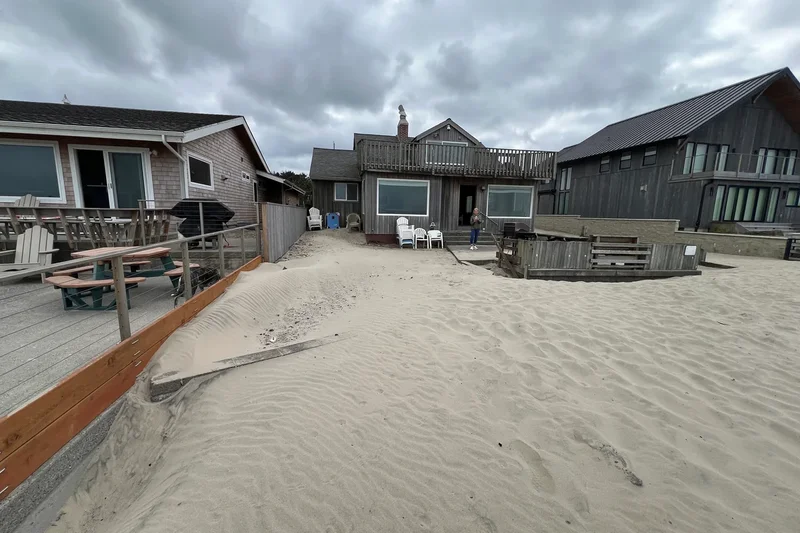
An Oregon homeowner says her family's $2.4 million beach house is being buried by sand because a state agency won't let her dig out a seawall to protect it from the Pacific Ocean.
Stacy Niedermeyer told The Independent that she's been barred from moving windblown sand toward the water since 2023, after decades of routinely hiring a contractor to push back the sand in late spring or early summer.
As a result, the seawall —which Niedemayer says is located four feet inside her property line — is now buried under what she estimates is 10 feet of sand that also covers her deck and slopes up toward the back of her house.
“We've done nothing wrong, and our house is getting buried,” she said. “It is like getting buried alive.”
The sprawling, five-bedroom, four-bathroom house was built in 1941 and sits along the picturesque shoreline of Cannon Beach, a coastal city in northwestern Oregon, about a 90-minute drive from Portland.
Niedermeyer’s property offers sweeping views of the ocean and basalt rock pillars, including the iconic 235-foot Haystack Rock, which is part of the Oregon Islands National Wildlife Refuge.
The stunning scenery has appeared in movies including the 1985 children’s adventure comedy, The Goonies, 1990’s Arnold Schwarzenegger action comedy Kindergarten Cop and the 2008 teenage vampire romance blockbuster, Twilight.
The parents of Niedermeyer's late husband, Scott Niedermeyer, bought the home sometime in the 1960s or 70s, she said. Both the house and the seawall briefly appear during the opening credits of The Goonies, and Scott claimed to have appeared in the background of one scene and to have sold sodas and snacks to the film crew, she recalled.
Last year, the Oregon Parks and Recreation Department denied Niedermeyer's application for a so-called Ocean Shore Alteration Permit, saying in an 11-page staff report that she hadn't shown “that sand accumulation has affected the function of the seawall.”
The report also says that Niedermeyer hadn’t shown that sand had “built up against exterior walls, doors or windows” of her house.
Niedermeyer appealed the decision to the state’s Office of Administrative Hearings, where a judge sided with the department in April.
An OPRD spokesperson told The Independent that the department’s final order, which can be appealed to the state’s Court of Appeals, was expected by the end of this month.
Niedermeyer, a 64-year-old real estate broker, said she has been forced to dip into her retirement savings to pay more than $400,000 in legal fees for her ongoing battle with Oregon Parks.
One son, Joseph Niedermeyer, spearheaded creation of the “Save Our Cannon Beach Home” website and a GoFundMe page to help pay for his mom's lawyer. Her other son, McKinnon “Mack” Niedermeyer, has been helping her handle media inquiries about the legal battle with OPRD.
Niedermeyer said she's terrified that winter storms will send logs and other debris smashing into her house without the seawall to protect it during the annual king tides forecast in November, December and January.
“The tides come all the way up to the house,” she said. “The seawall protected it forever. That's why it was built.”
A 2020 photo Niedermayer shared with The Independent shows more than a dozen people standing on the seawall during an engagement party for her eldest daughter, Eleanor, and now-husband Lorenzo Bissonnette.
Photos taken more recently show sand completely covering that area. Niedermeyer said the sand has also buried the outlet of the property’s storm drains, causing the system to back up and create pools of rainwater on the driveway and around the foundations after downpours.
The buried seawall also allows the wind to carry sand onto the public road in front of the home, forcing the city to “plow the streets to get rid of the sand like snow,” Niedermeyer said.
The situation stems from a 2020 revision of the city's Beach Foredune Management Plan, which prohibits any efforts to change the height or slope of the beach except to “address sand inundation of structures, maintaining public access and limited emergency situations.”
The beach management plan reflects a strategy to “protect the community from the effects of climate change” by raising the height of dunes closest to the shore. In a worst-case scenario, the sea level could rise more than nine feet by 2100, according to public officials.
A Cannon Beach city spokesperson declined to comment to The Independent.
Oregon Parks and Recreation Department told The Independent in a statement: “Sand can be moved from a property back to the beach through a permit waiver process if it meets city or county requirements.”
With a waiver, homeowners can move sand on the beach “to protect buildings from sand or debris inundation,” the statement added, citing a section of the Oregon Administrative Code.
The statement added: “OPRD has shared that information with the applicant on several occasions.”
In the appeal of her permit denial, Niedermeyer’s lawyer wrote that nothing had changed since the last waiver she received in 2023, and that OPRD “used its discretion for the first time to not apply the waiver and instead to require a permit.”
“They granted us a waiver for years and years based on our application. We didn’t need to apply because it was part of our original application,” Niedermeyer told The Independent. "It's pretty disingenuous of OPRD to claim we didn't apply.”
In an email, department spokesperson Lauren Wirtis said that “we have no application for a permit waiver to return sand back to the beach that has accumulated against the residence.”
“The application we denied was for more extensive work as described in the application and agency decision,” she added.