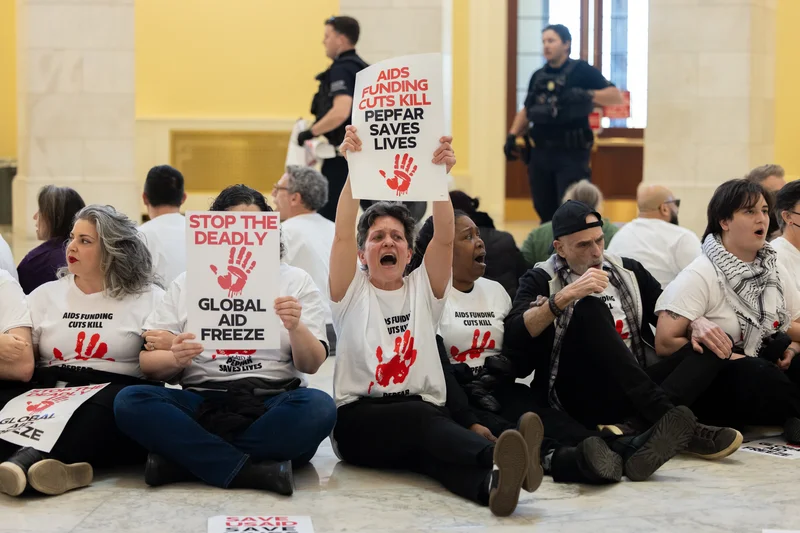
To preserve U.S. financing amid a wave of cuts initiated last year by the Trump administration, many organizations that combat HIV/AIDS had to mold themselves to Washington’s new rules, which limit programs related to diversity and inclusion, in addition to services that supposedly support abortion — or cease their programs entirely.
A new study, published Tuesday by researchers from the Foundation for AIDS Research (amfAR) and other institutions in the run-up to the 26th International AIDS Conference has revealed that 77% of the governments, NGOs and companies that receive resources from the U.S. President’s Emergency Plan for AIDS Relief (PEPFAR) were ordered to restrict their activities to align with new U.S. policies.
The result, according to the study’s authors, has been a more limited response to the virus.
The PEPFAR Pulse study was carried out through a survey of PEPFAR-implementing partners around the world. Of the 708 that were contacted, 166 responded. The program, which began in 2003 during the presidency of George W. Bush, has contributed to saving 26 million lives through services of prevention, treatment and community worker support. It was frozen in January 2025, and though the United States subsequently reactivated it, its reach has been reduced, as documented by KFF, a non-profit organization dedicated to health policy analysis.
Greg Millet, director of amfAR’s public policy office, explained during a press conference that so far, a large part of the cuts’ impact has been calculated through projections and models. “This study contributes real-world data supplied by PEPFAR beneficiaries, about what is really happening on the ground. To document the reach of these disturbances, our team is carrying out the first large-scale global survey of its partners. The results are quite concerning.”
Not only did 77% of those surveyed report that they had seen at least one of their grants revoked or delayed, but practically eight of every 10 had to restrict their work to “comply with additional U.S. policy restrictions.” Elise Lankiewicz, the study’s principal investigator, enumerated three such policies by email. The first consists of limiting financing exclusively to activities that are considered life-saving. The second restricts activities related to diversity, equity and inclusion. And the third was the Mexico City Policy.
The latter, which is also known as the Global Gag Rule, is a U.S. policy that prohibits the use of the country’s funds for activities related to abortion. Though the directive hails from the 1970s, it has been taken back up by Trump during his two administrations, and used to restrict actions in the fight against HIV — as the survey demonstrates — including blocking the distribution of contraceptives to Global South countries.
AmFAR’s study reveals that in order to keep their funding, 61% of implementing partners had to suspend a service, such as those related to family planning. In addition, 44% of PEPFAR’s implementing partners stopped providing services to transgendered individuals, men who have sex with men and sex workers, while 61% had to censor their communications. “The partners said that they eliminated or avoided specific terms in proposals, work plans and grant documents, among them ‘gender’, ‘gender-based violence’, ‘key populations’, ‘transgender’ and ‘equity,’” said the researcher.
Global HIV response depends in large part on international funding, according to UNAIDS. In 2024, such resources accounted for 42% of HIV response in low and middle-income countries, as well as around 66% of the HIV preventative programs and initiatives that eliminated barriers to accessing treatment. Around the world, 40.9 million people live with HIV and, in 2025, 570,000 people died from the virus, the majority in sub-Saharan Africa.
That’s why the 2025 cuts were critical. According to the amfAR survey, changes to PEPFAR led to the closure of 1,714 care facilities. The most affected services were those for key populations, with 73% of implementing partners having to cease such programming. The same took place with programs related to community-based service delivery (46%), socioeconomics (49%) and prevention (43%). In addition, more than 20% of organizations reported that it was practically impossible to obtain contraceptives, laboratory materials, pre-exposure prophylaxis (PrEP) and anti-retroviral medication.
And the cuts are becoming more and more serious. The U.S. government’s 2027 budget proposal includes $5.1 billion for global health programs. Before, PEPFAR alone received more than $6 billion annually for the fight against HIV.
Plus, the proposed funds are dependent on the Mexico City Policy. “The Budget would ensure no funding supports abortion, unfettered access to birth control, and also eliminates funding for circumcision and Lesbian, Gay, Bisexual, Transgender, and Queer services to better focus funds on life-saving assistance. The United States should not pay for the world’s birth control and therapy,” states its official document.
Fewer children receiving treatment
Another study published Tuesday has revealed that 77,163 fewer children living with chronic HIV received treatment financed by PEPFAR in 2025. Though the U.S. State Department says that the reductions in the number of children in treatment was foreseeable, due to the trend of fewer children receiving early diagnosis and treatment, the study’s authors offer a different hypothesis.
The project analyzed data from 21 countries that reported having more than 2,000 minors undergoing treatment funded by the U.S. program. 20 of them had reported a decrease in such treatment and of those, five — Uganda, Haiti, South Africa and Kenya — reported reductions below historical trends.
Ramona Godbole, one of the study’s authors, says that the rates of treatment among children and adults “is diverging in such a way that they provide justification for a more detailed analysis of underlying factors, country by country.” Given the serious impacts HIV has on underaged individuals, such investigation is urgent. “Without timely diagnosis and treatment, approximately half of all children with HIV die before reaching the age of two,” she warns in an email.
Amid the current panorama of cuts, researchers continue to evaluate which treatments are most effective in reducing children deaths from HIV and associated conditions. In The Lancet on July 17, scientists from Spain and several African countries published the results of a study on medications provided to babies with HIV who were in danger of dying from severe cases of pneumonia. One group was treated with valganciclovir — which is not available in the majority of African countries — and others with standard medication and drugs used to combat tuberculosis. Results showed that the valganciclovir reduced the risk of mortality by 40% in the first 15 days of treatment, in comparison with the other methods.
But researchers did recognize that the benefits that were detected by the study could remain on the page. “Access to valganciclovir is currently extremely limited in low-income countries due to cost and availability. Without expanded generic production, and policy-level interventions, the clinical benefits seen in this trial might not translate into meaningful population-level impact,” the study states.
English version by Caitlin Donohue.
Sign up for our weekly newsletter to get more English-language news coverage from EL PAÍS USA Edition