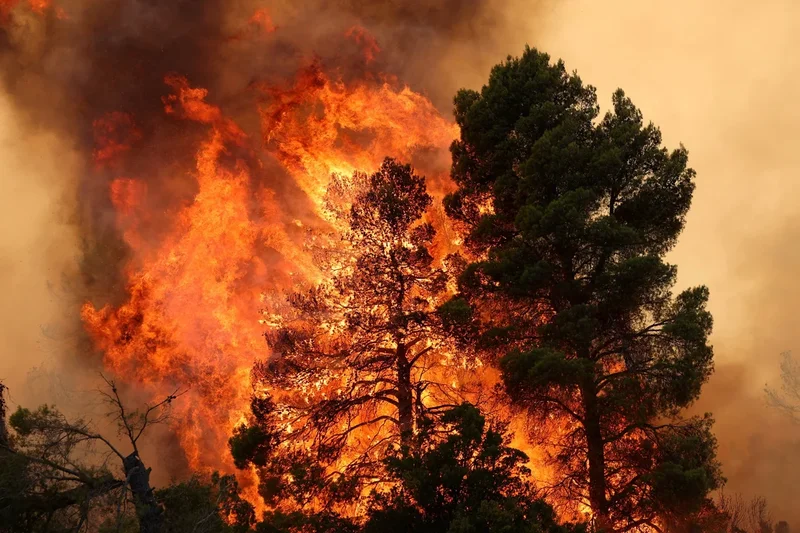
After ferocious wildfires swept through southern Europe, the continent is still in the midst of one of the most devastating summers in its history.
Extreme wildfires have ripped through France, Spain, Italy and Greece, forcing hundreds of thousands to evacuate their homes, scorching vast swathes of land and driving up concerns that damaging fires are becoming an annual fixture in summer.
The fires have already cost the continent up to £16.4 billion in economic costs, estimates published by forecaster AccuWeather showed on Thursday. This includes the cost of emergency response, damage to property, and health impacts.
The threat from wildfires far from over, with vast swathes of the continent under extreme wildfire warnings, as experts warn that the wildfire season is increasing in length and intensity each year.
“Europe has experienced a dangerous combination of extreme heat, prolonged drought and highly flammable vegetation,” said Dr Samantha Burgess, deputy director of the EU’s Copernicus Climate Change Service.
“Several factors have come together from a wet spring followed by an early summer onset, followed by repeated heatwaves drying out vegetation, and persistent rainfall deficits have led to extremely dry soils in some parts of Europe, which has led to extremely dry vegetation.”
A summer of record-breaking temperatures and extreme dry weather - over the course of four heatwaves so far - has left a large part of the continent scorched. Drought conditions have stretched across Europe, from the UK to Ukraine, leaving land increasingly vulnerable to widespread blazes.
The cumulative number of wildfires in France, Spain and Italy this year dwarfs the average from the previous two decades, figures from Copernicus’ European Forest Fire Information System (EFFIS) show.
In France and Spain, more than 300,000 people were forced to flee their homes, in an evacuation operation that now ranks among the largest the continent has seen since World War II.
More than 530,000 hectares of land have burned across the European Union in 2026, on pace with the 1.08 million hectares that burned throughout 2025, according to Accuweather. In the UK, more than 22,000 hectares have burned.
In Bordeaux, a record-setting fire burned around 420 square kilometres of land, forcing the evacuation of more than 220,000 people.
Images emerging from around Europe have been near-apocalyptic, showing hillsides engulfed in flames and firefighters battling huge infernos across the continent.
Greece is the latest country to be engulfed in the flames, this week seeing a blaze destroy dozens of homes and over 100 square kilometres (39 square miles) of land in mountainous and coastal areas near Athens.
Fire crews supported by water-bombing aircraft and reinforcements from Romania and France were dousing flames west of Athens in the Gulf of Corinth from last Friday into this week.
Last weekend, two people were killed after two firefighting helicopters collided while battling vast blazes tearing through an area west of Athens on Sunday.
Tragic footage of the collision showed two helicopters crossing paths at low altitude, before the main rotor of the lower helicopter strikes the underside of the other, causing it to crash down in flames. The second helicopter was able to fly away and carry out an emergency landing.
The new normal?
Europe is the world’s fastest warming continent, warming at twice the rate of the second-fastest - and the summer has no doubt exposed the shortcomings in Europe’s firefighting capabilities and preparedness for wildfires.
The European Union is set to push its member states to invest more in environmental management to reduce wildfire risk, the bloc's environment commissioner told the Reuters news agency on Thursday.
The risk will only continue to increase in the coming years, Dr Burgess says.
“The scientific evidence suggests that wildfire risk is likely to continue increasing unless greenhouse gas emissions are rapidly reduced and adaptation measures are scaled up,” she said. “Europe will continue to see fires occurring in places that historically had lower wildfire risk. The fire ’season’ is also growing longer, starting earlier and finishing later.”
Dr Burgess stressed that while Europe is becoming “better at responding to fire”, climate change is “increasing the challenge”.
“The question is no longer only about limiting the impacts of increasing fire risk but also designing landscapes and communities that are adapted and more resilient to the increased wildfire risk,” she added.
The fires are not yet over for this season, with warnings still in place across much of Europe.
“Extreme heat and drought will continue to keep Europe’s wildfire risk elevated,” Accuweather said.
Its latest forecast showed “very extreme wildfire danger across a large part of western and central Europe, with parts of France, northern Spain, and the southern half of the British Isles at the greatest risk”.
It adds: “There are other areas of elevated risk across southern Scandinavia, Italy, parts of eastern Europe, and the Balkans.”