We returned to Equatorial Guinea in 2012 for another tournament, but we were a changed side. Earlier that year, we participated in our first global event, the Olympic Games, which proved to us that we could compete on a world stage.
It also felt like we were maturing as a side and getting closer to achieving success on the continent, and this tournament felt like a good chance to prove how far we had come. Fortunately for us, we didnât have Nigeria in our group, which we hoped would give us the chance to gain some momentum going into the knockouts.
That backfired almost immediately, and we had a poor start to the tournament. Our first match was against the hosts and we lost 1-0 in a lacklustre performance. Luckily, we managed to pull things back and beat Senegal and the Democratic Republic of Congo in our next two games, which put us into the semifinals.
Ordinarily, we would have preferred to play Cameroon over our best-enemies Nigeria, but this time it was slightly different. Unlike us, Nigeria had not been to the Olympics, after theyâd lost to Cameroon on penalties in Olympic qualifying, which made it the first time since 1996 that they hadnât been to the Games.
We sensed they were vulnerable and a little unsettled and saw it as an opportunity to finally end our drought against them, especially as there were so many of us who had been part of teams that had lost to Nigeria before. Our mindset was different this time, and we hoped the result would reflect it.
Ready and steady
In our team meeting before the match, we were asked to look back on all the times weâd come close to beating Nigeria, and then to think of all our family members back home who have supported us through our journey and what it would mean for them if we were able to get over the line. That fuelled our desire to show that we could overcome a Nigerian team, to prove to the people we loved and to ourselves that we could do it. When we walked out of that room, I could feel the positivity and sensed that we were ready.
The game kicked off, and it felt different. There were none of the usual nerves or fears that came with playing against a powerhouse like Nigeria. In defence, every tackle was made with determination to stop a certain goal, and upfront, every shot was getting closer and closer to becoming a goal. We dictated the course of play, and for the first time ever, I felt we were in control of a match against Nigeria.
Fairly early on, we attacked their goal and created enough pressure to get a corner. With our set pieces, I usually stood on the edge of the eighteen-yard box to wait for the rebound ball because I was good at striking powerful shots from a distance. The corner was taken and cleared by a Nigerian head, but not in my direction. Fortunately, it fell to one of my teammatesâ feet. The Nigerian players came sprinting out at full force, looking to catch us on the counter-attack, and the ball rolled to Nothando Vilakazi.
Because she is a left-footed player, I thought she would just kick the ball back over the defence towards our attackers, but instead, she rolled it with a well-weighted pass towards me. I could feel the Nigerians were inches away, breathing down my neck.
Split-second decision
I hesitated a little and struggled to control the ball and pull it to my dominant foot, so I had no choice but to swing my left foot as hard as I could, with the thought that I could at least kick it towards the goal or over the goal. If I held on to the ball for too long, it would most likely be intercepted and put my team in trouble.
It was a decision I made in a split-second: to take a shot, albeit with my weaker foot, rather than try to do anything else. I released the shot and, to my surprise, it turned out that I struck it perfectly. From about twenty-five yards out, the ball travelled at quite a height, so, initially, I thought it would go over the goal, but as I watched, I saw goalkeeper Precious Dede dive and the ball dip towards her left. Dede managed to get a touch, but not enough to make the save. The ball hit the underside of the crossbar and fell into the top right corner of the net. That must have been my lucky spot.
Two goals in two games at two African Championships against Nigeria.
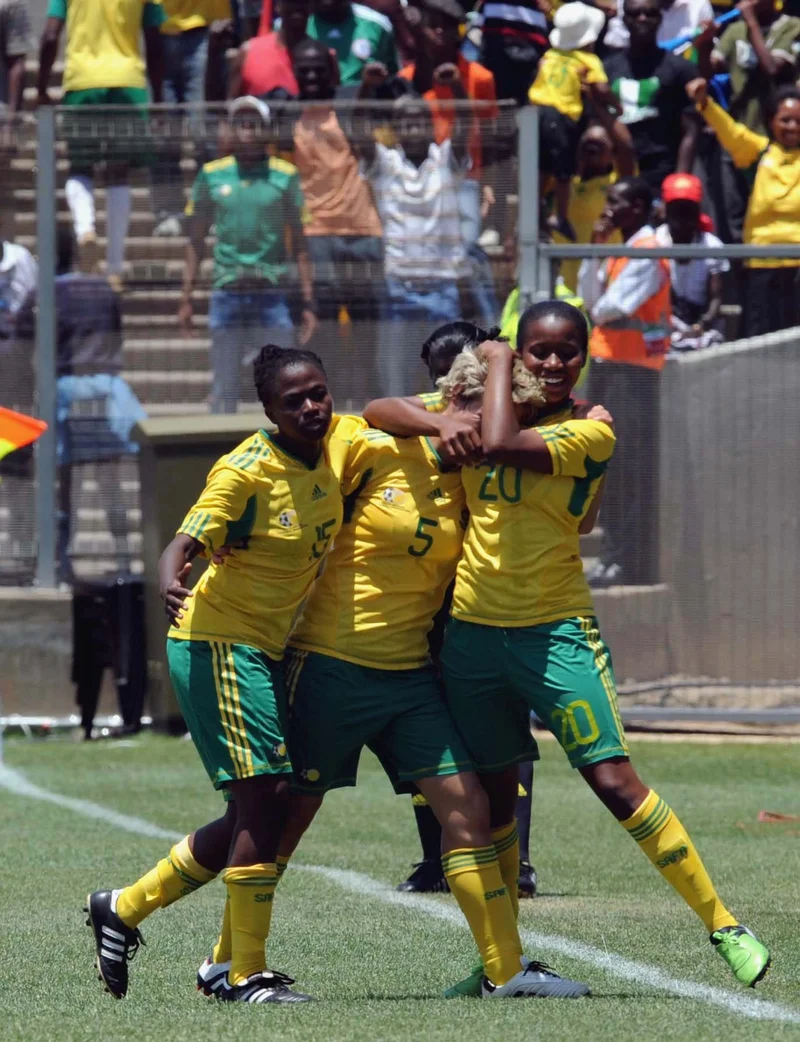
I was so stunned that I didnât know what to do, which direction to run in or how to celebrate. I sprinted towards the bench, but because it was early evening and the fields were damp from the humid air, I was worried I would slip and potentially hurt myself, so I decided to slide on my stomach in celebration instead. My teammates rushed to fall on the ground with me and we formed a mass human pile of joy. It was incredible.
For the rest of the game, we defended that goal with our lives. Nigeria had several opportunities, but everyone was laser-Âfocused and no one put a foot wrong. Our defence was particularly sharp that day and I must commend Amanda Dlamini, Gabisile Hlumbane and Nothando for the work they put in. We were made to run hard but we held on, and when the whistle went after ninety minutes, we had made history.
Afterwards, I told the press that the win proved we could compete against and beat the best on the continent. Privately, it felt like that was the best goal I had ever scored, and I was thrilled that it was my strike that put us into the final. I was also determined to finish the job and get us over the line, and I hoped everyone else felt the same way.
Mind vs body
We had four days and some travel between the semifinal and the final, so we had a little bit of time to recover from the physical and emotional rollercoasters of beating Nigeria. Our opponents in the final, Equatorial Guinea, were already in their capital, Malabo, where they had beaten Cameroon 2-0 in the earlier semifinal and would also have been brimming with confidence.
I didnât realise how much the Nigeria game had taken out of us until we started the final and it became clear that, as much as our minds were set to compete, our bodies could not keep up. Our passes were poor and incomplete, and we missed a number of tackles that Equatorial Guinea capitalised on.
Although we expected to be confronted by their passionate and noisy fans, it also played a role in the way we performed. It took them until just before half-time to score, but once they did, the floodgates opened. We conceded four goals to lose our fourth continental final.
The feeling of being not quite good enough was starting to take its toll. It was especially tough to fail to qualify for a World Cup again, and even though we had been at the Olympics that year, I wondered if I would ever get to play on the biggest stage in global football. DM
This is an extract from 185: The Janine van Wyk Story as told to Firdose Moonda. It is available in bookshops from 11 August.
This story first appeared in our weekly DM168 newspaper, available countrywide for R35.