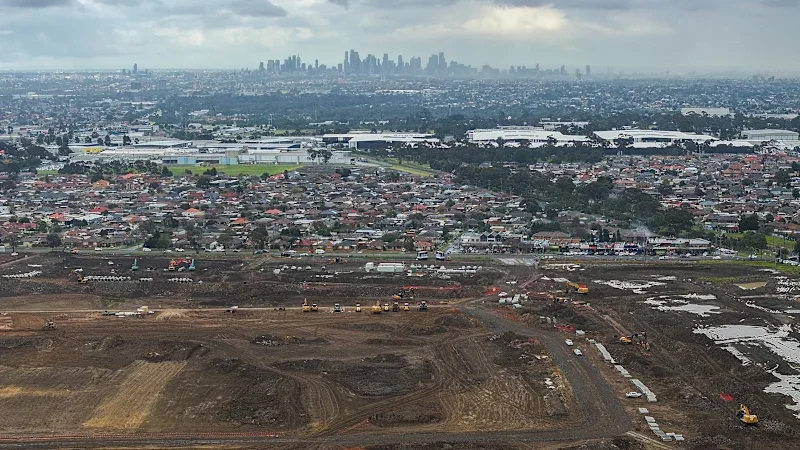
The former Ford car factory will become a $1.1 billion data centre campus, which would double Melbourne’s current data centre power draw when completed, under the government’s special fast-track major project approval process.
The Campbellfield proposal has raised concerns about noise, pollution, fuel storage and its potentially fast-tracked government approval – as well as dashing hopes the site could once again become a major employment hub or a higher education campus in one of Melbourne’s most disadvantaged areas.
Documents lodged with the state government show Singaporean-backed developer Zerra DC’s proposed “Project Dune” will consume 336 megawatts of power once fully operational across six stages. If built today, this would match the combined energy draw of all 55 operating data centres in Melbourne.
The project, submitted directly to Planning Minister Sonya Kilkenny under special state planning provisions for big projects that bypass local councils and remove the option for residents to challenge them at the Victorian Civil and Administrative Tribunal, spans 22 hectares at 300-340 Barry Road.
The data centre would take up roughly half of the total site between the Upfield train station and Sydney Road, which was home to the Ford car factory from 1959 until its closure in 2016.
Stage one includes a two-storey, 48-megawatt data hall covering 30,000 square metres, supported by 48 emergency generators and 1 million litres of diesel fuel.
While the first stage is set back 650 metres from nearby houses, hazard and acoustic assessments confirm later stages will close the gap to just 260 metres from homes along Barry Road, and 290 metres from residential streets in Dallas.
Subsequent stages will also sit 170 metres from homes and 130 metres from a medical centre and pathology clinic.
Anastasia Drapaniotis lives about 300 metres from where the centre would be built, and said most of her neighbours had no idea the development had been proposed and could be approved any day.
The 30-year-old nurse said she received a vague notice in her letterbox last month on July 24 that said Zerra DC had lodged an application with the planning minister – just four days before the July 28 deadline after which Kilkenny could give it the green light.
“The letter itself had little to no information about what this data centre actually was,” she said.
“There’s a lot of elderly people, and they wouldn’t know how to go online to look this up. I went door-to-door to my neighbours, but they had no idea.”
Drapaniotis said she was concerned about constant low-frequency noise the centre could produce, power supply, pollution from backup generators, and the fire risk from storing the equivalent of almost three Olympic swimming pools worth of diesel on site.
“Heat islands” were another concern, she said, with recent University of Cambridge research showing new data centres warmed land around them by 2 degrees on average, and by up to 9 degrees in extreme cases.
“In summer, we open up our windows at nighttime to let the cool breeze come in. With the noise, will we even be able to?” she asked.
“It just shows that there is a lack of care and respect towards the community. They know how these centres will affect us, and they didn’t care to give us any more notice.”
While the facility would occupy an immense footprint – more than 10 times the size of the MCG’s playing surface – application reports reveal it will generate minimal long-term employment once built.
Stage one will require 49 employees to operate, and this will grow to 255 on-site staff when all six stages are completed over a 12-year build, reports submitted as part of the planning application say.
The Ford Broadmeadows Assembly Plant employed nearly 5200 people at its peak in the 1980s, mostly from migrant backgrounds and living in surrounding suburbs, and produced more than 600 cars a day.
Since the end of the auto industry in Australia, Ford’s former chassis plant in Geelong has transformed into an advanced manufacturing hub with the help of significant federal and state support, while Victoria has committed $179 million to turn the former Holden site in Fishermans Bend into an “innovation precinct”.
Hume councillor Naim Kurt was the local council’s appointee to the 2017 Broadmeadows Revitalisation Board, which considered future uses for the Campbellfield site, and said the community felt let down that there had not been the same level of government support to maximise employment opportunities there.
“A lot of promises were made about manufacturing continuing in the area and maximising employment,” Kurt said.
“It was the largest undivided industrial block of land in the northern suburbs, in a strategic industrial precinct, and it needed to be kept together and used for the highest use of employment and continuance of manufacturing. And if not manufacturing, then education.”
Campbellfield and the neighbouring suburbs of Meadow Heights and Broadmeadows had twice the unemployment rate of the rest of the state at the last census of more than 10 per cent.
Hume councillors will on Monday night consider a motion to call for a moratorium on new data centre approvals until the government develops a new framework to manage their environmental and economic impacts.
“The data centre could bring investment, create employment opportunities and support new technology and innovation,” Mayor Carly Moore said. “But there are significant concerns about whether it would deliver the lasting economic and community benefits we should expect from such an important site.”
Broadmeadows state Labor MP Kathleen Matthews-Ward said she did not believe the site was suitable for a data centre, and had raised concerns about the proposal within government.
“Given its manufacturing history and proximity to freeways, freight rail and the airports, I think this location would be best used for productive and advanced manufacturing,” she said.
“I have also requested an improved consultation process on the project given the high proportion of local residents that do not speak English at home.”
Zerra DC said the project would be a productive use of industrially zoned land which had the grid capacity and connectivity to support a data centre.
“The project will deliver an economic boost to the local community through construction activity, employment and local spending,” they said.
“In further support of the local economy, we have incorporated a local supply and procurement requirement into the project, with a focus on prioritising local businesses, trades and materials where possible.”
Property developers Pelligra Group bought the Campbellfield site in 2019. Its chairman, Ross Pelligra, said Zerra DC would purchase around half the total site if its centre were approved, and he was working towards developing and leasing the remainder of the site with interest from manufacturing, logistics and food industries.
A spokesperson for the planning minister said Kilkenny would consider the fast-tracked Development Facilitation Program application on its merits, with input from the local council, the Environment Protection Authority (EPA), Fire Rescue Victoria and the local electricity distribution and water authorities.
“Submissions from the community and nearby business can be provided up until a decision is made,” the spokesperson said.
Zerra DC’s application outlines the first stage would be followed by three subsequent two-storey, 48-megawatt data halls ranging between 28,000 and 32,000 square metres. The final two stages will mark a step-change in height and capacity, introducing two three-storey, 72-megawatt halls measuring more than 44,000 square metres each.
Due to the intense heat data servers generate, continuous cooling is vital. Zerra DC plans to use closed-loop air-cooled chillers to avoid drawing heavy volumes from Melbourne’s water supply. But reductions in water use come with a trade-off: greater energy use for cooling.
So dramatic will the energy demand be to cool the hundreds of racks of servers inside the data centres that the project will ultimately house 294 rooftop chillers – 44 in stage one, and 250 in subsequent phases – alongside dozens of condensers and exhaust fans.
Acoustic modelling by engineering firm Aurecon completed as part of the application found stage one’s 44 chillers would create a low-frequency hum that will fall within EPA guidelines.
But to handle the cumulative noise that will creep up under later stages – which will be built closer to homes – the developer will be forced to construct acoustic screening walls up to eight metres high on the roofs of stages two to six.