The UK is set to witness its fullest solar eclipse for the next 54 years this Wednesday, with the Met Office pinpointing Devon and Cornwall as prime locations for viewing the celestial event.
Between 6.17pm and 8.06pm on August 12, over 90 per cent of the sun will be obscured by the moon.
It will be the most extensive blockage of the sun over British skies since the total eclipse of 1999.
The south-west of England, specifically Devon and Cornwall, and the westernmost parts of Pembrokeshire in Wales, are forecast to experience the fullest extent of the eclipse, with 94 to 96 per cent of the sun expected to be covered.
Plymouth, for instance, is predicted to see 94.66 per cent obscuration at 7.16pm.
Elsewhere, regions including the rest of Wales, Northern Ireland, parts of the West Midlands and the wider South West, and western Scotland, can anticipate between 92 and 94 per cent solar coverage.
Cardiff is expected to see 93.24 per cent of the sun obscured at 7.13pm, while Belfast will experience 93.09 per cent coverage at 7.08pm.
Skygazers in the rest of the UK will likely see the moon obscure 90 per cent to 92 per cent of the sun – with 91.79 per cent expected in Birmingham at 7.12pm, 91.41 per cent in London at 7.13pm, 90.74 per cent in Inverness at 7.03pm, 90.71 per cent in Edinburgh at 7.06pm and 90.22 per cent in Newcastle at 7.07pm.
Those keen to catch a sight of the fullest possible solar eclipse should avoid the easternmost parts of the UK, where only 88 per cent to 90 per cent of solar coverage is expected.
These include the coasts of Norfolk, Yorkshire and Aberdeenshire, as well as the Orkney and Shetland Islands.
Do I need glasses to view the solar eclipse?
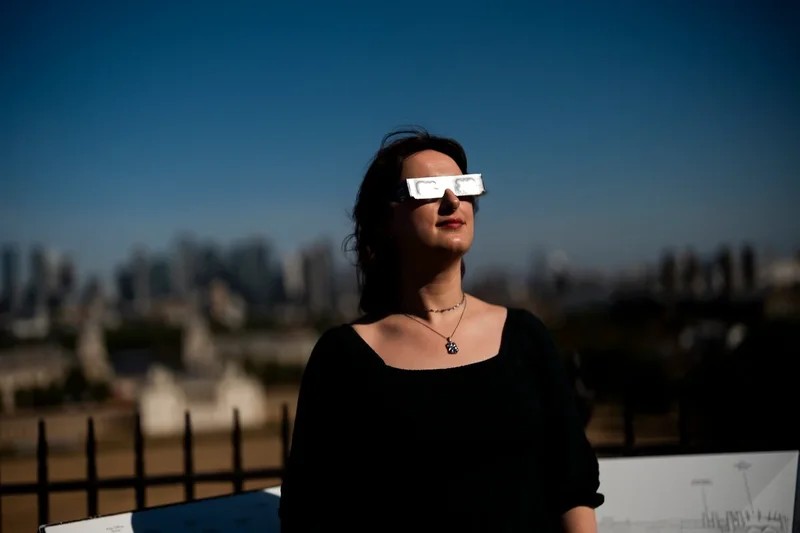
The Royal Greenwich Observatory warned the public that regular sunglasses are not a safe enough method to view the cosmic phenomenon.
Imo Bell, a planetarium astronomer at the observatory, previously said: “It’s not a total eclipse, but over 90 per cent is really exciting. We’re not going to get one this good for a really long time.
“So, it’s important not to miss it, and to be prepared. You can’t just go out and expect to have a look because it’s really dangerous for your eyes.
“So, you can use solar eclipse glasses, which are very, very different from sunglasses – they block out so much light that you can’t see anything through them except the sun, because that’s how much light they need to block for the damaging light of the sun to be safe to view.
“Ideally a solar telescope is an amazing way to witness it, and if you don’t have one of them then you can look into whether your local astronomy society is doing any events.
“And if all else fails, you can project the image of the eclipse using a household item like a colander which has lots of holes in – point the colander towards the Sun with your back facing it, and in the shadow of the colander you’ll be able to see the eclipse in the holes, which is really cool.”
The next time the moon obscures as much of the sun will be in 2081 and the next total solar eclipse in the UK will be in 2090.
Ms Bell advised getting to a vantage point facing west, with minimal buildings around, as the best way to view the eclipse.
“We might notice the sky getting a little bit dark, so if you’re looking safely, it’ll look a bit like the moon is taking a bite out of the sun, you’ll see something that looks a bit like a crescent sun.”