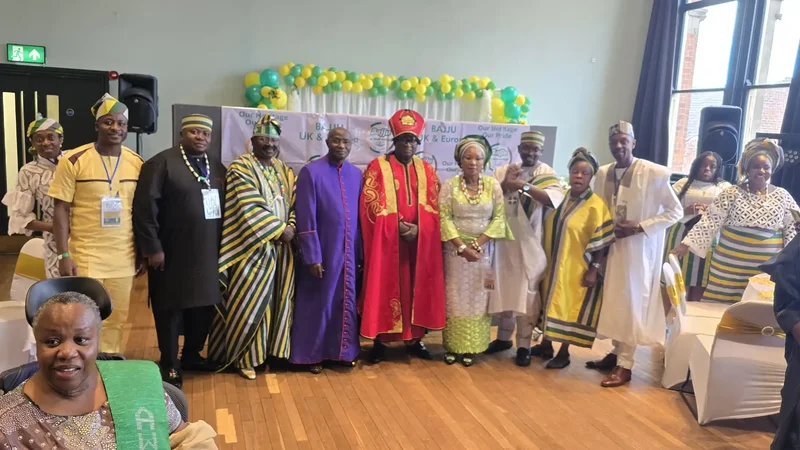
The newly launched Bajju UK and Europe Association has announced plans to establish an educational trust fund to provide scholarships for less privileged children in Bajju communities in Southern Kaduna.
The association said the initiative is part of a broader development agenda through which Bajju people in the United Kingdom and Europe hope to contribute to education, infrastructure and cultural preservation in their ancestral communities.
The association was formally launched on Saturday at Stretford Public Hall, Chester Road, Stretford, Manchester.
Speaking at the event, the association’s president, Nathaniel James, said the educational trust is one of the new organisation’s major priorities.
| | |
|---|
“One of the things that we want to do is we want to establish an educational trust,” Mr James said.
“Now, this is supposed to offer a scholarship to less privileged children.”
The initiative is expected to help the association move beyond individual support for relatives and channel the collective resources of the Bajju diaspora into projects with broader community impact.
‘We need to do something more concrete’
The chairman of the launch planning committee, Jummai Hamza, said the association was created because members believed they had the skills and resources to contribute more meaningfully to development back home.
“So we want to advance. We want to develop. The government alone cannot do much for us. We have so much expertise amongst us in different spheres of society. We have the know-how, and we’re just sitting down, not really doing a lot.”
Ms Hamza said the association would begin projects within its capacity before seeking government intervention where necessary.
“The world is moving very fast, and that is why we think we can’t be grumbling aside and waiting for the government to come and do this and do that in our own little way.”
“We will start, and then we will project it, and the government will see where we can’t go further, and they will step in and help us. So this is just for the development and advancement of our people.”
She said the focus was primarily on communities in Nigeria, where members continued to hear about challenges affecting their relatives.
“Primarily it’s for the projects back at home because here, yes, to God be the glory, it’s not like the way it is at home so we can manage, but our people are really struggling and it beats us so badly when we speak to them and they’re crying, lack of farm, lack of fertilizer, lack of road, lack of schools and everything.”
She said the association wanted to move beyond occasional financial assistance to relatives.
“We sit down here, we say, no, we can’t sit down and fold hands and be sending them £10, £20 now and then. So we need to do something more concrete. So that’s the reason why.”
Education, infrastructure
Ms Hamza said the association’s long-term vision included improving schools, increasing the availability of science teachers and supporting infrastructure in Bajju communities.
“By the grace of God, we want to see that we are beyond where we are now, back home. We are ahead of where we are now.”
“So we want to see that our schools are of a high standard. We want to see more science teachers. We want to see more good roads in our area. We want to see our people in government because we have the capacity to get there.”
“But this is a step up for us by the grace of God.”
From Manchester to the UK and Europe
The new association grew from a Bajju community organisation in Manchester that has existed for about two decades.
According to members, the Manchester community began with regular gatherings aimed at strengthening relationships, promoting welfare and ensuring that younger Bajju people in the diaspora remained connected to their roots.
Dr James said the Bajju people living in different parts of the UK and Europe later decided to create a broader association.
“Some of us have been living in this country for more than 40 years. And we actually have not really had an association as a people.”
“Some actually want to be part of the Manchester one. We said, ” No, let’s do a global one. So we decided to put together the UK and Europe. So that is why we are here today.”
The wider association began taking shape about two years ago after members created a Bajju UK and Europe WhatsApp group, which subsequently developed into a wider network.
Preserving the Bajju language
The association’s treasurer, Mercy Maaji, said cultural preservation would be another major focus, particularly among younger Bajju people in Europe.
“We want to promote our tribe. We don’t just want it to die just like that. And that is why the Bajou is our pride and our heritage.”
“Because this Gen Z now, they don’t want to speak the language, and it’s dying. And we don’t want that to go down the drain.”
She said the association wanted younger generations to understand their language, history and place of origin.
“So we want our children, even our great-grandchildren, to know about the language, to know that we exist, to know where they come from.”
The Bajju, also known as Kajju, are an ethnic group primarily associated with Southern Kaduna, with Jju as their indigenous language. Zonkwa is the headquarters of Zangon Kataf Local Government Area and the seat of the Bajju traditional institution.
Palace project
Mr James also said the association was concerned about the ongoing construction of a palace for the Bajju traditional ruler and hoped to support efforts to complete the project.
READ ALSO: UK-based organisation honours NIWIMNRO for outstanding contributions in women mining sector
“As of last year, it was supposed to be 800 million, but now, because of the cost of living, it’s actually increasing. They’ve done the first decking, so they’re just building, you know.”
He said the association would continue to engage the Kaduna State Government on the project.
The late Agwam Bajju I, Nuhu Bature, became the first monarch of the chiefdom following its creation in 1995 and was later elevated to first-class status. He died in December 2021. His successor, Agwam Bajju II, Luka Kogi Yabwat, who currently heads the traditional institution, was present at Saturday’s event in Manchester.