A column in two halves. Let’s start with the Liberals. In 2019, then prime minister Scott Morrison spoke of “a negative globalism that coercively seeks to impose a mandate from an often ill-defined borderless global community. And worse still an unaccountable internationalist bureaucracy”. Only an Australian government could defend its national interest: “We can never answer to a higher authority than the people of Australia.”
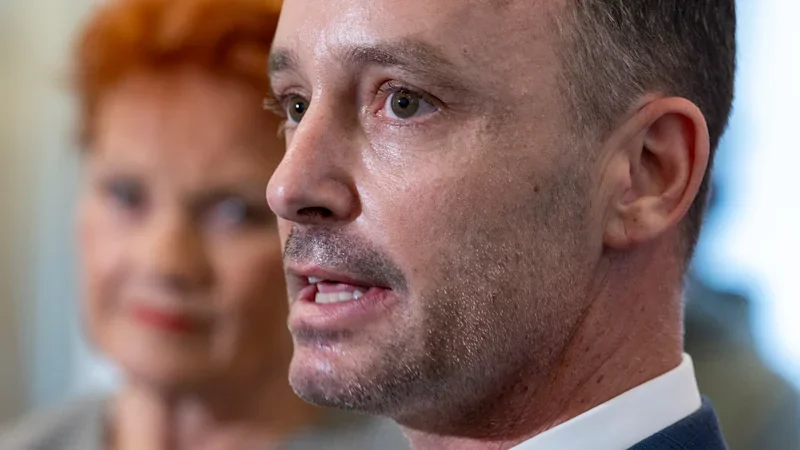
So my ears pricked up when I read about Pauline Hanson announcing that Warren Pickering would lead One Nation in Victoria. Here – as reported in this masthead – is what Pickering was saying last year: Australia is “in the grips of a bunch of unelected foreign bureaucrats … Let’s tell those globalists … what it means to be Australian.”
More recently – about a month ago – Tony Abbott spoke of “sustained mass migration” being implemented with the aim to “dilute and eventually to extinguish the Anglo-Celtic core culture”. “To green-left, cultural-Marxist governments, mass migration from the ‘global south’ is not a problem; it’s the plan.”
Here, it seems, Pickering got there first, talking in 2024 of migration being deployed by globalists as a tool to change Australia’s population in order “to get away with all the other things they’re trying to do”. Mass migration as a Trojan horse to deliver a shadowy left-wing agenda.
Except that Abbott has been dabbling in this area for years. In 2019, he was guest of honour at a conference on demography in Hungary, opened by Viktor Orban, then prime minister, who spoke of “political forces in Europe who want a replacement of population for ideological or other reasons.” Abbott praised the far-right Orban’s courage, warned of migrants “swarming” Europe’s borders, and said, “our failure to produce children [is] the extinction rebellion against which we really need to work”.
Abbott did not parrot Orban – he was not explicitly repeating the Great Replacement Theory that Orban and much of the right loves. But he was, at the least, ploughing similar ground. As I wrote at the time, he was making a bet of sorts – that within a few years these types of themes would find significant purchase in Australia.
As Pickering’s ascent shows, those who hold such views are becoming more powerful – within a party some polls suggest is the most popular in Australia.
Arguably, then, Abbott’s bet is paying off. Not entirely in his favour, because he is president of a political party seemingly in decline. But that might change – and Abbott has been written off before. It is a measure of the strangeness of the times that an Abbott-led Liberal Party reinvigorated by a rightward turn no longer seems entirely implausible (which is not the same as likely).
Let’s shift topics (though not really). On Friday, we learned of Coles’ plans to move up to 1000 jobs offshore working with consultancy firm Accenture. Three days earlier, we learnt Qantas will do the same: move 1000 jobs out of Australia by working with Accenture. Woolworths is also moving jobs offshore.
These were reported in The Australian Financial Review, as was the fact unions are increasingly concerned about workplace surveillance at the Commonwealth Bank. The claims are disputed, but include suggestions that workers are surveilled at home, that the bank can monitor whether they are listening to music or their level of participation in online meetings.
What else do these companies have in common? In 2024, Anthony Albanese defended Coles and Woolworths from the Coalition’s plans to force them to sell stores, calling it an “anti-capitalism agenda”. In 2023, Qantas was protected from competition when Labor blocked Qatar Airways from running extra flights. Last month, Commonwealth Bank’s chief executive, Matt Comyn, was one of the guests at Anthony Albanese’s widely discussed fundraising dinner with Felix Ming Ze Lee.
You might conclude, therefore, that Labor is in thrall to big business. Here, though, that would be simplistic and unfair: the policies are arguable, businesses make business decisions, governments have to deal with business. Even individual events are not always what they seem: the Qatar decision was later essentially reversed.
But as those offshore jobs suggest, we are entering a time where relationships with large businesses are becoming increasingly treacherous ground for governments. Recently, Albanese said he wanted to speed up the construction of data centres. You can understand this from the perspective of economic growth. But there are real concerns – raised recently by RBA assistant governor Sarah Hunter – that the data centre boom may mean it is harder to get workers necessary to build housing.
This could easily become an emblem of the disconnect between politicians and voters: a booming industry enriching overseas billionaires while displacing workers and depriving them of homes – all while supported by government.
Recent efforts by some Liberals to push back against One Nation are, realistically, rearguard actions. By now, senior Liberal figures have spent years softening up voters for the arguments One Nation wants to make. That makes those arguments easier to land – and makes it harder to dismiss the politicians, like Pickering, who make them. Abbott’s bet might be paying off – but that is in part because he helped create the conditions that have been so favourable to that outcome.
But centre-left governments have played a role in the rise of the far-right, too – and must be vigilant about contributing further. Right-wing populism is a creative force, finding fuel wherever it can. As a potential clash between large businesses and workers looms, governments must recognise that it would be all too easy to confirm the suspicions of conspiracy theorists about elites routinely doing over ordinary people.
In coming weeks, Labor will place two large bets of its own. It will make a decision on the gambling industry: whether to go further to win support for its laws in the Senate – or to risk the appearance of siding with a powerful industry. It will also announce further immigration measures. As one minister told this masthead’s Paul Sakkal, this could easily elevate the issue, helping Hanson. In other words, Labor will need to consider whether its approach helps address the concerns of those choosing One Nation or merely does what Abbott and Morrison so effectively did for Pickering: help him land his case.
Sean Kelly is an author, a regular columnist and a former adviser to Julia Gillard and Kevin Rudd.
More: