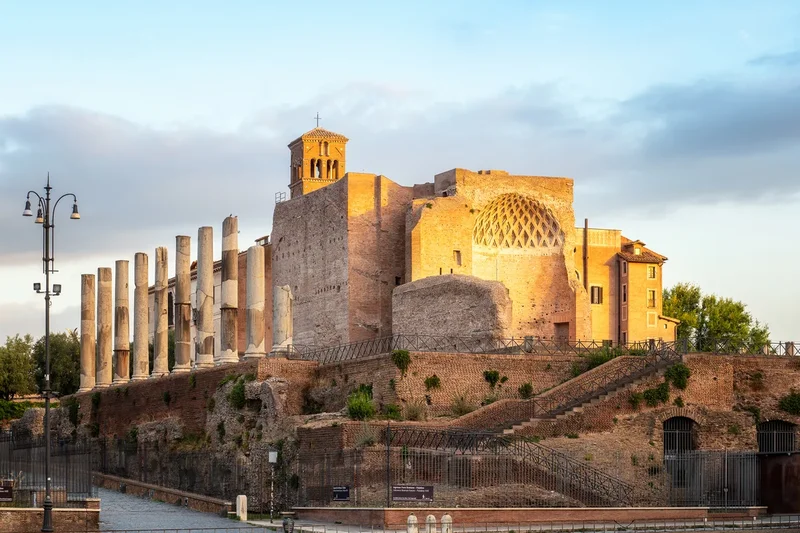
You’ve probably heard the news. Rome is hot this summer, and not in a good way. Roman summers are typically hot and humid, but this season has been one for the record books, with daily temperatures routinely topping 39C. It's beastly — bestiale, as we say in Italian. Yet it hasn't kept visitors away. In July, Rome averaged 60,000-80,000 visitors a day in its centro storico. That's a lot of sweaty people crowding into the Colosseum.
Every guidebook will tell you to duck into a church for a break from the heat, and that’s good advice: marble floors, high ceilings and thick walls do their job. But if you really want to escape the Roman summer, you need to go underground. Below the churches, below the streets, below 2,000 years of layered history, there’s a level of Rome that’s always cool: its underground archaeological sites where the temperatures are pleasant — sometimes even chilly — year-round, with temperatures as low as 10C, no matter how sweltering it is up on street level.
The cool air, though, is really just an excuse. The five sites listed below are among some of the most fascinating in Rome, offering, in many cases, a real glimpse of what the city looked like when it reigned as caput mundi — capital of the ancient world.
Domus Aurea – the Golden House of Nero
Read more: The best hotels in Rome, reviewed
It was already hot by mid-June as my guests and I huddled in a small patch of shade, waiting for our timed entry to the Domus Aurea. When our guide appeared, dressed in a puffer jacket, scarf and beanie cap, I thought she was exaggerating. About 40 minutes into our tour, I understood her cold weather attire and was grateful that I'd at least worn long sleeves.
The partially excavated remains of notorious Emperor Nero’s vast pleasure palace are entirely underground, thanks to the Roman practice of damnatio memoriae, erasing all traces of undesirables from history and memory. After Nero's death in 68CE by noble suicide, the palace, which once covered as many as 300 acres, was entirely filled with millions of tonnes of rubble and lay forgotten for 14 centuries. Today, guided tours reveal a maze of connected rooms, many with fragments of frescoes, marble and mosaics. A virtual reality experience is breathtakingly vivid. The downside is that it’s only open Friday-Sunday, and tickets get snatched up as soon as they go on sale, so act fast.
Basilica di San Clemente excavations
A few minutes' walk from the crowds baking outside the Colosseum, San Clemente illustrates, perhaps better than any site in Rome, how the city’s many layers were stacked atop one another, reused, and in some cases, remarkably well-preserved. Beneath the (not to be skipped over) 12th-century basilica lies a 4th-century Paleo-Christian church and, below that, a 1st-century CE apartment and a Mithraeum — a cave-like temple dedicated to the Eastern god Mithras. Water still courses through an ancient underground channel here and provides the soundtrack to a dark and mysterious ambience. The upper basilica is free to enter, while the excavation area is ticketed.
Read more: I recreated my own Roman Holiday on a Vespa tour of Italy’s capital
Domus Romane at Palazzo Valentini
I'm such a fan of this underground archaeological site that I almost hesitate to recommend it, because I'm not sure I want people to find out about it. The Domus Romane lie seven metres below 19th-century Palazzo Valentini and are reached by an entrance near Trajan’s Column. This is one of the best-interpreted sites in Rome — visitors walk across a glass floor, and peer down into the ruins, where light projections illustrate what these patrician houses looked like at their peak — mosaicked and marbled floors, frescoed walls, and even a swimming pool. Because the site is not as well-known as its famous neighbours (the Colosseum and Forum are right nearby), it’s still easy — for now — to book a timed-entry tour here. If it’s available, book a tour that includes the presentation about Trajan’s Column.
The Catacombs on the Appian Way
Outside the Aurelian Walls along the Via Appia Antica (the Old Appian Way), lie several early Christian tomb complexes, dug several storeys deep into the volcanic tuff stone. Among them are the catacombs of San Callisto, San Sebastiano, and Domitilla. It’s hard to say which one is the “best” of the bunch; San Callisto is the largest, but often the most crowded by tour buses. The San Sebastiano tour goes deeper underground, and Domitilla contains well-preserved frescoes. All maintain a steady temperature of about 15C. The three catacombs rotate their closing dates during the week so be sure to check online before you make your plans.
The Vatican Grottoes
Beneath the main floor of St Peter’s Basilica, these vaulted chambers house the tombs of dozens of popes, dating from the 10th to 16th centuries — making them practically modern by Rome’s standards. Still, it’s neat to descend under the main basilica and ponder the age and gravitas of these spaces, which include a gilded monument over the burial place of St. Peter. The other sarcophagi range from austere to elaborate. The Grottoes are accessed from the interior of the basilica, at the pier to the right of Bernini’s Baldacchino — look for signs marked or "Tombe dei Papi”. Like the basilica, entrance to the Grottoes is free of charge.
Read more: The Italy faux pas all tourists should know